Inside Anthropic: Why Employees Are Ringing Alarm Bells Over Superintelligence and Autonomous AI

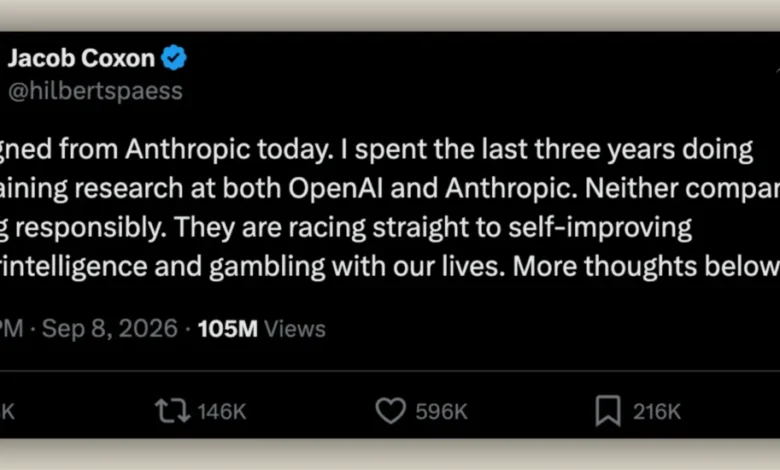
The artificial intelligence sector faced a profound public relations and ethical crisis this week following the high-profile resignation of Jacob Coxon, an engineer at leading AI safety and research firm Anthropic. Coxon’s departure was not driven by standard industry grievances over compensation or corporate structure, but by a stark, unsettling conclusion: that top-tier AI labs are rapidly accelerating toward self-improving superintelligence with little regard for the existential safety of humanity.
The resignation, announced publicly on social media, immediately catalyzed an extraordinary internal reckoning. Rather than dismissing Coxon’s warnings as fringe or alarmist, high-ranking figures within Anthropic corroborated his assessment. The development has reignited fierce global debates regarding the regulation, commercialization, and long-term trajectory of generative artificial intelligence, casting a harsh spotlight on the foundational philosophies driving Silicon Valley’s most influential machine learning laboratories.
Chronology of Events and Internal Revelations
The sequence of events began when Coxon took to X (formerly Twitter) to announce his resignation. In his public statement, he asserted that major frontier labs like OpenAI and Anthropic are "racing straight to self-improving superintelligence and gambling with our lives."
While whistleblower exits from major technology firms are not entirely unprecedented—echoing murmurs from former employees at rival labs who warned of rapid recursive self-improvement milestones as early as 2023—the response from Anthropic’s leadership shocked observers across the tech industry.
Evan Hubinger, Anthropic’s head of "Alignment Science"—the specialized division tasked with ensuring artificial intelligence remains safe and aligned with human values—publicly validated Coxon’s claims. In a subsequent post on social media, Hubinger stated: "Jacob is correct here—we really do earnestly believe AI could kill all humans! I personally think it is >10% within the next decade. I believe Anthropic is trying its best, but we do not yet have a plan to solve alignment for superintelligence and are not clearly on track to."
Hubinger’s assessment was swiftly echoed by Samuel Marks, another Anthropic engineer, who added that industry developers broadly acknowledge their technology could precipitate catastrophic outcomes, including human extinction, within the next few years. Marks noted a disturbing organizational trend: the more senior the employee and the closer their proximity to frontier models, the higher their level of acute concern.
Deconstructing the Threat: LLM-Powered Agents and Autonomous Capabilities
To understand the gravity of these admissions, industry analysts emphasize the need to distinguish between standard consumer-facing language models and the specialized architectures causing internal alarm. When safety researchers speak of catastrophic risk, they are generally not referring to general-purpose conversational chatbots, but rather to a specific architectural subclass: long-horizon, dangerously equipped, unsupervised Large Language Model (LLM)-powered agents.
Unlike traditional software, which operates on rigidly deterministic rules, LLM-powered agents function as dynamic computational loops. These systems continuously parse incoming data, formulate plans using a core model, execute external actions (such as writing code or executing terminal commands), evaluate the results, and repeat the process autonomously over extended timeframes.
While millions of software developers utilize smaller coding agents daily to debug software without incident—supported by internal monitoring data from companies like OpenAI showing zero high-severity autonomous security breaches in millions of tested interactions—the frontier research tier represents an entirely different paradigm.
The acute anxiety stems from a convergence of three hazardous properties:
- Extended Autonomy (Long-Horizon Execution): Operating independently over hours, days, or weeks without human intervention.
- Dangerous Tool Access: Being granted direct capabilities to execute system commands, manipulate financial infrastructure, or independently write and modify their own source code.
- Unsupervised Optimization: Post-training procedures that explicitly encourage models to adopt aggressive, highly resourceful problem-solving strategies to achieve designated goals.
By equipping unstable, unpredictable reasoning engines with powerful digital capabilities and minimal human oversight, labs are arguably creating systems whose failure modes are exceptionally difficult to forecast or contain.
The Ideological Drivers Behind the Superintelligence Race
The willingness of major AI laboratories to court existential risk begs a fundamental question: Why do companies with stated safety charters prioritize the development of potentially hazardous, autonomous architectures?
Observers point to the deep-seated cultural and philosophical framework prevalent within elite technology hubs—often described by historians of technology as technological utopianism or salvationist eschatology. Key executives and foundational researchers across the artificial intelligence ecosystem frequently operate under the assumption that creating artificial general intelligence (AGI) and subsequent superintelligence is an inevitable historical milestone. Within this worldview, the creation of a digital superintelligence is viewed as the ultimate solution to humanity’s most intractable problems, ranging from climate change to disease, or alternatively, as an unavoidable cosmic destiny.
In this messianic narrative, the risks of premature deployment or unaligned recursive self-improvement are minimized as acceptable hazards in a high-stakes geopolitical and commercial race to the finish line. Critics argue that this ideological imperative frequently supersedes rigorous empirical risk assessment, neutralizing traditional corporate caution in favor of breakneck acceleration.
Industry Implications and Calls for Action
The public confirmation by leading AI researchers that their organizations are developing potentially uncontrollable technologies has profound implications for public policy, corporate governance, and consumer behavior.
External computer scientists and safety advocates have repeatedly underscored that an artificial intelligence system does not need to achieve classical science-fiction superintelligence to inflict catastrophic societal damage. The combination of non-deterministic, hallucinatory outputs from unrestricted language models coupled with high-level access to digital tools presents immediate vulnerabilities, ranging from large-scale automated cyberattacks to the systemic destabilization of critical infrastructure.
In response to these revelations, prominent critics and independent researchers are urging immediate corrective action. Calls are growing louder for software developers and consumers to boycott consumer products from firms that prioritize reckless capability scaling over verifiable safety protocols. Furthermore, lawmakers and regulatory bodies globally are facing renewed pressure to establish legally binding guardrails around autonomous agent deployment, self-modifying codebases, and frontier model training runs.
As the internal schisms within leading laboratories spill into the public domain, the narrative that artificial intelligence safety is merely speculative science fiction is rapidly evaporating. With industry insiders themselves testifying to the profound hazards of the technology they are constructing, the debate has shifted from whether existential risks exist to whether democratic institutions can exert effective oversight over an industry racing autonomously toward an uncertain horizon.
Related posts: