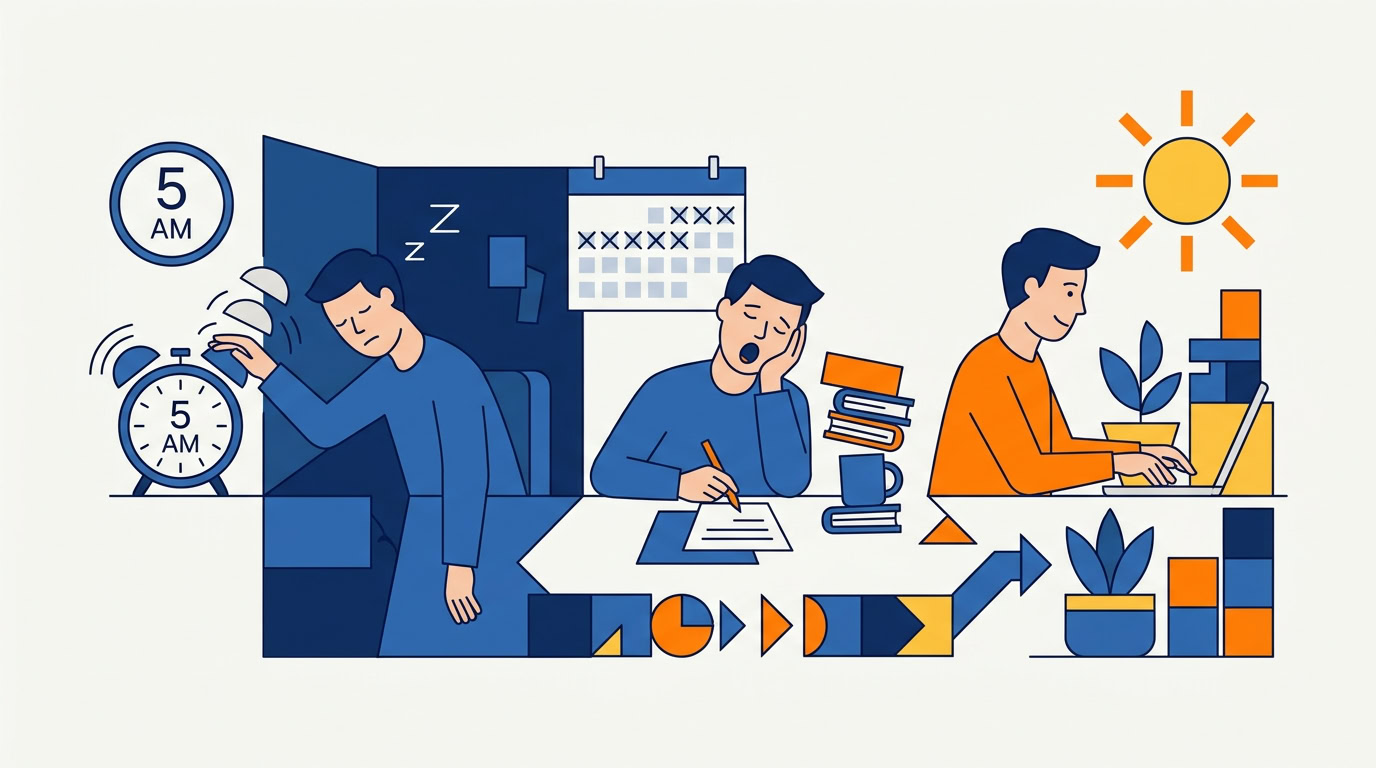
The widespread corporate and personal development trend of the "5 a.m. club"—the practice of waking before dawn to achieve maximum productivity—is increasingly being challenged by evidence suggesting that early rising is not a universal panacea for success. For many professionals, the shift to a pre-dawn schedule results in chronic sleep deprivation, leading to a predictable mid-day cognitive collapse. Recent studies in chronobiology indicate that individual circadian rhythms, or "chronotypes," dictate optimal performance windows. Forcing an early start without accounting for total sleep requirements often produces the opposite of the intended effect: a decrease in sustained focus and an increase in decision fatigue.
The Administrative Barrier to Morning Efficacy
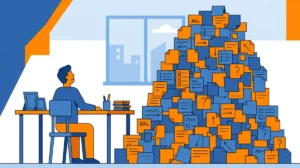
The failure of the early-morning model often stems from a misunderstanding of what actually constitutes "meaningful work." For most professionals, the first two hours of the day are consumed not by high-value creative output, but by administrative "pre-flight" checks. This includes triaging email inboxes, reconciling calendar conflicts, reviewing past meeting transcripts, and attempting to prioritize the day’s objectives.
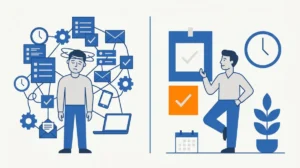
When this heavy lifting is performed manually, it depletes the cognitive reserves required for deep, analytical work. By the time a professional is ready to engage with their primary goals, their mental energy is already partially exhausted. The integration of artificial intelligence agents into these morning routines represents a paradigm shift. By delegating the synthesis of disparate information—emails, calendar appointments, and task lists—to an automated system, individuals can bypass the "administrative friction" that has historically necessitated an early start.
Chronology of the Productivity Shift
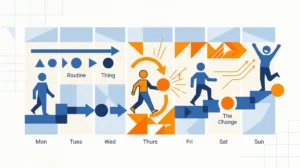
The transition from manual morning triage to agent-assisted planning involves a structured, multi-phase implementation. Historically, the "morning routine" movement gained mainstream traction in the early 2010s, with high-profile executives championing 4:00 or 5:00 a.m. starts. However, the 2023-2024 period marked a pivot in workplace efficiency, as the accessibility of Large Language Models (LLMs) allowed for the delegation of cognitive tasks.
- Evening Preparation (9:00 p.m. – 10:00 p.m.): Rather than manual planning, users now deploy AI workflows to review unfinished tasks and upcoming commitments. The agent evaluates these against long-term strategic goals (e.g., 30-day benchmarks) to propose a primary task for the following morning.
- Automated Synthesis (Overnight): While the user rests, the agent consolidates data streams, reducing the morning burden.
- Morning Briefing (Start of Workday): Instead of a chaotic inbox scan, the user receives a "brief"—a curated list of priorities and a draft of responses—allowing them to begin work with immediate direction.
- Mid-Morning Secondary Pass (11:00 a.m.): A secondary delivery of lower-priority items, such as relationship management updates and non-urgent emails, keeps the morning hours free for "deep work."
Data-Driven Insights on Cognitive Load
Research from the American Psychological Association (APA) and various studies on "ego depletion" suggest that decision-making is a finite resource. Each small decision—such as determining which email to answer first or re-checking a calendar—consumes "glucose" in the brain’s decision-making centers.
By automating the synthesis of information, professionals can conserve this resource for complex problem-solving. Data from early adopters of AI-assisted productivity workflows suggests that by moving the "administrative barrier" to an automated process, users report a 30% to 40% increase in time spent on high-leverage activities before noon. Furthermore, by delaying the start time while maintaining the same level of preparation, employees often report better sleep quality, which is directly correlated with higher emotional regulation and sustained task persistence.
Institutional Perspectives and Risk Management
Experts in digital security and corporate efficiency emphasize that while AI agents offer significant time-saving potential, they necessitate a robust "permissions architecture." The consensus among productivity consultants is that automation should be restricted to information synthesis, while final execution remains human-centric.
Financial and reputation-sensitive operations represent a "red line" in this workflow. Institutional guidelines for integrating AI into daily routines typically follow a three-tier permission model:
- Read Access: Agents are granted permission to scan calendars, emails, and CRM notes to extract context.
- Drafting Phase: Agents prepare responses and task lists, but these remain in a "draft" state until reviewed by the human user.
- Manual Authorization: Any action involving financial transactions, formal contractual commitments, or public-facing communication requires explicit, manual verification.
This "human-in-the-loop" requirement ensures that while the agent provides the efficiency of a machine, the professional retains the accountability of a human. As one productivity expert noted, "The agent proposes, but the human disposes."
The "Important vs. Urgent" Trap
A recurring challenge identified by analysts is the tendency for AI to prioritize tasks based on proximity to deadlines rather than their alignment with long-term strategic goals. This is often referred to as the "Urgency Trap." Because AI agents are programmed to clear backlogs, they may neglect "important, non-urgent" work—the kind of creative or strategic tasks that drive long-term business growth.
To mitigate this, users are advised to implement a "question-based" prompt system. Rather than asking an agent to "plan the day," users are increasingly utilizing targeted, four-to-six-question prompts. By forcing the agent to consider goals, specific constraints, and information sources before generating a plan, the user ensures the output remains aligned with their overarching professional trajectory.
Implications for Future Workplace Dynamics
The broader implication of this shift is a potential redefinition of the "standard workday." If the administrative burden of a job can be offloaded to an agent, the necessity for a 5:00 a.m. start to "get ahead of the emails" becomes obsolete. This could lead to a more sustainable work-life balance, where the emphasis shifts from the hour of the day to the quality of the output.
Furthermore, this model challenges the traditional notion that early rising is a proxy for professional discipline. As technology continues to lower the barrier to entry for complex information synthesis, the competitive advantage will likely shift from those who work the longest hours to those who most effectively manage their AI-augmented cognitive load.
Conclusion: A Strategic Approach to Automation
For professionals seeking to optimize their mornings, the evidence points toward a strategic move away from raw effort and toward intelligent delegation. By identifying a single, recurring morning task—such as the daily calendar reconciliation or the inbox review—and assigning it to an automated workflow, individuals can recapture lost hours without sacrificing sleep.
The goal is not merely to work faster, but to eliminate the manual, low-value work that currently serves as a barrier to productivity. By establishing clear permissions, focusing on high-level strategy, and treating the AI agent as a junior assistant rather than a final decision-maker, the modern professional can achieve a level of clarity that no amount of early-morning caffeine or pre-dawn alarm settings can replicate. As technology evolves, the most successful individuals will be those who recognize that the key to a better day often lies not in how early they start, but in how intelligently they delegate the preparation.