Salesforce Unveils Koa Decisions to Revolutionize Enterprise AI Routing and Efficiency

The artificial intelligence sector is undergoing a quiet but fundamental shift as industry leaders pivot away from relying solely on massive, general-purpose large language models (LLMs) for every computational task. In a strategic move to optimize enterprise workflows, Salesforce has officially introduced Koa Decisions, the latest iteration of its high-performance decision-modeling technology. This release arrives amidst a burgeoning market for specialized decision-making tools, as companies like OpenAI and emerging startups like TypeSafe AI race to provide businesses with more surgical, efficient, and cost-effective AI solutions.
The evolution of decision models marks a departure from the "one-size-fits-all" approach that dominated the initial generative AI boom. Where an LLM is designed to draft prose, synthesize information, and reason through complex narratives, a decision model is engineered for the high-velocity, binary, or categorical tasks that form the backbone of enterprise operations. By delegating classification, routing, and scoring to specialized models, organizations can significantly reduce latency and operational expenditures.
A Chronology of the Decision Model Surge
The rise of decision models is not an overnight phenomenon, though the current calendar year has seen an accelerated pace of adoption and commercial availability.

In mid-September, TypeSafe AI emerged from stealth mode, introducing Jev, a specialized model designed specifically for multi-option selection tasks. This announcement signaled a growing realization that enterprises require modularity. Just one month later, in October, OpenAI moved to capture this emerging market by making its Decisions API generally available. This move effectively codified the category, legitimizing the need for models that prioritize speed and accuracy over generative creativity.
Salesforce, however, has been refining this technology internally for years. The company’s "HyperClassifier" served as the initial proving ground, specifically integrated into the Agentforce platform. By routing complex service inquiries—such as distinguishing between a "where is my order" query and an escalation request—HyperClassifier proved that intelligent, targeted routing could drastically improve the responsiveness of automated agents. With the launch of Koa Decisions, Salesforce is now transitioning from a proprietary internal tool to a scalable, multimodal framework that extends beyond text-based routing into complex workflow orchestration.
Technical Architecture and Performance Metrics
At the core of Koa Decisions is an innovative application of Google’s Gemma, an open-weight model refined through proprietary training techniques developed by the Salesforce data science team. Unlike traditional LLMs, which operate via auto-regressive token generation—a process where the model predicts the next word in a sequence, leading to increased latency—Koa Decisions utilizes a single-step inference process.
The technical implications of this architecture are profound. In internal benchmarks conducted by Salesforce, the difference in latency between general-purpose LLMs and Koa Decisions was stark. Routing requests through a standard LLM typically takes approximately 1.4 seconds, a delay that can be perceptible to users in a high-volume customer service environment. In contrast, Koa Decisions processes the same requests in approximately 26 milliseconds. This represents a 50-fold increase in speed, allowing for near-instantaneous backend decision-making.
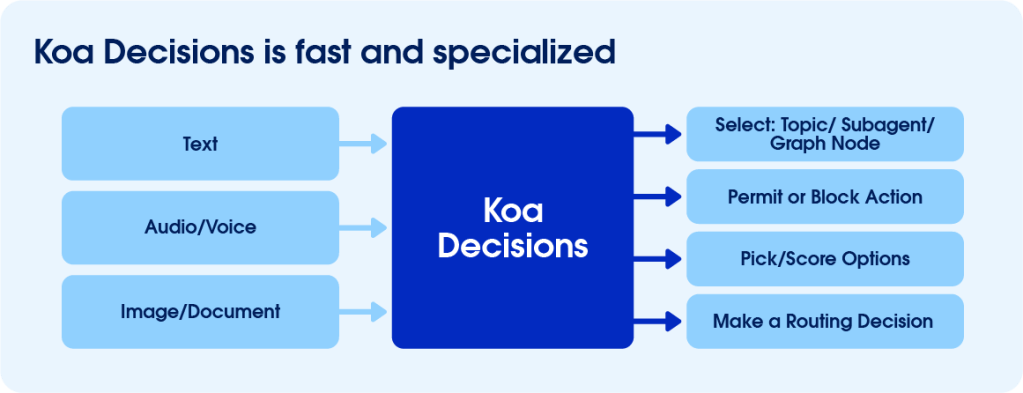
Furthermore, Koa Decisions introduces multimodal capabilities, enabling the model to ingest and process images and audio alongside text. This expansion is critical for modern enterprise environments where agents must handle diverse inputs, such as analyzing a photograph of a damaged product or transcribing a voice inquiry, to determine the appropriate resolution path.
Shifting from Predictive AI to Dynamic Decisioning
The transition to decision models represents a paradigm shift in how software engineers and business analysts approach automation. For decades, the "gold standard" for classification tasks was the predictive machine learning model. These models required a rigorous, time-intensive lifecycle: defining outcomes, collecting and labeling massive datasets, training the model, and conducting iterative accuracy testing. This process often rendered the development-to-production pipeline a multi-month endeavor.
Decision models fundamentally disrupt this timeline. Because these models are built upon foundational language models that already possess a deep understanding of semantic relationships—such as the conceptual link between "returning an item" and "logistics processes"—the requirement for exhaustive training data is drastically reduced. Salesforce reports that teams can now define new categories and push them to production in a matter of hours rather than months. This agility allows enterprises to pivot their automated workflows in response to real-time market changes without needing to overhaul their entire AI infrastructure.
Broader Implications for Enterprise AI Strategy
The emergence of Koa Decisions highlights a critical trend: the "right-sizing" of AI. As organizations become increasingly conscious of the cost-per-inference associated with large-scale models, the economic argument for decision models becomes irresistible. Using an expensive, massive LLM to perform a simple yes-or-no classification is an inefficient allocation of computing resources. By reserving LLMs for high-value tasks—such as summarizing customer interactions or generating complex reports—and utilizing Koa Decisions for routing and triage, companies can achieve a balanced, cost-efficient AI stack.

Industry analysts suggest that this modular approach will become the standard for the next generation of enterprise software. As businesses move from experimentation to full-scale deployment of autonomous agents, the ability to orchestrate multiple, purpose-built models will determine the efficacy of their digital transformation efforts.
Future Roadmap and Integration
Salesforce has indicated that the rollout of Koa Decisions is only the beginning. The company plans to integrate the model deep into its ecosystem, extending its reach into Apex (Salesforce’s proprietary programming language), automated Flows, and the Prompt Builder interface. This integration will empower Salesforce developers to build sophisticated, event-driven applications that react to data in real-time.
Furthermore, by providing an API for developers, Salesforce is positioning Koa Decisions as a platform-agnostic tool for those who may not be full-scale Salesforce customers but require high-performance, low-latency decision-making capabilities. The model is also designed to be part of the wider Koa family, which includes reasoning models developed in collaboration with NVIDIA, suggesting a future where Salesforce environments are governed by a tiered hierarchy of specialized AI agents working in concert.
For enterprise leaders, the lesson is clear: the future of AI is not just about the most powerful model, but the most efficient one. As the market for decision models continues to mature, the focus will likely shift from raw capability to the precision of integration. With Koa Decisions, Salesforce has established a technical benchmark that emphasizes speed, scalability, and ease of implementation, setting a high bar for competitors in the space. As organizations navigate the complexities of AI adoption, the ability to make the "right call" in milliseconds will ultimately define the winners of the enterprise automation race.