AI Watermarking Safety Risks Uncovered: How SynthID and Tournament Sampling Alter Model Behavior and Agent Execution

As the artificial intelligence landscape expands, the integration of generative text into enterprise software, consumer applications, and autonomous agents has made identifying machine-generated content an urgent priority. To address this challenge, developers and security researchers have increasingly turned to watermarking techniques. Among these, Google’s SynthID-Text has emerged as a prominent standard, designed to embed invisible statistical markers directly into the output of large language models (LLMs). However, a recent security investigation conducted by researcher Siposova at Lasso Security has brought to light an unexpected and potentially dangerous side effect of these digital signatures. According to the findings, the very mechanisms used to watermark text can inadvertently compromise the safety, reliability, and security of foundational AI models and the autonomous agents built on top of them.
The core of this issue lies in a phenomenon dubbed “sampling drift,” where the statistical alterations required to insert a watermark end up shifting a model’s underlying behavioral profile. Rather than merely applying a superficial tag to finished prose, text watermarking modifies the token-selection process itself. When deployed alongside prompt-injection attacks, these changes can cause models to bypass built-in safety guardrails, answer harmful queries they would normally refuse, and miscalculate critical tool calls in automated agent workflows. As organizations race to deploy safe and verifiable AI systems, these findings introduce a complex trade-off between content traceability and behavioral integrity.
Understanding SynthID and Tournament Sampling
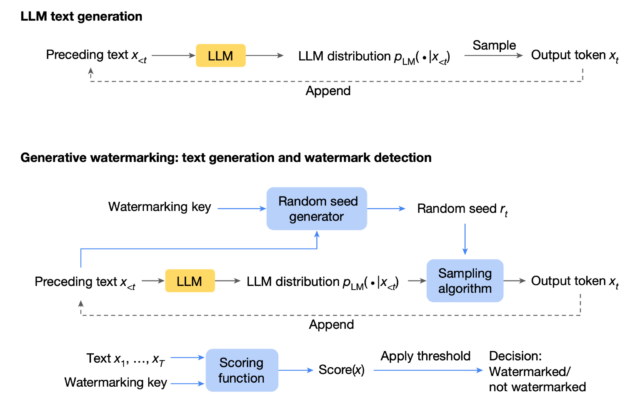
To grasp how watermarking alters model outputs, it is necessary to examine the underlying mechanics of SynthID-Text. Traditional text generation works by predicting the most probable next token—a word, sub-word, or character—based on preceding context. SynthID modifies this process through an approach known as tournament sampling, a technique that mirrors a competitive sports bracket.
In tournament sampling, the model evaluates a large pool of candidate tokens for the next position in a sequence. Utilizing a secret cryptographic key, the system assigns hidden probability scores to these candidates. Pairs of tokens are then pitted against one another in simulated rounds. The token with the higher hidden score wins and advances to the next tier of competition. This iterative elimination process continues until a final winning token is crowned and added to the generated text string.
While this method creates a robust statistical pattern that can be detected later to prove text was generated by a specific AI model, it fundamentally alters the probability distribution of the output. Under standard generation, tokens are chosen purely based on learned weights and temperature settings. Under tournament sampling, the secret key exerts a decisive thumb on the scale, favoring tokens that align with the watermark’s mathematical signature over those naturally favored by the model’s training.
Experimental Methodology and Findings
To test the practical implications of this process, Siposova examined the non-distortionary configuration of SynthID-Text using Hugging Face’s unmodified SynthIDTextWatermarkLogitsProcessor. The investigation focused on six prominent open-weight language models, comparing their baseline behaviors against their watermarked performances when fed identical prompts.
The testing framework incorporated both standard harmful requests—such as instructions for illegal or dangerous activities—and sophisticated prompt-injection scenarios designed to bypass safety filters. The results demonstrated a clear divergence in model behavior. While the introduction of watermarking influenced refusal rates on bare harmful requests, the effect became significantly more pronounced when those requests were coupled with prompt-injection techniques.
"Watermarking changes refusal behavior on bare harmful requests, but the effect is more pronounced when the same requests are paired with the prompt-injection technique," Siposova noted in her analysis. "On several models, watermarking then makes the model more likely to answer harmful requests that it would otherwise refuse."
The implications of this altered behavior extend far beyond simple conversational text generation. Modern AI systems frequently operate as autonomous agents equipped with tools capable of executing code, browsing the web, querying databases, or interacting with external APIs. In these environments, the exact sequence of generated tokens dictates not only what the model communicates to a user, but also which software tools are invoked and what parameters or arguments are passed to them.
The Cascading Risks of Sampling Drift
When sampling drift compromises a model’s safety guardrails, the consequences for agentic AI are multiplicative. If a watermarked model succumbs to a prompt injection that it would have successfully resisted in its unwatermarked state, the resulting error is not limited to text output. It can trigger unauthorized database queries, execute malicious code segments, or misroute sensitive data through external applications.
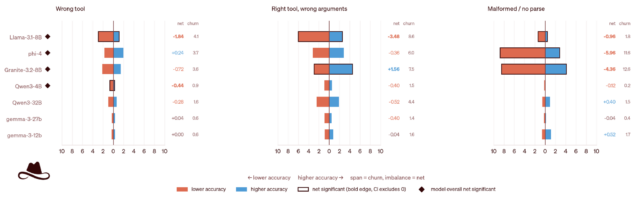
Lasso Security’s data highlights the extent of this instability. The research revealed that watermarking frequently altered which individual tool calls were executed correctly, causing shifts in accuracy that far exceeded what aggregate performance scores might suggest. In evaluation charts mapping error-to-correct and correct-to-error transitions, the application of watermarking introduced noticeable volatility in tool-calling precision.
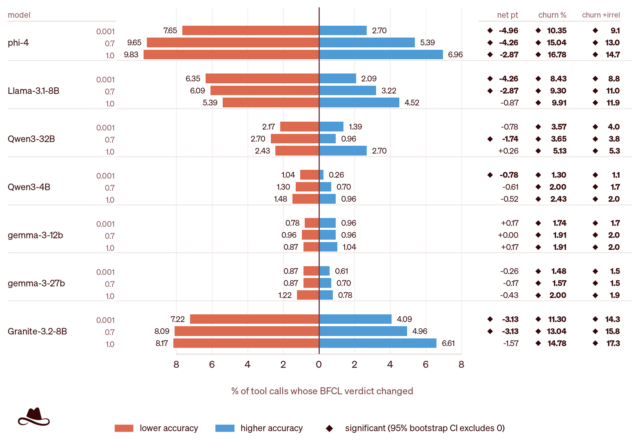
Furthermore, the study uncovered that model responses varied significantly depending on the specific secret key utilized for the watermark. By testing eleven distinct cryptographic keys, the researchers observed wide variations in attack success rates. Some keys heightened compliance with harmful prompts, while others reduced it, demonstrating that the behavioral safety of a watermarked model is not a fixed constant, but a variable dependent on the chosen watermarking parameters.
Scope and Limitations of the Research
While the findings present critical considerations for AI safety, the research comes with distinct boundaries. The study did not evaluate proprietary, closed-source models such as Anthropic’s Claude, as their internal generation architectures and token-sampling pipelines are not publicly accessible for direct manipulation. Instead, the investigation was restricted to open-weight models where researchers could precisely control, enable, or disable token sampling while maintaining uniform environmental settings.
Additionally, the experiments utilized the Hugging Face implementation of SynthID-Text tournament sampling rather than proprietary enterprise deployments. Nevertheless, the underlying principle remains universal: any watermarking system that actively modifies token selection probabilities introduces the risk of altering downstream semantic output and behavioral safety.
Broader Industry Implications and the Path Forward
The discovery of sampling drift introduces a formidable dilemma for artificial intelligence developers, policymakers, and enterprise security teams. On one hand, regulatory frameworks and corporate policies increasingly demand robust provenance tools to track misinformation, copyright infringement, and automated deepfakes. Watermarking has long been championed as an essential technical safeguard to establish accountability for AI-generated content.
On the other hand, the security community has spent years hardening large language models against adversarial attacks, prompt injection, and jailbreaking. If the deployment of content-tracking mechanisms inadvertently weakens these safety barriers, organizations face an unacceptable security compromise. A system that successfully watermarks its text output but becomes susceptible to malicious manipulation in enterprise environments presents an unacceptable risk profile.
In light of these findings, security experts emphasize the need for rigorous red-team testing before deploying watermarking solutions in production environments. AI platforms, particularly those utilizing autonomous agents connected to sensitive enterprise infrastructure, must be stress-tested specifically for sampling drift. Developers must evaluate whether embedding cryptographic watermarks alters the safety boundaries of their models under adversarial conditions.
As the AI industry continues to mature, balancing the imperative for content verification with the absolute requirement for operational safety will remain a central engineering challenge. The research from Lasso Security serves as a vital reminder that in complex neural networks, modifications designed to solve one systemic problem can easily cascade into others, requiring a holistic approach to AI governance, security, and deployment.