Speed Isn’t A Substitute For Direction: AI Accelerates But Doesn’t Redefine Enterprise Transformation

The current wave of enthusiasm surrounding Artificial Intelligence (AI) has led many to believe that it has fundamentally rewritten the rules of enterprise transformation. However, a closer examination reveals that AI’s primary impact has been to accelerate existing processes, introduce new terminology, and, for a brief period, foster a misconception among some business leaders that foundational principles no longer apply. While autonomous agents can now execute tasks at machine speed, thereby compelling Chief Information Officers (CIOs) to manage value, risk, and strategic alignment in near real-time, this represents an evolution rather than a revolution in enterprise strategy. The core tenets of successful transformation remain intact, albeit under increased pressure and with a heightened demand for agility.
The Enduring Pillars of Transformation Success
The fundamental ingredients for successful enterprise transformation have not changed. Strategy, as always, remains paramount; however, the accelerated pace means that poorly conceived strategies will now fail much more rapidly. Measurable outcomes are still the bedrock of credibility, but the expectation is that these outcomes must now be delivered with unprecedented speed. Similarly, capability assessments are as crucial as ever, with the added dimension of incorporating generative AI (genAI) and its supporting technologies into an enterprise’s existing toolkit. In essence, while the language and the tools have evolved, the underlying strategic exercise remains the same.
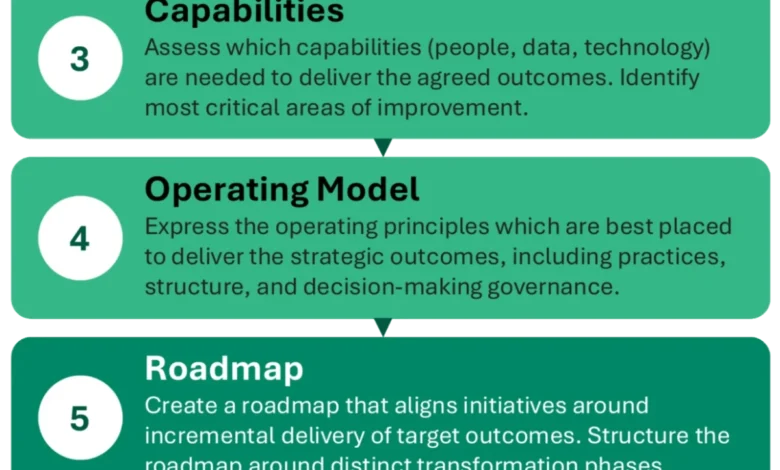
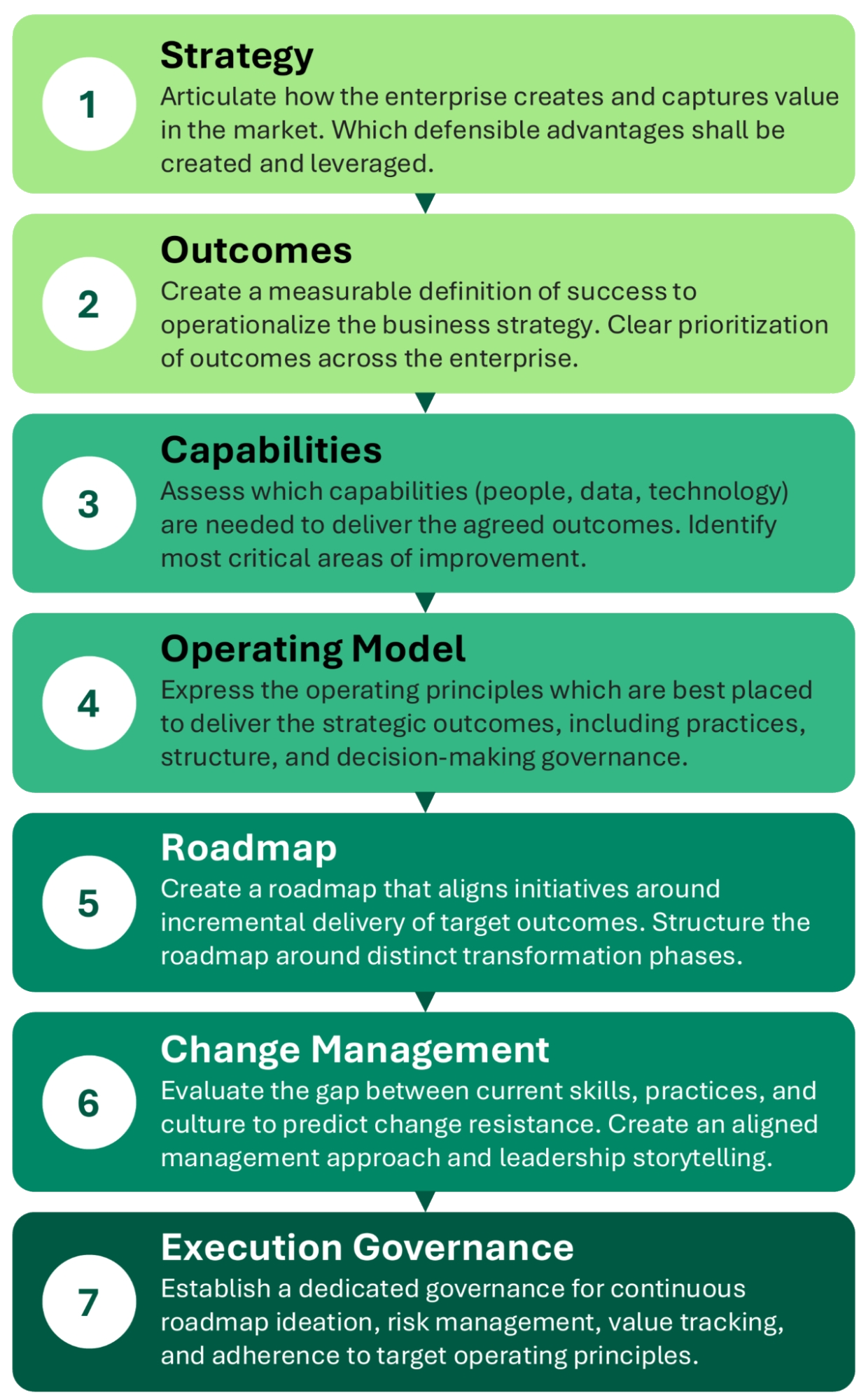
Forrester’s research consistently highlights seven essential steps for establishing a robust enterprise transformation program. These steps, visualized in Figure 1, typically include:
- Defining Vision and Strategy: Clearly articulating the desired future state and the strategic roadmap to achieve it.
- Assessing Current Capabilities: Understanding existing strengths, weaknesses, and technological infrastructure.
- Identifying Key Initiatives: Prioritizing and defining the specific projects and programs that will drive transformation.
- Establishing Governance and Operating Model: Designing the structures, processes, and decision-making frameworks to manage the transformation.
- Managing Change and Communication: Ensuring organizational buy-in, stakeholder engagement, and effective communication throughout the process.
- Executing in Increments: Adopting an agile approach to implementation, delivering value iteratively.
- Measuring and Optimizing: Continuously tracking progress against defined metrics and making necessary adjustments.
These foundational steps, while seemingly straightforward, become significantly more complex and demanding in the current landscape. The introduction of AI, particularly genAI, adds layers of complexity to capability assessments, necessitating a deep understanding of AI’s potential applications, ethical considerations, and integration requirements. The speed at which AI can operate also pressures organizations to compress timelines for execution and measurement, demanding a more dynamic and responsive approach to transformation management.
What’s Truly New in the AI Era?
While the fundamental principles of transformation endure, the advent of genAI has introduced novel dynamics that require strategic adaptation. The ability of autonomous AI agents to execute complex workflows at machine speed forces a paradigm shift in how CIOs and business leaders approach management. Instead of the traditional quarterly or annual strategic reviews, organizations are now compelled to manage value realization, identify and mitigate emergent risks, and ensure strategic alignment on a near real-time basis. This demands a more continuous and proactive approach to oversight, moving away from periodic assessments to ongoing monitoring and rapid adaptation.
The implications for IT leadership are profound. CIOs are no longer solely responsible for the reliable delivery of technology; they are now central figures in orchestrating a complex interplay between human expertise and artificial intelligence. This includes:
- Value Orchestration: Ensuring that AI investments are directly tied to measurable business outcomes and that the value generated is continuously tracked and optimized. This moves beyond simple ROI calculations to a more dynamic assessment of how AI contributes to strategic objectives.
- Risk Management: Identifying and mitigating the unique risks associated with AI, including data privacy, algorithmic bias, security vulnerabilities, and the potential for unintended consequences. This requires a proactive and multi-disciplinary approach to risk assessment and mitigation.
- Alignment and Governance: Ensuring that AI initiatives are aligned with the overall business strategy and that robust governance frameworks are in place to guide their development and deployment. This involves establishing clear lines of accountability and decision-making authority in an environment where AI can operate with significant autonomy.
This heightened pressure on management necessitates a recalibration of organizational structures and processes. The traditional, linear approach to transformation is being challenged by the need for iterative development, continuous learning, and rapid response to dynamic market conditions and technological advancements. The winners in this new era will be those organizations that can execute these fundamental transformation principles with exceptional efficiency and speed, leveraging AI as a powerful accelerator rather than a substitute for sound strategic thinking.
The Accelerated Pace of Enterprise Transformation
The integration of AI, particularly generative AI, has undeniably compressed timelines across the board. A strategy that might have taken years to formulate and implement can now be significantly accelerated. This acceleration is not merely about doing things faster; it’s about achieving desired outcomes with greater efficiency and a reduced tolerance for delays.
For example, consider the traditional process of market analysis and product development. Historically, extensive market research, data analysis, and consumer feedback loops could take months, if not years, to complete. With AI-powered tools, market trends can be identified and analyzed in near real-time, consumer sentiment can be gauged through advanced natural language processing, and even initial product prototypes can be generated through AI design tools. This allows businesses to move from ideation to market testing at a pace previously unimaginable.
This accelerated cycle places immense pressure on every stage of the transformation journey. If a bad strategy fails faster, then a good strategy must be identified and executed with equal, if not greater, speed. The ability to pivot and adapt becomes a critical differentiator. Organizations that can swiftly assess their capabilities, reconfigure their operating models, and deploy new technologies are far more likely to succeed than those clinging to outdated methodologies.
The Role of Generative AI in Capability Enhancement
Generative AI (genAI) represents a significant addition to the enterprise’s arsenal of tools. Its ability to create novel content, generate code, and automate complex creative and analytical tasks opens up new avenues for innovation and efficiency. When assessing enterprise capabilities, organizations must now consider not only their existing human talent and technological infrastructure but also their capacity to effectively leverage genAI.
This involves:
- Identifying GenAI Use Cases: Pinpointing specific business processes and functions where genAI can deliver tangible benefits, such as content creation, customer service automation, software development, and data analysis.
- Developing GenAI Expertise: Cultivating internal talent or partnering with external experts to develop, implement, and manage genAI solutions. This includes understanding prompt engineering, model fine-tuning, and ethical deployment.
- Integrating GenAI into Workflows: Seamlessly embedding genAI tools into existing business processes to enhance productivity and unlock new capabilities. This requires careful consideration of data integration, security, and user adoption.
For instance, a marketing department can use genAI to draft marketing copy, generate ad creatives, and personalize customer communications at scale. A software development team can leverage genAI to write code, identify bugs, and automate testing, significantly reducing development cycles. A research team can use genAI to summarize vast amounts of information, identify patterns, and generate hypotheses, accelerating the pace of discovery.
However, the adoption of genAI is not without its challenges. Concerns around data privacy, intellectual property rights, and the potential for biased outputs require careful consideration and robust governance frameworks. The “black box” nature of some AI models also presents challenges in terms of explainability and accountability, necessitating a focus on transparency and ethical AI development.
The Imperative of Execution and Organizational Alignment
Ultimately, the success of any enterprise transformation, regardless of the technological advancements, hinges on effective execution and strong organizational alignment. The most sophisticated AI tools and strategies are rendered ineffective if they cannot be translated into tangible results within the organization.
This means:
- Agile Execution: Embracing iterative development and deployment, delivering value in manageable increments, and being prepared to adapt based on feedback and changing conditions. This contrasts with traditional, large-scale, "big bang" implementations that often prove too rigid in a rapidly evolving environment.
- Change Management: Actively managing the human element of transformation. This involves clear communication, stakeholder engagement, training, and support to ensure that employees understand and embrace the changes. Resistance to change, whether due to fear of job displacement or simply a reluctance to adopt new ways of working, can derail even the most well-intentioned transformation efforts.
- Cultural Adaptation: Fostering a culture of continuous learning, experimentation, and adaptability. Organizations that encourage innovation, embrace calculated risks, and learn from both successes and failures are better positioned to thrive in the age of AI.
The winners in this accelerated era of transformation will be those who master the art of doing ordinary things extraordinarily well, but with unprecedented speed and fewer excuses. They will be the organizations that understand that AI is a powerful enabler, not a magic bullet, and that the enduring principles of strategy, capability, execution, and organizational alignment remain the bedrock of sustainable success. The language may have changed, and the tools may be more sophisticated, but the fundamental challenge of transforming an enterprise to meet the demands of the future remains a deeply human and strategic endeavor. The current technological landscape simply amplifies the need for precision, agility, and a clear, unwavering direction.