Ensuring Patient Trust and Regulatory Compliance: A Comprehensive Guide to HIPAA-Compliant Video Conferencing in Healthcare


Choosing HIPAA-compliant video conferencing software is among the most critical technology decisions a healthcare organization faces, carrying profound implications that extend far beyond mere operational efficiency. Errors in selection create a dual vulnerability: a significant compliance gap exposing sensitive patient data to severe legal and financial risks, coupled with a usability deficit that can deter patients from accessing crucial care even before their virtual appointment begins.
Under federal inflation-adjusted civil penalty guidelines, a single unintentional HIPAA violation can incur fines up to $73,011. For systemic platform neglect, the annual cap for penalties can reach a staggering $2.19 million. These figures, enforced by the Office for Civil Rights (OCR), underscore the immense financial and reputational stakes involved. Beyond legal ramifications, a platform that is difficult to use can lead to missed appointments, frustrated patients, and overburdened support staff, effectively costing a practice patients and diminishing its ability to deliver timely care. Therefore, the ideal solution must not only protect patient data under penalty of law but also offer an intuitive experience, allowing a first-time telehealth patient to seamlessly join their session without a single technical support call.
The Evolving Landscape of Telehealth and Regulatory Scrutiny
The healthcare industry has undergone a rapid transformation in recent years, significantly accelerated by the global pandemic. Telehealth, once a niche offering, has firmly entrenched itself as a routine, indispensable component of care delivery. This shift has not only increased patient access but also elevated patient expectations. Modern healthcare providers are now expected to offer advanced capabilities such as AI-powered documentation, browser-based appointments, and enterprise-grade reliability, which have transitioned from mere "nice-to-haves" to fundamental operational necessities.
This evolution brings heightened scrutiny from regulatory bodies. The Health Insurance Portability and Accountability Act (HIPAA) of 1996, later strengthened by the Health Information Technology for Economic and Clinical Health (HITECH) Act of 2009, established stringent national standards for protecting sensitive patient health information (PHI). These regulations mandate that healthcare providers, health plans, and healthcare clearinghouses – known as "covered entities" – along with their "business associates" (third-party vendors handling PHI), implement robust administrative, physical, and technical safeguards to ensure the confidentiality, integrity, and availability of electronic protected health information (ePHI). Selecting the wrong technology for video conferencing can dramatically increase compliance risks, frustrate staff with cumbersome workflows, and contribute to technology sprawl across an organization, ultimately undermining both patient trust and operational effectiveness.
Beyond Basic Features: The Imperative for Integrated Solutions

While many vendor checklists for video conferencing stop at surface-level features like screen sharing, recording, and chat, this approach often overlooks the true compliance risk. When clinical staff encounter a tool that is slow, confusing, or unreliable, they may resort to using personal smartphones or unapproved, non-compliant applications. This shadow IT behavior is precisely how unauthorized PHI exposure and subsequent HIPAA violations occur in practice. Therefore, usability and seamless integration are not just conveniences; they are critical components of a robust compliance strategy.
Three capabilities, often overlooked in initial evaluations, warrant prioritization from the outset:
- AI-powered documentation: The ability to automatically transcribe and summarize virtual visits, reducing the administrative burden on clinicians while maintaining accuracy and compliance.
- Browser-based access: Eliminating the need for software downloads or account creation, simplifying the patient experience and improving accessibility.
- Enterprise-grade reliability: Ensuring consistent uptime and performance to prevent disruptions in critical care delivery.
These advanced capabilities, however, are only valuable if the underlying healthcare video conferencing software first meets its foundational compliance requirements.
Navigating the Market: Key Considerations for HIPAA-Compliant Platforms
The bedrock of HIPAA compliance for any third-party technology vendor, especially for video conferencing, rests on several non-negotiable pillars:
1. Business Associate Agreements (BAAs) and Access Logs:
A vendor cannot simply advertise "HIPAA compliance" or claim to be "HIPAA-ready" or "HIPAA-enabled." Such marketing language should be treated as a starting point, not proof. The absolute requirement is the vendor’s willingness and ability to execute a Business Associate Agreement (BAA) with the healthcare organization. A BAA is a legally binding contract that defines the responsibilities of both parties regarding the protection of PHI when it is created, received, maintained, or transmitted by the business associate on behalf of the covered entity. Without a signed BAA, any use of that vendor for handling patient information directly transfers full HIPAA liability to the healthcare organization. Healthcare organizations must verify that the platform’s security controls—including encryption, access management, audit logging, and administrative safeguards—are explicitly covered and guaranteed by a signed BAA.
Beyond the BAA, robust audit logs are the second non-negotiable. Every access event, from who joined a meeting, at what time, from which device, to specific actions taken within the platform, must be recorded in a verifiable log. These logs provide a transparent, immutable audit trail that a compliance team can pull on demand. Under HIPAA’s documentation requirements, access logs and related records must be kept for at least six years from the date of creation or the date they were last in effect. Should the Office for Civil Rights (OCR) initiate an investigation following a breach or complaint, these audit trails serve as the primary evidence of proper oversight and adherence to security protocols, demonstrating due diligence in protecting ePHI.
2. End-to-End Data Encryption and Meeting Access Controls:
Encrypted video conferencing forms the technical foundation of HIPAA compliance for virtual care. The HIPAA Security Rule mandates that electronic protected health information (ePHI) be protected both in transit and at rest using "reasonable and appropriate" technical safeguards. While intentionally technology-neutral, for secure video conferencing, AES 256-bit encryption has become the recognized industry standard. This robust encryption protocol must be applied across all data streams—video, audio, and chat—as they travel between participants and across vendor servers. Enterprise-grade platforms extend this standard to all forms of stored data, including recorded sessions, transcripts, and AI-generated summaries, ensuring continuous protection throughout the data lifecycle.
Video conference security extends beyond the transmission layer. Comprehensive access controls are vital to prevent unauthorized access. These include multi-factor authentication (MFA) to verify user identity, role-based permissions that limit access to information based on an individual’s function, and automatic session timeouts for inactive users. Most compliant organizations implement these safeguards in full, and any that do not must document why an equivalent alternative provides the same level of protection. Virtual waiting rooms, where a host manually admits each participant, offer a low-tech yet highly effective barrier against unauthorized entry. Additionally, meeting passwords, authenticated user access, and granular role-based permissions further strengthen identity verification, ensuring that only authorized patients, clinicians, and support staff can participate in discussions involving protected health information. This combination of encrypted data and layered access controls ensures that every component of a virtual session—from live video and audio to chat messages, AI-generated summaries, and stored recordings—is meticulously protected throughout its entire lifecycle.
3. Simple Connection Setup and EHR Compatibility:
Even the most secure, HIPAA-compliant platform loses significant value if patients cannot easily join appointments. Browser-based video conferencing eliminates one of the most common barriers to virtual care by allowing patients to connect through a secure link without the need to download software, create accounts, or manage complex installations. This one-click access significantly improves appointment attendance rates, reduces technical support requests for clinical staff, and ultimately enhances the overall patient experience.
Equally critical is robust EHR (Electronic Health Record) workflow compatibility. Ideally, appointment scheduling, patient intake information, digital consent forms, clinical documentation, and post-visit summaries should flow seamlessly between systems with minimal manual entry. Deep integrations with existing practice management platforms make this possible, dramatically reducing duplicate work, minimizing administrative handoffs, and mitigating the risk of data entry errors. This integration allows clinicians to spend more time directly engaging with patients rather than transferring data between disconnected tools, thereby improving efficiency, reducing clinician burnout, and maintaining consistent security and compliance across the entire patient journey.
Spotlight on Leading HIPAA-Compliant Video Conferencing Platforms
The market for HIPAA-compliant video conferencing solutions offers a range of platforms, each tailored to different organizational sizes and specific needs.
RingCentral Video Meetings
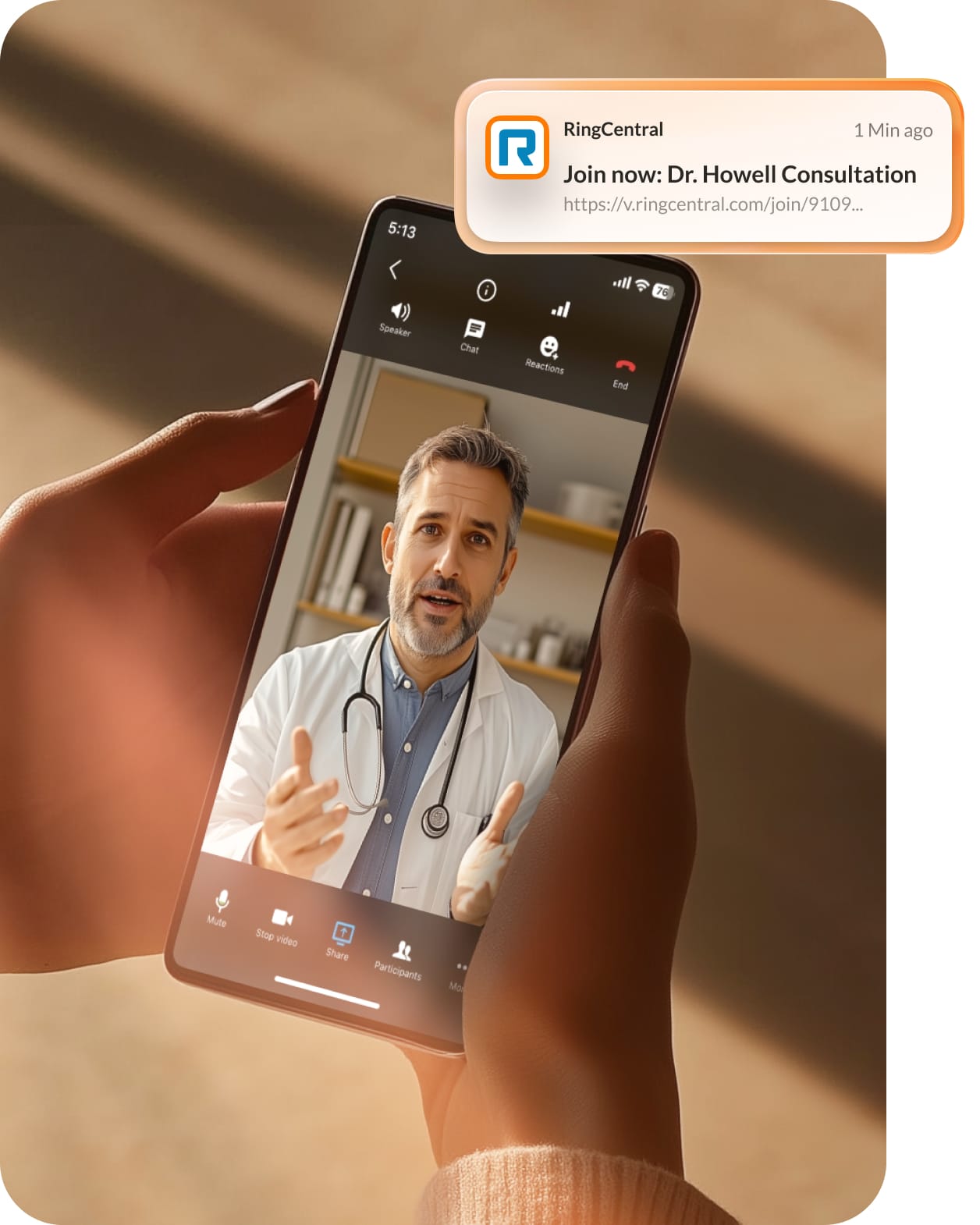
RingCentral Video is a secure, browser-based video conferencing solution engineered for organizations that demand enterprise-grade reliability without compromising ease of use. Patients can join appointments with a single click via any desktop or mobile browser, effectively dismantling technical barriers that frequently contribute to missed or delayed virtual visits. Its intuitive interface streamlines patient onboarding, particularly for first-time telehealth users, while delivering the robust security, stringent compliance, and superior streaming quality expected from an enterprise-level healthcare platform.
For organizations primarily focused on telehealth appointments, RingCentral Video serves as a strong standalone solution. However, its maximum enterprise value is unlocked when paired with RingEX, RingCentral’s unified communications (UCaaS) offering. Together, they forge a comprehensive communications environment that integrates secure virtual consultations with advanced features like AI-powered meeting documentation, centralized administration, and broader collaboration capabilities—all without requiring staff to juggle multiple disparate applications. This integrated approach is particularly valuable given that virtual care rarely begins and ends with the video appointment itself. Automated appointment reminders, secure messaging, voice calls, fax communications, and clinical collaboration are often integral components of the patient journey. By consolidating these communication channels within a single HIPAA-ready environment and enabling integration with existing practice management platforms, RingCentral helps reduce administrative handoffs, ensures consistent security, and maintains compliance across the entire continuum of patient care.
- Best For: Mid-market and enterprise healthcare systems requiring scalable, integrated solutions.
- Custom Workflows: High flexibility for integration and tailored communication flows.
- HIPAA Compliance Guardrails: Comprehensive BAA, end-to-end encryption, granular audit controls, advanced AI governance.
- Enterprise Reliability: Industry-leading 99.999% uptime guarantee, ensuring continuous service.
- Key Features: One-click browser-based access, AI meeting summaries and transcription, unified communications (voice, video, messaging, fax), robust EHR integrations, administrative controls.
- Pros: Exceptional reliability, comprehensive feature set, strong compliance posture, ease of use for patients, scalable for large organizations, reduces tech sprawl.
- Cons: Full benefits require integration with RingEX, potentially a broader feature set than solo practitioners need.
- Pricing: Included with RingEX plans, starting at $20/user/month.
Blaze.tech
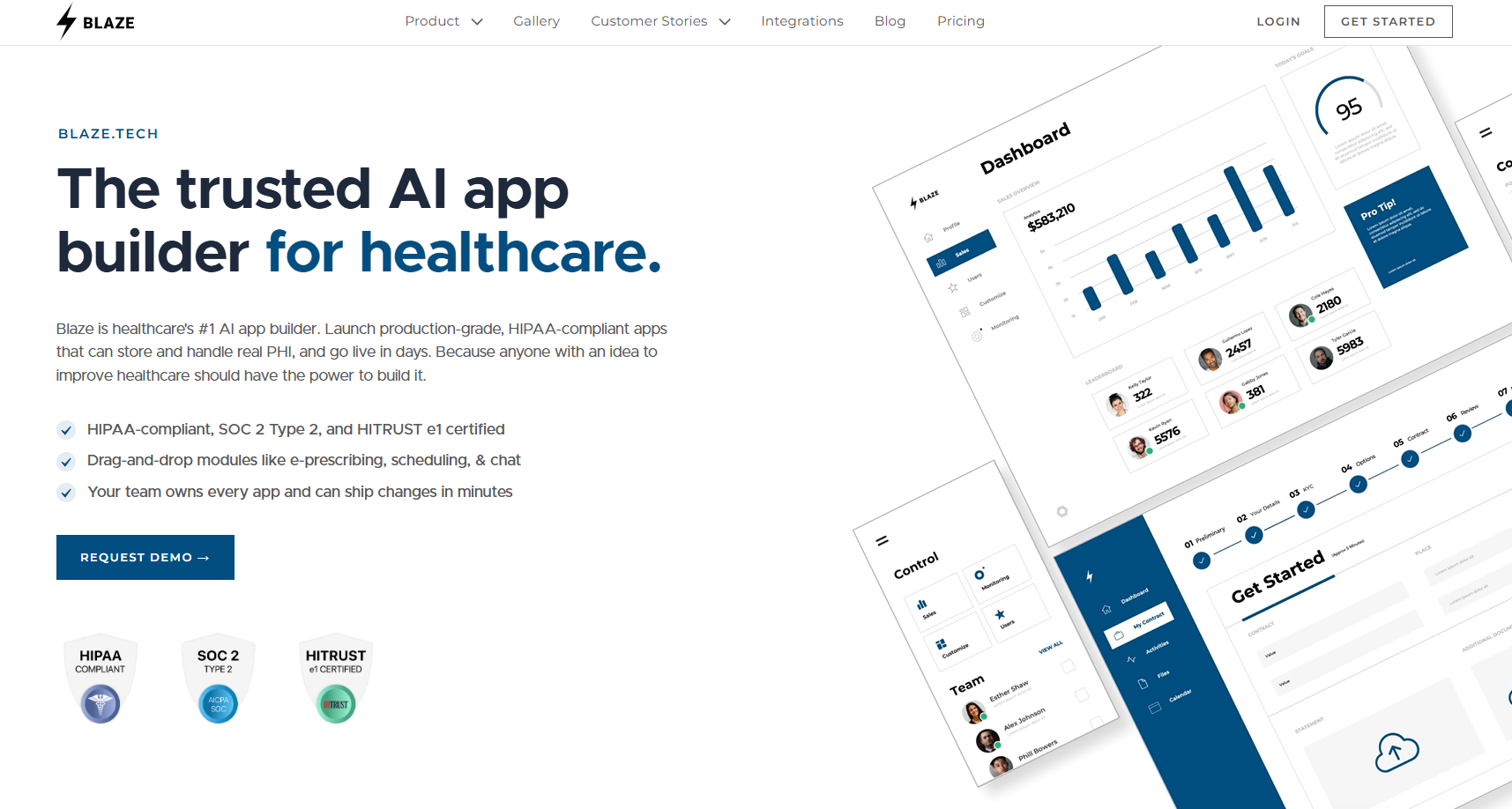
Blaze.tech approaches healthcare technology from a distinct angle. Rather than operating solely as a video conferencing platform, it empowers healthcare organizations to construct custom applications—including bespoke patient portals, dynamic intake forms, sophisticated workflow automation, and tailored scheduling tools—without requiring extensive software development expertise. Its inherent flexibility makes it particularly appealing for organizations with specialized operational requirements that cannot be adequately met by generic, off-the-shelf software solutions. This low-code/no-code platform allows for rapid deployment of highly customized digital tools.
- Best For: Healthcare organizations needing custom applications and unique patient engagement tools.
- Custom Workflows: Very High, designed for bespoke solutions.
- HIPAA Compliance Guardrails: BAA support, secure app development environment, data encryption.
- Enterprise Reliability: Dependent on underlying cloud infrastructure, generally robust.
- Key Features: No-code application builder, custom patient portals, workflow automation, secure data handling, integration capabilities.
- Pros: Unparalleled customization, rapid application development, addresses unique organizational needs, empowers non-developers.
- Cons: Not a standalone video conferencing solution, requires internal resources for app building, pricing can vary significantly based on complexity.
- Pricing: Contact Blaze.tech directly for current pricing.
Zoom for Healthcare
Zoom for Healthcare is a compliance-configured variant of the widely recognized Zoom platform, specifically designed for clinical environments. It comes with a signed Business Associate Agreement (BAA) and incorporates additional security settings tailored to healthcare operations. This makes it an attractive option for healthcare organizations already utilizing Zoom for internal communications, allowing them to transition into clinical compliance without having to overhaul existing workflows or retrain staff on a completely new interface. Its widespread familiarity minimizes the learning curve.
- Best For: Small-to-mid-sized organizations and independent practices already familiar with the Zoom ecosystem.
- Custom Workflows: Moderate, through APIs and integrations.
- HIPAA Compliance Guardrails: BAA, administrative controls, encryption, privacy features.
- Enterprise Reliability: Strong, with enterprise SLA options available.
- Key Features: Familiar user interface, secure video consultations, virtual waiting rooms, screen sharing, recording, administrative dashboards.
- Pros: High user familiarity, relatively easy adoption, strong feature set for virtual visits, robust security settings.
- Cons: Healthcare-specific features may require a higher-tier plan, can be perceived as less integrated than unified communication suites.
- Pricing: Healthcare-specific pricing is available through Zoom sales.
Doxy.me
Doxy.me is a browser-based, video-only platform purpose-built exclusively for telemedicine. Unlike broader communication suites, it focuses almost entirely on providing simple, secure, browser-based virtual consultations. This streamlined, minimalist approach is highly appealing to independent providers and small practices who prioritize simplicity and ease of use over an extensive array of collaboration features. Its directness makes it particularly accessible for both providers and patients.
- Best For: Independent providers, therapists, and small practices seeking a straightforward, dedicated telemedicine solution.
- Custom Workflows: Low, designed for simplicity.
- HIPAA Compliance Guardrails: BAA included on both free and paid plans, encrypted sessions, secure waiting room.
- Enterprise Reliability: Cloud-based availability, generally reliable for its target audience.
- Key Features: One-click patient access, virtual waiting room, basic chat, screen sharing, no downloads required.
- Pros: Extremely easy to use for both patients and providers, free HIPAA-compliant plan available, purpose-built for telemedicine, no software installation needed.
- Cons: Limited advanced features, no unified communications capabilities, less scalable for larger organizations.
- Pricing: Free plan available. Premium plan starts at $29/user/month.
Strategic Selection: Matching Platform to Practice Size and Needs
No single platform is the universally "right" answer for every organization. To determine which HIPAA-compliant video conferencing solution best matches your current operational reality and strategic goals, a comprehensive evaluation across several critical dimensions is necessary. This ensures that the chosen technology not only meets regulatory mandates but also enhances patient care and supports organizational growth.
1. Infrastructure and Reliability:
- Scalability: Can the platform seamlessly accommodate growth, from a few practitioners to a large multi-specialty clinic or even a hospital system, without performance degradation or significant cost spikes?
- Uptime Guarantees (SLA): What Service Level Agreements (SLAs) does the vendor offer regarding uptime? For healthcare, a minimum of 99.9% uptime is often considered baseline, with enterprise systems aiming for "five nines" (99.999%).
- Data Residency and Disaster Recovery: Where is patient data physically stored, and what are the vendor’s disaster recovery and business continuity plans? Understanding data residency is crucial for some regulatory environments.
2. Patient and Provider Experience:
- Ease of Use: How intuitive is the platform for both patients (especially first-time telehealth users) and clinical staff? Does it minimize clicks and technical hurdles?
- Mobile Accessibility: Is the platform fully functional and optimized for mobile devices (smartphones, tablets) across various operating systems?
- Accessibility Features: Does it offer features for patients with disabilities, such as closed captioning, screen reader compatibility, or language translation?
- Training and Support: What level of training and ongoing technical support does the vendor provide for staff and, if applicable, for patient-facing issues?
3. Compliance and Customization:
- BAA Specificity: Does the vendor’s BAA explicitly cover all anticipated uses, including potential future uses like AI-powered features, and align with your organization’s internal compliance policies?
- Audit Log Granularity: How detailed are the audit logs, and how easily can your compliance team access and interpret them for investigations or routine reviews?
- API Availability and Integration Ecosystem: Does the platform offer robust APIs (Application Programming Interfaces) to facilitate custom integrations with your existing EHR, practice management software, or other clinical systems? This is critical for creating a cohesive workflow.
- Vendor Compliance Support: How responsive and knowledgeable is the vendor’s team regarding HIPAA regulations and specific compliance inquiries?
The Broader Trust Implication
Patients share their most sensitive and personal information during clinical conversations, whether in-person or virtually. They do so with an implicit trust that your organization will handle this data with the utmost responsibility, care, and security. The video conferencing platform you choose either reinforces that fundamental trust or subtly, yet profoundly, puts it at risk.
Ultimately, the best buying decision for HIPAA-compliant video conferencing software is a delicate balance of security, usability, and operational efficiency. It must rigorously protect patient information against breaches and misuse while simultaneously making virtual care as seamless and accessible as possible for clinicians, administrators, and patients alike. An investment in a truly compliant and user-friendly platform is not merely a cost of doing business; it is an investment in patient safety, operational resilience, and the enduring trust that forms the bedrock of every healthcare relationship.
HIPAA-Compliant Video Conferencing FAQs
What video conferencing software is HIPAA compliant?
Platforms that qualify as HIPAA-compliant video conferencing solutions include RingCentral Video, Zoom for Healthcare, Doxy.me, and Blaze.tech. What fundamentally distinguishes these from general-purpose video tools—like Google Meet’s standard tier, personal FaceTime, or consumer Skype—is not just advanced encryption or features. It is primarily the vendor’s legal willingness to sign a Business Associate Agreement (BAA) with a covered entity, thereby accepting shared legal liability for how Protected Health Information (PHI) is handled, stored, and transmitted within their system. Without a signed BAA, any platform, regardless of its technical security, cannot be considered HIPAA-compliant for healthcare use cases involving PHI.
What makes a video conferencing platform HIPAA-compliant?
HIPAA-compliant video conferencing rests on three interlocking layers of protection, as defined by the HIPAA Security Rule:
- Business Associate Agreement (BAA): A legally binding contract between the healthcare organization (covered entity) and the software vendor (business associate) that outlines each party’s responsibilities for protecting PHI. This is non-negotiable.
- Technical Safeguards: These include robust end-to-end encryption (e.g., AES 256-bit) for data in transit and at rest (recordings, chat), multi-factor authentication (MFA), granular access controls (role-based permissions), secure data storage (SOC 2 Type II certified data centers), audit logging, and automatic session timeouts.
- Administrative Safeguards: Policies and procedures governing how staff use the platform, regular risk assessments, staff training on HIPAA protocols, and incident response plans. These ensure that human processes align with technical capabilities.
Can we securely store video recordings of patient consultations in the cloud?
Yes, it is possible and often more secure than on-premises solutions, provided the right vendor and controls are in place. Any saved recording immediately becomes ePHI and must be protected accordingly. This means it must be encrypted at rest, stored within SOC 2 Type II-certified and geographically redundant data centers, and governed by strict role-based access controls that restrict playback to staff with a legitimate clinical need. HIPAA also requires that ePHI records be retained for a minimum of six years. Therefore, healthcare organizations must verify that their vendor’s data retention and deletion policies align with this timeline and ensure data integrity over the long term before signing a contract. The same rigorous protections apply to AI-generated meeting summaries and transcripts; each becomes part of the clinical record once saved and must be treated with the same level of security and compliance.
Can a platform use AI to take meeting notes safely?
Yes, when implemented correctly and within a compliant framework, AI-generated summaries and notes can be a powerful tool for reducing administrative burden. For AI-powered note-taking to be HIPAA-compliant, several conditions must be met: the patient data must remain securely within the vendor’s covered infrastructure, the Business Associate Agreement (BAA) must explicitly cover and specify the AI processing of PHI, and the AI outputs (summaries, transcripts) must be stored with the same stringent encryption and access controls applied to all other ePHI. The AI models themselves should also be designed to protect privacy, avoiding the use of PHI for training public models unless explicitly consented to and anonymized.
How does HIPAA-compliant video conferencing fit into a telehealth workflow?
A HIPAA-compliant video conferencing platform serves as the central communication hub for virtual appointments, but its true value is maximized when it seamlessly integrates with the broader ecosystem of systems that support patient care before, during, and after the consultation. This integrated workflow typically includes:
- Pre-appointment: Appointment scheduling systems, digital patient intake forms, and electronic consent platforms.
- During appointment: Secure messaging and chat tools for in-session communication, and direct access to clinical documentation within the EHR.
- Post-appointment: Automated post-visit summaries, prescription management, follow-up scheduling, and secure payment workflows.
The goal is not to replace every application with one platform, but to choose video conferencing software that connects efficiently and securely with the tools your organization already uses, maintaining end-to-end HIPAA compliance across the entire patient journey and optimizing operational efficiency.
Updated Jul 21, 2026
Related posts: