Mastering AI: Beyond the Swiss Army Knife Approach to Unlocking Strategic Insights

The prevailing approach to artificial intelligence tools, characterized by selecting a single application and attempting to leverage it for all tasks, is fundamentally flawed and hinders true productivity gains. Experts are increasingly advocating for a more nuanced strategy: employing specialized AI tools for specific functions and orchestrating them into cohesive workflows. This paradigm shift, moving from a "one-size-fits-all" mentality to a task-oriented, integrated system, is proving to be the key differentiator for individuals and organizations seeking to maximize the impact of AI. A prominent workflow example illustrates this evolution, particularly in the critical post-meeting analysis phase, transforming raw information into actionable strategic directives.
The challenge of post-meeting processing is a universal one. Following an important discussion, whether it reveals a strategic pivot, highlights a critical problem, confirms a chosen direction, or uncovers a new opportunity, the immediate aftermath often sees valuable insights dissipate. While many individuals resort to rudimentary note-taking or rely on AI-powered summarization tools, the generated transcript or summary frequently remains siloed, becoming increasingly inaccessible and forgotten over time. The core issue, therefore, is not the mere capture of meeting data, but its subsequent processing, comprehension, and integration with existing knowledge and ongoing projects. This is where the strategic deployment of AI, not as a passive recorder but as an active thinking partner and executor, becomes paramount.
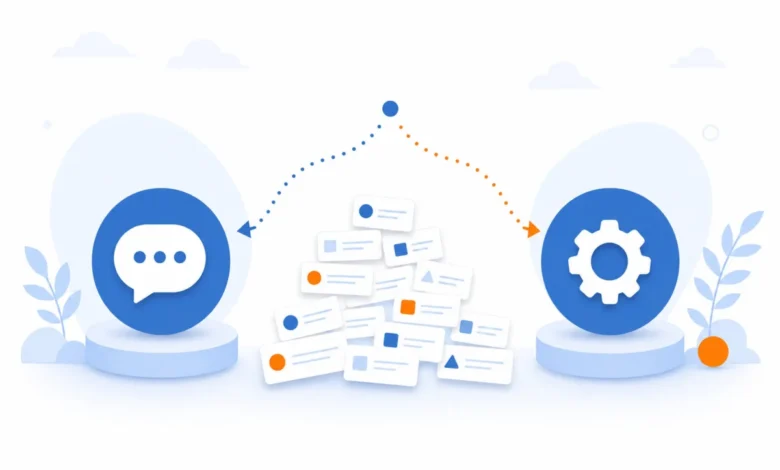
The Two-Tiered AI Workflow: Thinking with ChatGPT, Acting with Lindy
A sophisticated workflow, championed by productivity experts, bifurcates the AI process into distinct yet complementary phases: cognitive exploration and practical execution. This dual approach leverages the unique strengths of different AI platforms to address specific needs within a given task.
Phase 1: Cognitive Exploration and Strategic Articulation with ChatGPT
The initial phase focuses on deep thinking and strategic synthesis, a domain where large language models like ChatGPT excel. After a significant meeting, the transcript is fed into ChatGPT, accompanied by contextual information regarding current strategic objectives. The prompt is designed to elicit analytical reasoning rather than mere summarization. For instance, a user might input: "Here is a transcript of a recent conversation. Please consider this in light of my current strategic priorities. Help me understand the implications of this meeting for my long-term goals. Feel free to ask clarifying questions to deepen your understanding."
ChatGPT, in this context, acts as an intellectual sparring partner. It doesn’t simply rephrase the conversation but actively connects disparate points, identifies underlying assumptions, and poses probing questions that compel the user to articulate their own evolving thoughts and perspectives. This interactive dialogue fosters clarity, allowing the user to solidify their understanding of the meeting’s significance and determine necessary adjustments to their strategic roadmap. The objective is to move beyond superficial comprehension to a profound grasp of the meeting’s impact.
Upon achieving this clarity, the next step involves translating these insights into a format suitable for action. The user then prompts ChatGPT to generate a specific output: "Now, please generate a detailed memo that I can provide to my automation tool to update my master strategy document." ChatGPT, adept at structured output, produces a clear, concise, and actionable memo, ready for the subsequent execution phase.
Phase 2: Reliable Execution and System Integration with Lindy
The memo generated by ChatGPT is then passed to a specialized automation tool, such as Lindy. Lindy is designed not for exploratory thinking but for precise execution. Its core functionality lies in its ability to integrate with various external applications – including document management systems like Google Docs, communication platforms like email, calendaring services, and customer relationship management (CRM) software – to carry out specific instructions reliably.
In this workflow, Lindy would access the user’s master strategy document within Google Drive and implement the updates as detailed in the memo. This seamless transfer from cognitive processing to automated action represents the power of a well-designed AI workflow. The thinking and decision-making occur in the exploratory environment of ChatGPT, while the implementation, ensuring accuracy and consistency across integrated systems, is handled by Lindy.
The Rationale Behind a Multi-Tool Approach
The immediate question arising from this workflow is why not utilize a single AI tool, like ChatGPT with its expanding plugin ecosystem, for both thinking and execution? While ChatGPT’s capabilities are broad, the user experience and efficacy differ significantly when attempting to force it into roles for which it wasn’t primarily designed.
ChatGPT is fundamentally a conversational AI, optimized for dialogue and exploratory tasks. It excels when the path forward is unclear and discovery through interaction is necessary. Conversely, tools like Lindy are engineered for deterministic execution. They are built to receive precise instructions and carry them out with high reliability across multiple integrated platforms. Attempting to use ChatGPT for complex execution tasks often leads to inconsistent results, as its design prioritizes helpful and contextually relevant responses within a conversation, rather than the unwavering adherence to a predefined workflow. Similarly, using an execution-focused tool like Lindy for open-ended cognitive exploration is ineffective, as it lacks the interactive and reasoning capabilities required for deep thinking.
These tools are not in competition; they are complementary. They represent different facets of AI utility, each performing a distinct and vital role in a comprehensive productivity system. This understanding of their specialized strengths is the bedrock of effective AI integration.
The Evolution of AI Fluency: Beyond Prompt Engineering
Achieving true mastery of AI extends far beyond simply learning the optimal prompts for a given task. It necessitates a deeper comprehension of the underlying design philosophy and inherent strengths of each AI tool. Recognizing that AI applications are not interchangeable commodities, but rather specialized instruments, is crucial. The ability to match the right tool to the appropriate phase of work – whether it be initial ideation, strategic decision-making, practical implementation, or communication – is what differentiates individuals who achieve consistent, impactful results from those who struggle with unpredictable outcomes.
A pattern observed among highly proficient AI users reveals a consistent approach: they understand that the synergy between a conversational tool and an automation tool surpasses the individual capabilities of either. This realization is not merely a product-specific insight but a fundamental principle of effective workflow design in the age of AI.
Implementing the AI Workflow: A Practical Introduction
For individuals and organizations looking to adopt this integrated AI workflow, a phased implementation is recommended. The initial focus should be on establishing a reliable process for capturing and processing key information from important meetings.
Step 1: Select Your Tools. Identify a robust conversational AI, such as ChatGPT, for the thinking phase, and a reliable automation tool, like Lindy, for the execution phase. Evaluate other meeting transcription services if necessary, ensuring they integrate smoothly with your chosen AI platforms.
Step 2: Define Your Meeting Context. Before each important meeting, clarify the strategic objectives and the desired outcomes. This preparation will inform the prompts used in the AI analysis phase.
Step 3: Process the Transcript. After the meeting, feed the transcript into your conversational AI. Utilize prompts designed to elicit strategic insights and implications, rather than simple summaries. Encourage interactive questioning to deepen understanding.
Step 4: Generate an Actionable Memo. Once clarity is achieved, prompt the conversational AI to generate a specific memo outlining the necessary updates or actions for your master strategy document. This memo should be clear, concise, and directly actionable.
Step 5: Execute with Your Automation Tool. Transfer the generated memo to your automation tool. Configure the tool to execute the instructions precisely, ensuring updates are made accurately and efficiently within your designated systems.
The ultimate goal of this workflow is not necessarily to automate every aspect of work, but to prevent the valuable insights gleaned from crucial conversations from being lost. In today’s fast-paced environment, a significant portion of meeting learnings can be forgotten by the following day. This integrated AI workflow provides a systematic method for preserving and acting upon this critical information, thereby fostering continuous strategic improvement and organizational agility. The ability to transform ephemeral discussion into enduring strategic assets is a hallmark of advanced AI utilization.
Related posts: