Mastering Data Transformation: Corporate Finance Institute Launches Comprehensive Introduction to Power Query Course

In an era defined by data-driven decision-making, finance professionals, business analysts, and corporate workers frequently find themselves spending more time manually cleaning and formatting data than actually analyzing it. To address this persistent operational bottleneck, the Corporate Finance Institute (CFI) has officially launched its comprehensive online training offering, titled Introduction to Power Query. This self-paced, five-hour program is specifically engineered to bridge the gap between raw, unstructured data sources and polished, analytical insights across Microsoft Excel and Power BI platforms.
The introduction of this curriculum comes at a critical juncture for the modern corporate landscape. As organizations aggregate vast amounts of operational, financial, and market data from disparate sources, traditional manual reporting methods have become unsustainable. By shifting workers away from error-prone copy-pasting and repetitive manual formatting toward automated, repeatable workflows, CFI’s new offering aims to redefine baseline technical competencies for financial analysts, business intelligence specialists, and administrative professionals alike.
Background and Context: The Evolution of Data Preparation
Data preparation has historically constituted up to eighty percent of an analyst’s daily workload, a phenomenon widely acknowledged by data scientists and financial modelers. For decades, Microsoft Excel served as the primary canvas for financial reporting, budgeting, and forecasting. However, as dataset sizes expanded and the velocity of business reporting accelerated, legacy methods—such as complex VLOOKUP nesting, manual macro recording, and ad-hoc text manipulation—proved increasingly inadequate for maintaining data integrity.
Microsoft’s development of Power Query represented a paradigm shift in how users ingest and transform data. Originally introduced as an add-in for Excel 2010 and 2013, Power Query was eventually integrated natively into modern versions of Excel for Windows and Mac, as well as Microsoft Power BI. Despite its immense capability, many business professionals struggle to adopt the tool organically, often relying on superficial features rather than harnessing its full potential to build robust, automated ETL (Extract, Transform, Load) pipelines.
Recognizing this skills gap, CFI developed the Introduction to Power Query curriculum to provide a structured, practical foundation. Rather than focusing on abstract theoretical concepts, the syllabus prioritizes real-world application, ensuring that students can immediately translate lessons into measurable productivity gains within their respective organizations.
Curriculum Structure and Core Learning Modules
Spanning five hours of online, self-paced instruction, the Introduction to Power Query course is categorized under Level 3 proficiency within CFI’s educational framework. The curriculum is meticulously organized into seven distinct modules, designed to guide learners progressively from foundational concepts to advanced workflow automation.
The journey begins with an essential orientation module that demystifies the Power Query interface, its underlying formula language (M), and its role within the broader Microsoft analytics ecosystem. Students then transition into basic data transformations, learning how to establish live connections to various source files, promote headers, adjust data types, and filter raw datasets efficiently.
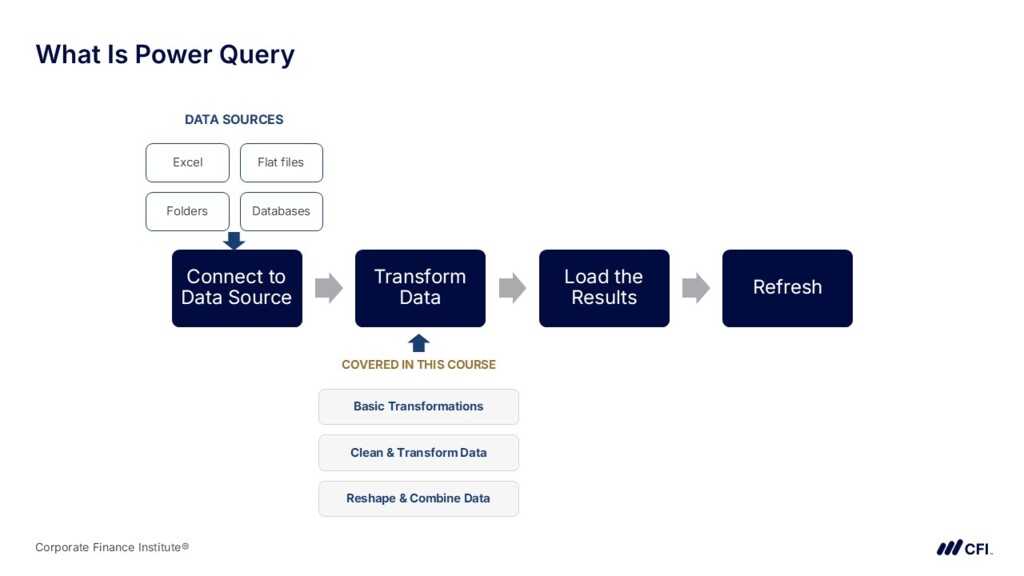
As the curriculum advances into cleaning and transforming data, learners tackle common corporate data anomalies—such as handling null values, removing duplicate entries, splitting and merging columns, and standardizing text casing. These modules are vital for eliminating the data hygiene issues that frequently compromise downstream financial models and executive dashboards.
The subsequent phase focuses on reshaping and combining data. Here, students master advanced table operations, including unpivoting cross-tabulated reports, appending multiple datasets with matching schemas, and merging tables using relational database logic similar to SQL joins.
The pedagogical peak of the course centers on building repeatable workflows. By emphasizing how Power Query records every applied step in an editable sequence, the curriculum teaches students how to future-proof their reporting structures. When source data is updated or replaced, analysts can simply refresh the query, instantly executing hours of historical manual formatting in a matter of seconds.
The course concludes with a comprehensive wrap-up and a qualified assessment. To successfully earn their certificate of completion, students must pass an online examination comprising multiple-choice questions, fill-in-the-blanks, and practical Excel-based challenges, requiring a minimum passing score of 80 percent.
Integration Within Professional Certification Pathways
Rather than standing alone as an isolated technical tutorial, the Introduction to Power Query course has been strategically integrated into several of CFI’s most prestigious professional development programs. These include the Business Essentials Certificate, the Data Analysis in Excel Specialization, the Business Intelligence Analyst Specialization, and the Financial Planning & Analysis (FP&A) Professional program.
By embedding Power Query training into these broader credentials, CFI ensures that modern finance and data professionals possess a standardized toolkit for modern corporate environments. Graduates of these specializations not only demonstrate proficiency in financial modeling and strategic forecasting but also validate their ability to manage large-scale data ingestion pipelines efficiently.
Furthermore, many of these programs qualify for Continuing Professional Education (CPE) credits, aligning with standards maintained by the National Association of State Boards of Accountancy (NASBA) in the United States and CPA institutions in Canada. This accreditation adds substantial professional value for certified public accountants and chartered accountants seeking to fulfill annual continuing education requirements while simultaneously upgrading their technical skill sets.
Target Audience and Software Prerequisites
Designed with professional accessibility in mind, the course caters to a diverse demographic of learners. Absolute beginners seeking to learn Power Query from scratch will find the step-by-step methodology approachable, while seasoned Excel and Power BI users can utilize the curriculum to formalize their knowledge and adopt industry best practices. Additionally, finance professionals, accountants, and business analysts bogged down by manual reporting cycles are identified as primary beneficiaries of the workflow automation techniques taught in the syllabus.
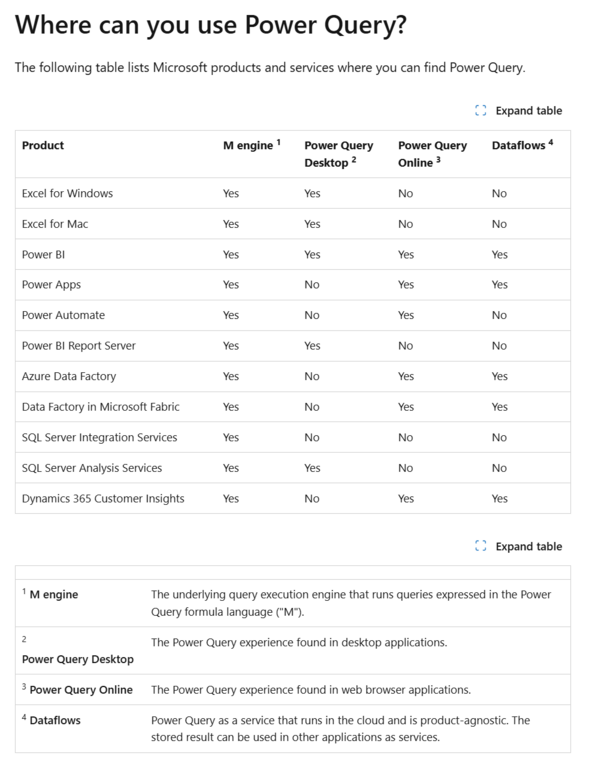
From a technical standpoint, the course requires access to a personal computer (PC or Mac) running a stable internet connection and Microsoft Office suite version 2016 or newer, or Microsoft Power BI. Because Microsoft deploys Power Query differently across various platforms and operating systems, CFI advises participants to verify software feature availability using official Microsoft documentation prior to enrollment.
Student Reception and Industry Implications
Since its release, the course has drawn positive feedback from early participants who have integrated the curriculum into their daily professional routines. Alumni have noted that the transition from legacy data-cleaning methods to Power Query-driven workflows has dramatically reduced report generation times and minimized human error in financial analyses.
Industry analysts observing the launch point to broader implications for the corporate workforce. As automation, artificial intelligence, and advanced business intelligence tools continue to permeate corporate finance departments, the baseline definition of financial literacy is evolving. Traditional spreadsheet proficiency—once measured primarily by mastery of formulas and pivot tables—now increasingly encompasses data engineering fundamentals, such as query building, data modeling, and automated ETL processes.
By equipping analysts with these vital capabilities, courses like CFI’s Introduction to Power Query play a pivotal role in shifting the corporate workforce away from low-value administrative tasks. When analysts are liberated from the drudgery of manual data cleaning, they can redirect their intellectual capital toward higher-level strategic advisory, predictive analytics, and enterprise decision-making.
Enrollment, Accessibility, and Support Options
The Introduction to Power Query course is currently available through CFI’s flexible online learning portal under its standard subscription and pricing models. Enrolled students receive yearly access to course materials, downloadable Excel files, practical modeling templates, and self-paced video modules.
Depending on the chosen enrollment bundle—such as self-study versus full immersion packages—students can also access premium features like direct email support from in-house financial and technical experts. This support mechanism enables learners to bridge the gap between academic exercises and the specific, idiosyncratic datasets they encounter in their respective workplaces.
As businesses continue to navigate data-saturated operational environments, mastery over tools that streamline data ingestion and transformation will remain a definitive career differentiator. Through this targeted educational offering, the Corporate Finance Institute continues to reinforce its commitment to practical, career-advancing training for the modern finance and analytics professional.
Related posts: