Navigating CRM Data Privacy: Essential Frameworks, Compliance Strategies, and Implementation Roadmaps for 2026

The global average cost of a data breach reached a staggering $4.99 million in 2026, according to recent findings from the IBM Cost of a Data Breach Report. For modern enterprises heavily reliant on Customer Relationship Management (CRM) platforms to store, track, and analyze client lifecycles, this figure represents an immediate and pressing operational vulnerability. Because CRMs are specifically designed to centralize and manage sensitive client details, any security compromise instantly exposes the core repository of customer information that these systems are meant to safeguard.
Furthermore, data privacy has evolved from a back-office legal obligation into a primary driver of consumer trust and brand equity. In an increasingly interconnected global economy, regulatory frameworks such as the General Data Protection Regulation (GDPR) in Europe and the California Consumer Privacy Act (CCPA) in the United States require rigid adherence to data handling protocols. Failure to establish robust internal controls can lead not only to catastrophic regulatory fines but also to irrecoverable reputational damage among key enterprise buyers.
Understanding CRM Data Privacy Versus CRM Security
To properly address vulnerabilities within a customer database, organizations must first distinguish between CRM data privacy and CRM security. While these two concepts heavily overlap, they govern fundamentally different aspects of information management. CRM security focuses on the technical and organizational safeguards designed to protect data from unauthorized access, accidental alteration, or malicious loss. This includes foundational layers such as encryption, multi-factor authentication (MFA), and single sign-on (SSO) protocols.
Conversely, CRM data privacy governs whether, why, and how personal data may be collected, processed, stored, shared, and ultimately deleted. An organization can maintain impeccable technical security controls—such as military-grade encryption and strict perimeter defenses—yet still violate privacy mandates if sales or marketing teams utilize customer data for unauthorized purposes or retain it longer than legally permitted.
Recent industry research underscores the commercial importance of bridging this gap. The Cisco Data and Privacy Benchmark Study revealed that 46% of surveyed business leaders identified clear, transparent communication regarding data usage as the single most effective action an enterprise can take to build consumer confidence. Consequently, transparent privacy workflows are no longer viewed merely as legal checkboxes, but rather as integral components of corporate trust and revenue generation.
The Evolution of Regulatory Pressures and Market Chronology
The modern era of CRM data privacy is rooted in a decade-long tightening of international regulatory standards. The implementation of the GDPR in May 2018 fundamentally shifted how global enterprises handle European citizens’ data, introducing severe financial penalties for non-compliance. Shortly thereafter, domestic frameworks such as the CCPA—which took effect in January 2020 and has since been expanded by the California Privacy Rights Act (CPRA)—forced companies operating in North America to adopt similar transparency and consumer opt-out mechanisms.
By 2024, the widespread commercial adoption of generative artificial intelligence introduced unprecedented complexity into customer data management. Sales teams began leveraging AI tools to automatically scrape, enrich, and draft outreach messaging using CRM data, frequently without standardized legal oversight. Recognizing these emerging risks, technology watchdogs and legal experts emphasized the necessity of embedding data governance directly into revenue operations (RevOps).
By 2026, the convergence of complex artificial intelligence capabilities and sophisticated cyberthreat vectors pushed enterprise boards to reevaluate their entire software stacks. According to the Verizon Data Breach Investigations Report, third-party software integrations accounted for nearly half of all security incidents, with supply-chain vulnerabilities rising sharply year over year. These macro-level developments have made comprehensive CRM data governance an imperative for survival in the digital marketplace.
Essential CRM Data Privacy Features Required in Modern Tech Stacks
When evaluating or upgrading a CRM platform, compliance, legal, and RevOps teams must demand a specific suite of native privacy features. These tools must support both complex regulatory workflows and day-to-day sales productivity without creating operational bottlenecks.
Consent and Preference Management
A comprehensive CRM must include native capabilities to track the legal basis for processing personal data. Whether an organization relies on explicit consent, legitimate interest, or contractual necessity, the system should record what the individual agreed to, the source of the collection, and the date of consent. Furthermore, preference centers must empower customers to easily modify their communication subscriptions across multiple channels, with changes automatically synchronizing to downstream sales and marketing workflows.
Roles, Permissions, and Least-Privilege Access
To mitigate insider threats and accidental data exposure, modern CRMs must utilize least-privilege access models. This principle ensures that users receive only the exact permissions required to perform their specific job functions. Administrators should have the ability to restrict access at the object, record, export, and property levels. For instance, Sales Development Representatives (SDRs) might require edit access to contact records within an assigned geographic territory, while master export permissions and access to highly sensitive data classes remain strictly limited to compliance officers and system administrators.
Comprehensive Audit Logs and Change History
Accountability requires visibility. Enterprise-grade CRMs must maintain detailed audit trails that track who modified a record or configuration, when the change occurred, and what specific alterations were made. Furthermore, security teams should configure automated alerts for high-risk activities, such as exceptionally large data exports or unexpected administrative permission changes, allowing them to investigate potential insider breaches immediately.
Data Minimization and Automated Retention Policies
In alignment with global privacy regulations, organizations should collect only the personal data necessary for a clearly defined business purpose. Modern CRMs must support automated data hygiene rules, allowing administrators to configure scheduled reviews and secure deletions for stale or inactive contacts. Automated retention rules reduce the burden on manual database maintenance while ensuring the organization does not hold personal data indefinitely.
Robust Encryption, SSO, and MFA Protocols
Data must be continuously protected both in transit and at rest using industry-standard cryptography, such as Transport Layer Security (TLS 1.2 or 1.3) and Advanced Encryption Standard (AES-256). Additionally, identity management must be secured via SAML-based single sign-on and mandatory multi-factor authentication for all platform users, effectively closing off common vectors for credential-stuffing attacks.

Executing a Repeatable Data Subject Request (DSR) Workflow
As consumer awareness regarding data rights grows, enterprises face an increasing volume of Data Subject Requests (DSRs). These include requests for data access, correction, portability, and complete deletion. Because statutory response deadlines are strictly enforced—typically ranging from 30 days under the GDPR to 45 calendar days under the CCPA—organizations must establish a standardized, three-step DSR operational workflow.
-
Intake and Identity Verification: When a request is received through a designated privacy portal or support channel, the privacy operations team must immediately log the inquiry, send a formal acknowledgment, and perform proportionate identity verification to prevent unauthorized data exposure or malicious deletion requests.
-
Location, Review, and Redaction: Once verified, privacy teams must locate all personal data associated with the individual across the CRM and any connected third-party systems, utilizing a maintained system-of-record map. Legal counsel must then review the data to determine if statutory exceptions or mandatory retention obligations apply before fulfilling the request.
-
Fulfillment, Documentation, and Closure: The requested action—whether providing a machine-readable export for data portability or executing a secure deletion—must be completed through secure channels. All actions, dates, and legal justifications must be meticulously documented in a centralized DSR audit log for future regulatory review.
Mitigating Risks in Third-Party Integrations and Artificial Intelligence
The modern revenue stack rarely consists of a standalone CRM. Most organizations utilize dozens of connected applications, ranging from automated dialers and email engagement platforms to customer data platforms and AI-driven writing assistants. Each integration represents a potential conduit for data leakage if left ungoverned.
Organizations must institute a rigorous vetting process for all third-party marketplace applications. This includes auditing requested OAuth scopes to ensure apps only request permissions strictly necessary for their core functionality, verifying data hosting and residency locations, and reviewing vendor data processing agreements (DPAs).
Concurrently, the rapid deployment of artificial intelligence within CRMs requires strict administrative boundaries. AI features used for automated lead scoring, sentiment analysis, or email generation must be configured with explicit purpose limits. Crucially, sensitive data fields should be completely blocked from AI training models, and human-in-the-loop review processes must be enforced to ensure customer-facing AI communications remain accurate, professional, and fully compliant with regulatory standards.

A Phased Implementation Roadmap for Revenue Operations
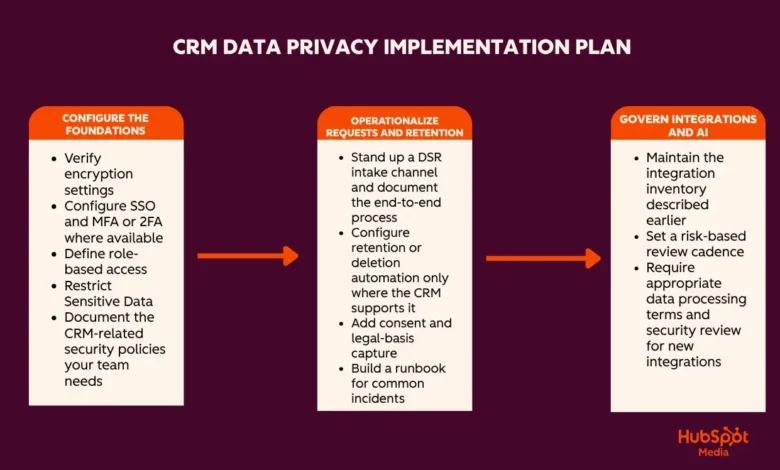
Organizations seeking to overhaul their CRM data privacy posture can adopt a structured, three-phase implementation roadmap designed to transition foundational controls into sustainable operational disciplines.
Phase 1: Configure the Foundations
Begin by locking down baseline security infrastructure. Enable mandatory multi-factor authentication across all user tiers, configure SAML-based single sign-on, and establish a comprehensive user role matrix enforcing least-privilege access. Simultaneously, conduct an initial data hygiene sweep to eliminate duplicate records, standardize data entry formats, and archive outdated contact lists in accordance with baseline retention policies.
Phase 2: Operationalize Requests and Retention
Transform theoretical privacy policies into active workflows. Establish a dedicated DSR intake queue and train support teams on identity verification protocols. Implement automated consent-capture fields on inbound lead generation forms and configure automated record deletion rules for inactive database segments, ensuring all processes align closely with corporate legal counsel guidance.
Phase 3: Govern Integrations and AI
Finalize an exhaustive integration inventory documenting every third-party application connected to the CRM, including designated internal owners and scheduled review cadences. Roll out organizational policies governing the use of artificial intelligence within sales workflows, ensuring continuous monitoring, restricted data access, and thorough audit logging for all automated actions.
Conclusion: Privacy as a Competitive Advantage
CRM data privacy has firmly transitioned from an isolated legal requirement into a critical operational discipline that directly influences enterprise valuation, risk management, and customer retention. By implementing rigorous access controls, maintaining transparent consent workflows, governing third-party integrations, and establishing repeatable DSR response mechanisms, organizations can successfully protect sensitive client data. Ultimately, companies that master CRM data privacy do more than simply avoid costly regulatory penalties—they build enduring trust with their customers, positioning themselves for sustainable growth in an increasingly security-conscious global market place.
Related posts: