Navigating the AI Scaling Divide: Insights from RingCentral’s Agentic AI Trends 2026 Report


The corporate adoption of artificial intelligence has officially transitioned from an exploratory phase into a mandatory operational strategy. According to recent findings from RingCentral’s comprehensive Agentic AI Trends 2026 report, the question facing modern enterprises is no longer whether they should integrate artificial intelligence into their workflows, but precisely how they should execute and scale those deployments. The empirical data indicates that 86% of surveyed organizations have established a long-term artificial intelligence strategy, while 83% have already successfully launched at least one initiative.
Despite this widespread enthusiasm and high baseline adoption, the research highlights a complex landscape characterized by significant variance in organizational methodology, deployment velocity, and evaluation metrics. By surveying 2,000 global respondents, the study provides a granular look at how different sectors are navigating the technological shift. While the findings do not establish a rigid leaderboard of buyer readiness, they successfully map out distinct maturity models across four key industries: Financial Services, Technology, Healthcare, and Retail. For executive leadership teams, these insights offer a crucial benchmark for evaluating internal progress, re-evaluating risk tolerances, and mapping out subsequent phases of digital transformation.
Strategic Objectives and the Pursuit of Multi-Faceted Goals

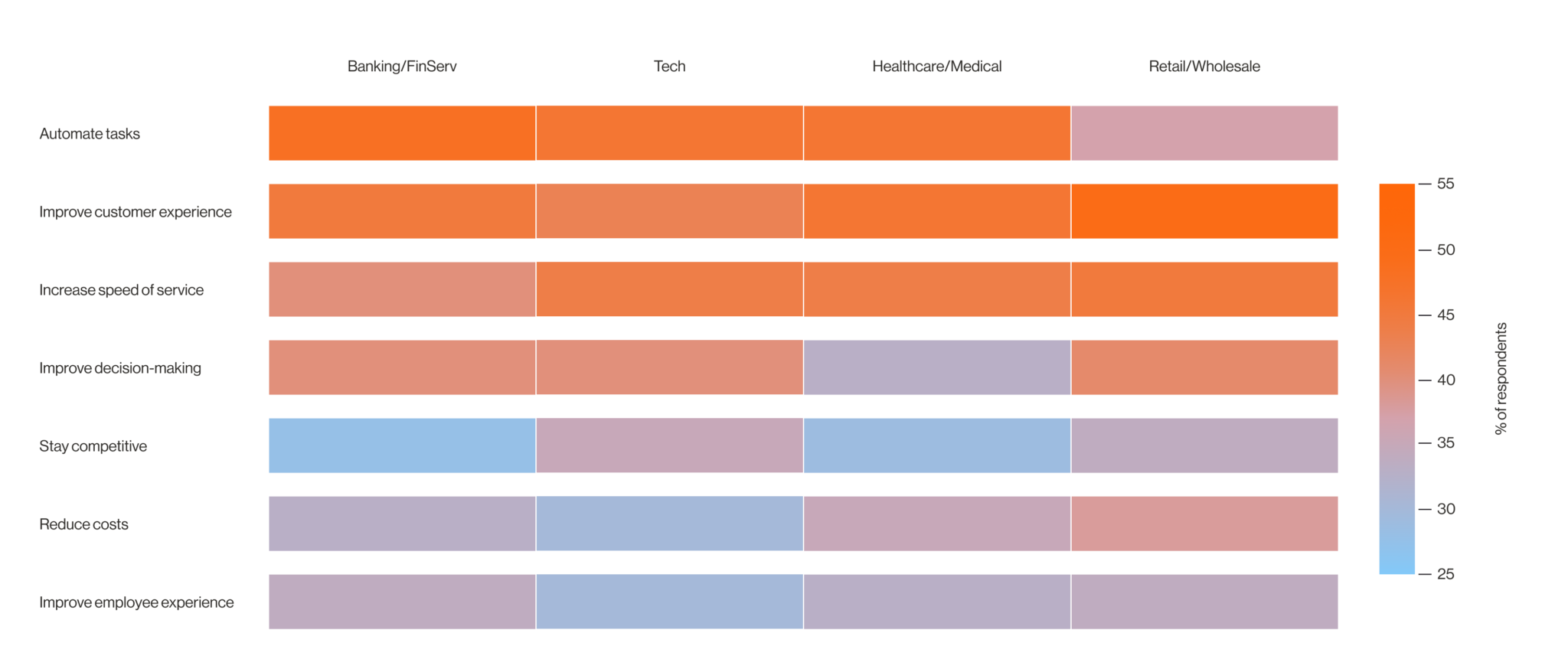
To accurately measure organizational maturity, it is essential to first examine what enterprises actually expect artificial intelligence to accomplish. Among the 1,716 respondents who reported having a defined long-term artificial intelligence strategy, the primary objectives clustered around several high-impact operational areas.
Respondents were permitted to select multiple answers, a trend that underscores a prevailing corporate mindset: many organizations still view artificial intelligence as an all-encompassing, silver-bullet solution capable of solving diverse operational bottlenecks simultaneously. Analysts suggest this broad spectrum of goals may indicate that numerous companies rushed to establish a high-level artificial intelligence strategy before defining the narrow, prioritized use cases necessary to guide efficient capital allocation.
Among the leading objectives cited in the research, the top three priorities heavily emphasized enhancements to the customer experience. Consequently, enterprise contact centers have organically emerged as the primary proving grounds for early deployments. Simultaneously, enterprise-wide task automation ranked prominently, aligning cleanly with the foundational capabilities of modern machine learning models and generative systems. However, as the data reveals, these overarching priorities begin to diverge significantly when segmented by specific industry verticals.
Deployment Velocities and Industry-Specific Complexities

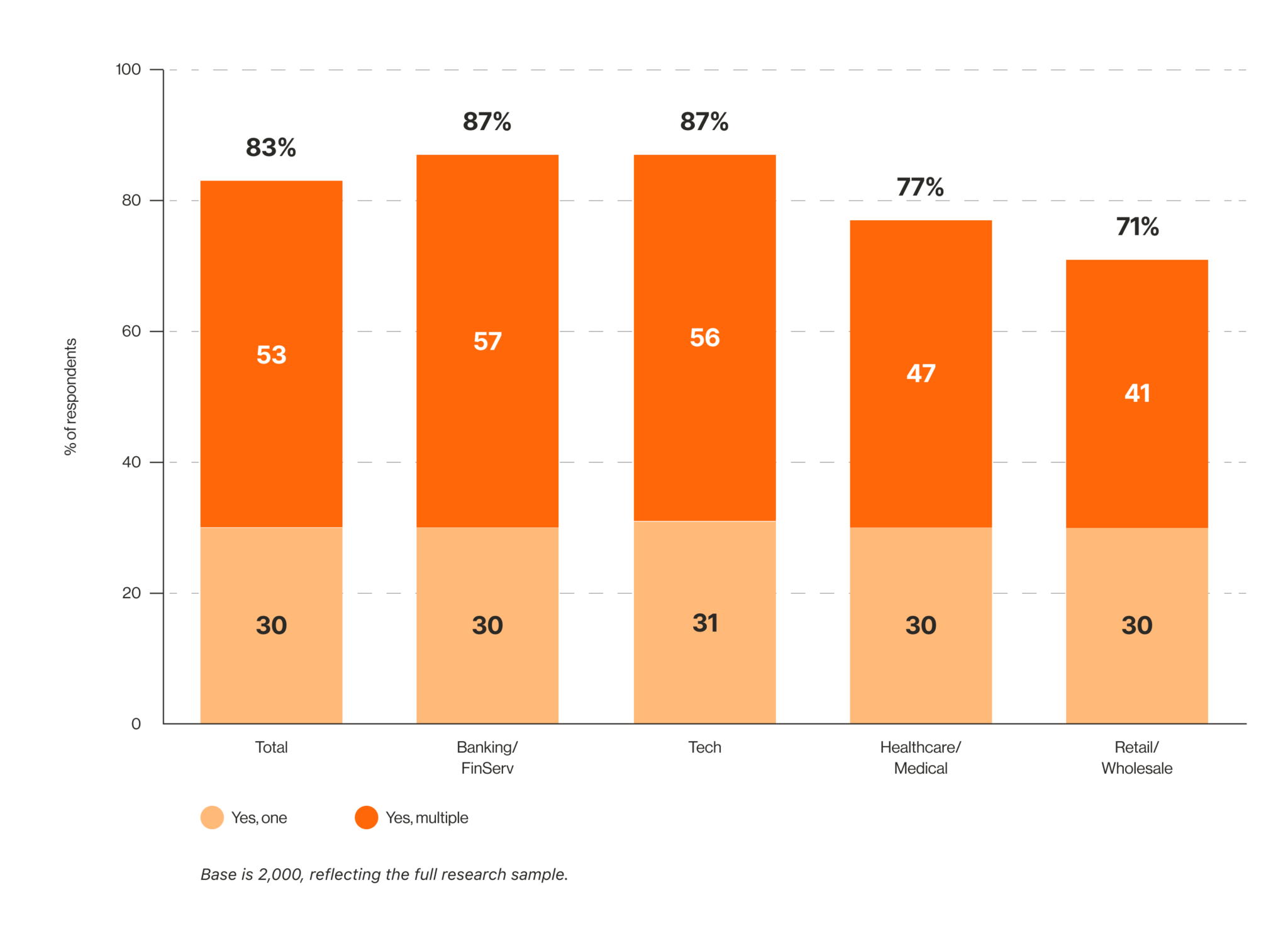
When analyzing deployment indicators, the research reveals that 83% of participating organizations have transitioned from strategy to execution by launching at least one artificial intelligence initiative, with 53% having rolled out multiple projects concurrently. A sectoral breakdown shows the Technology and Financial Services sectors taking an early lead, with 87% of respondents in each vertical reporting at least one active deployment. Conversely, adoption figures trail slightly in Healthcare and Retail, registering at 77% and 71%, respectively.
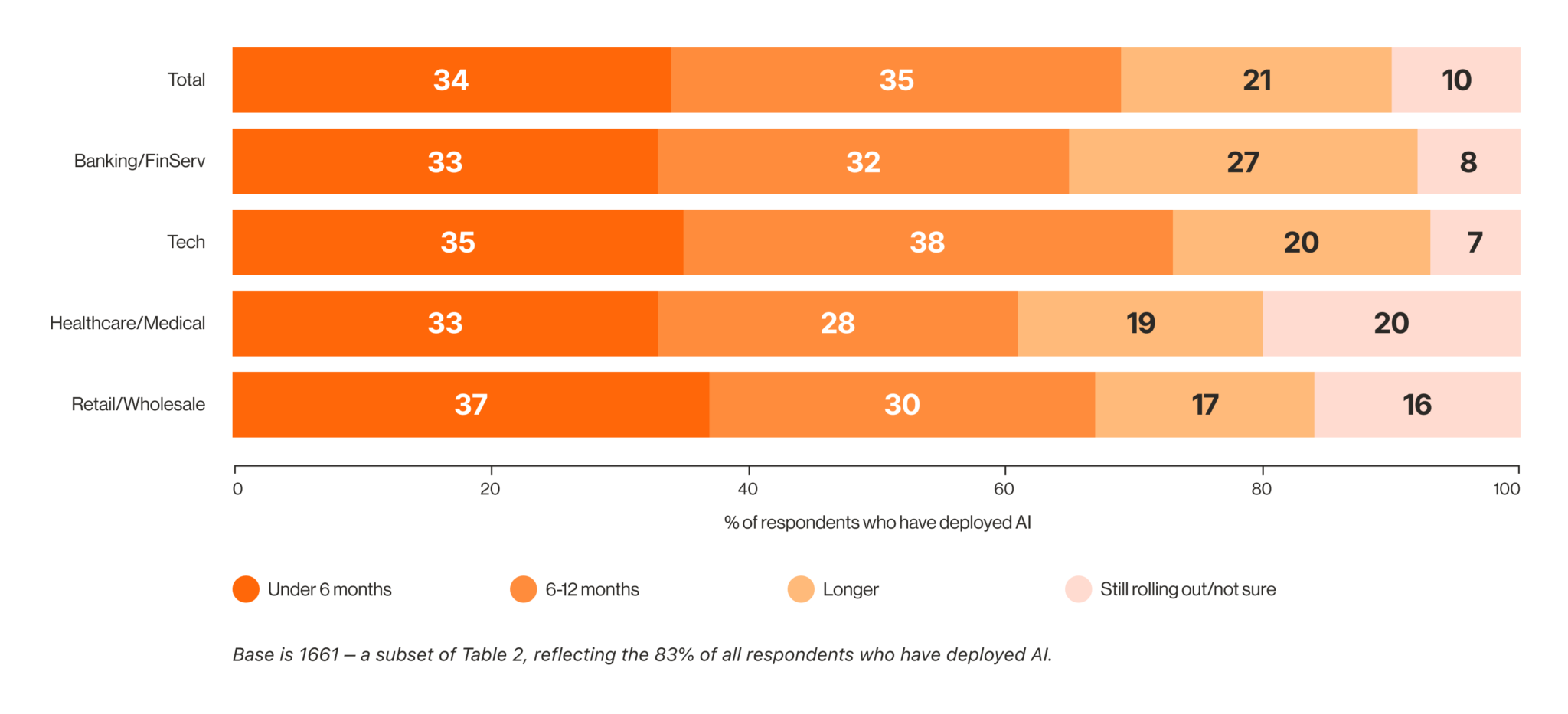
Speed to market has frequently been hailed as a primary metric of corporate innovation, with the data showing that 69% of organizations deployed their first artificial intelligence initiative within a twelve-month window. Yet, corporate leaders caution against viewing deployment speed as a unilateral sign of operational maturity. Industry-specific regulatory environments dictate vastly different implementation timelines.
In the Financial Services sector, 27% of respondents indicated that their initial deployment required more than a year to complete. Strict regulatory frameworks, compliance mandates, and the handling of highly sensitive financial records necessitate a deliberate, methodical pace. Such measured implementation is widely regarded as a hallmark of mature governance rather than sluggishness.
A nearly identical pattern emerges within the Healthcare sector, where 39% of respondents reported that their initial deployments took longer than a year or remained ongoing. The stringent demands of patient privacy regulations, electronic health record integration, and clinical validation naturally extend project timelines.
In contrast, the Retail sector demonstrated a much faster implementation cycle, with 37% of respondents deploying their initial solutions in under six months. This rapid velocity is largely attributed to the relative simplicity and lower regulatory friction of early retail use cases, which typically focus on customer service chatbots, inventory forecasting, and localized marketing personalization.
Time to Return on Investment (ROI) and Digital Workforce Integration
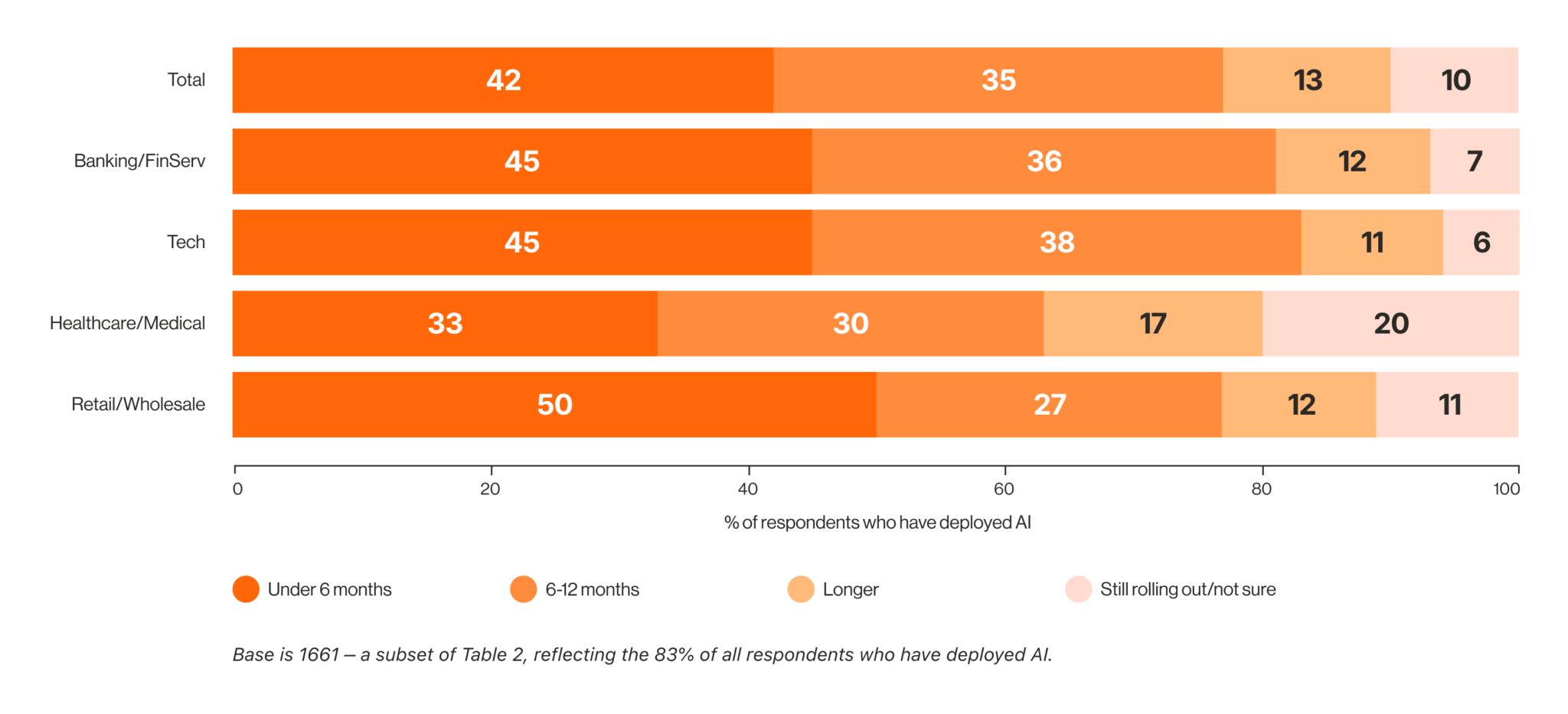
Beyond initial deployment speeds, corporate boards are increasingly scrutinizing the timeline for realizing tangible financial returns. Among organizations that have successfully deployed artificial intelligence solutions, an impressive 77% reported securing a measurable return on investment within the first year of operation. Notably, Financial Services and Technology reported the quickest fiscal paybacks, despite exhibiting stark differences in their initial deployment velocities.
Conversely, the Healthcare sector experienced unique measurement hurdles; 20% of healthcare respondents reported that they had either not yet observed a clear return on investment or remained uncertain of its status. Experts note this friction likely stems from the inherent difficulty of quantifying qualitative outcomes—such as improvements in patient care quality and clinical workflow efficiency—against standard financial key performance indicators used in traditional commercial sectors.
To gauge deeper operational integration, researchers tracked the deployment of autonomous digital workers. In Financial Services and Technology, 43% of respondents reported either deploying digital workers at scale or fully embedding them across core business operations. Meanwhile, adoption rates for digital workers stood at 28% for Healthcare and 32% for Retail. This deeper integration places Technology and Financial Services further along the enterprise maturity curve, transitioning from simple task automation to complex operational augmentation.
Performance Satisfaction, Course Correction, and the Value of Failure
Perhaps the most counterintuitive finding in the RingCentral report centers on the relationship between user satisfaction and project cancellations. Overall sentiment regarding artificial intelligence performance remains exceptionally high, with 92% of respondents reporting they were either very or somewhat satisfied with their deployments. The Technology sector recorded the highest overall satisfaction rate at 95%, accompanied by a negligible neutral response rate of just 3%.
However, this high degree of satisfaction coexists with a substantial rate of strategic course correction. Across the entire survey base, 42% of respondents reported that their organizations had either paused or canceled at least one artificial intelligence initiative. The Technology sector led this metric significantly, with 54% of respondents reporting canceled or paused projects, followed closely by Financial Services.
At first glance, a high rate of project termination might appear to signal technological failure or poor strategic planning. However, industry analysts interpret this data through a completely different lens. Technology companies typically run a higher volume of concurrent initiatives, inherently giving them more opportunities to test boundaries, identify underperforming models, and ruthlessly reallocate capital away from weak projects.
Consequently, the willingness to pause or cancel a problematic deployment indicates a high degree of organizational maturity and risk management readiness, rather than a lack of capability. Organizations that stubbornly press forward with flawed implementations often suffer from sunken-cost fallacies. In contrast, Healthcare and Retail reported lower rates of canceled initiatives, which—when paired with their lower overall deployment volumes—suggests a more risk-averse posture wherein organizations only greenlight projects with near-guaranteed outcomes.
Broader Implications for Enterprise Leaders
Synthesizing the empirical data, the research firmly positions the Technology sector at the vanguard of the artificial intelligence maturity curve, closely shadowed by Financial Services. Technology enterprises successfully navigate the technological landscape through aggressive experimentation and active course correction, whereas Financial Services organizations balance broad-scale deployment with rigorous regulatory governance.
Meanwhile, Healthcare and Retail continue to carve out distinct trajectories dictated by their unique operating environments. Healthcare navigates profound data complexity and regulatory scrutiny, while Retail leverages technological agility to optimize customer engagement and trim operational expenditures.
Ultimately, the findings challenge legacy assumptions carried over from previous enterprise software cycles. Rapid deployment velocity does not inherently equate to corporate maturity, nor does it guarantee a faster financial return. Instead, true enterprise readiness is demonstrated through deliberate governance, realistic priority setting, and the organizational flexibility required to execute timely course corrections. As business leaders look toward the remainder of the decade, the ability to align technological capabilities with industry-specific realities will dictate which enterprises successfully cross the artificial intelligence scaling divide.
Related posts: