Optimizing Contractor Communication: How Intelligent Answering Services Drive Growth and Customer Satisfaction


The daily rhythm of a trades business owner often involves a precarious balancing act: hands-on work in a crawlspace, scaling a ladder forty feet high, or navigating between job sites. These are moments when the phone, an essential lifeline to new business, frequently rings unanswered. A homeowner with a burst pipe or a malfunctioning air conditioning unit rarely leaves a voicemail, opting instead to quickly dial the next contractor in their search results. This immediate shift of customer attention represents a silent but significant drain on revenue, a daily calculus where every hour spent on a job site can translate into a lost opportunity. Unlike office-based enterprises that can staff a dedicated front desk, the itinerant nature of contracting work makes a traditional receptionist impractical, highlighting a critical gap in customer service and lead capture.
The Digital Demand: Shifting Customer Expectations in the Service Economy
In today’s hyper-connected world, customer expectations for immediate service have never been higher. The rise of the "on-demand" economy has conditioned consumers to expect instant gratification, a trend that profoundly impacts the home services sector. When a homeowner faces an urgent issue, such as a heating system failure in winter or a plumbing emergency, their primary concern is rapid resolution. The tolerance for delays, even a brief wait for a callback, has diminished considerably. This immediacy is not merely a preference; it has become a baseline expectation, fundamentally reshaping how contractors must engage with potential clients.
The competitive landscape further amplifies this urgency. Online search engines and review platforms have empowered consumers with unprecedented access to a multitude of service providers. A simple search yields dozens of options, making the decision-making process swift and often based on the first positive interaction. If a call goes unanswered, or if the experience is anything less than seamless, the customer moves on to the next name without hesitation. This "next-door neighbor" effect, where a missed call means the job goes to a competitor literally seconds later, underscores the profound impact of communication efficiency on business success. For contractors, failing to adapt to these evolving digital demands is not just an inconvenience; it is a direct threat to their market share and profitability.
Quantifying the Loss: The Stark Reality for Contractors
The financial implications of missed calls extend far beyond anecdotal frustrations. Data consistently reinforces what contractors instinctively feel: a missed call is almost always a lost job. Research from call analytics firms, such as Invoca, provides a sobering perspective, indicating that fewer than 3% of callers directed to a service business’s voicemail actually leave a message. This statistic is critical; it means that for every 100 calls sent to voicemail, 97 opportunities vanish without a trace. There’s no message to return, no lead to follow up on, and often, no awareness that a potential job ever existed. The invisibility of these lost opportunities makes them particularly insidious, as contractors cannot address a problem they don’t even know they have.
Beyond the sheer volume of lost calls, the speed of response is paramount. Studies show that customers who receive a response within five minutes are significantly more likely to engage with a business than those who wait longer. In the trades, where service and repair calls are frequently time-sensitive emergencies, this urgency is compounded. A customer with a burst pipe in their home is not patiently waiting for a return call; they are actively seeking an immediate solution. The average value of a single service call in trades like plumbing or HVAC can range from several hundred to several thousand dollars, depending on the complexity of the job. Accumulate these lost opportunities over weeks and months, and the financial impact on a small to medium-sized contracting business becomes substantial, potentially hindering growth, investment in new equipment, or hiring additional staff. The cumulative effect of these seemingly small, individual missed connections can represent hundreds of thousands of dollars in lost revenue annually for many businesses, transforming a minor operational oversight into a major financial liability.
Evolution of Communication: From Traditional Receptionists to Intelligent Automation
The history of call answering solutions reflects a broader technological progression, mirroring the needs of businesses adapting to changing communication landscapes. For decades, the traditional model relied on in-house receptionists, a luxury many small contractors could ill afford or logically accommodate given their mobile operations. This led to the emergence of basic live answering services, which offered a human voice to answer calls outside of business hours or during peak times. While an improvement, these services often lacked integration with a contractor’s specific scheduling or customer relationship management (CRM) systems, leading to disjointed customer experiences and potential information inaccuracies.
The late 20th and early 21st centuries saw the introduction of virtual assistants and more sophisticated call centers, but these often struggled with the unique, often urgent, and varied demands of the trades. The inflexibility of early automated phone trees frequently frustrated callers, leading to the "press 1 for this, press 2 for that" fatigue that many consumers still dread.
However, the advent of artificial intelligence (AI) and natural language processing (NLP) in the mid-2010s marked a paradigm shift. AI-powered answering services moved beyond rigid scripts, capable of understanding context, intent, and even emotional cues in a caller’s voice. This technological leap enabled automated systems to perform tasks previously reserved for human agents, such as intelligent call routing, data capture, and direct appointment scheduling. For the trades industry, this evolution offered a scalable, reliable, and increasingly sophisticated solution to the perennial problem of missed calls, transforming the basic act of answering the phone into a strategic advantage for job capture and customer retention. The timeline of this evolution demonstrates a clear trajectory: from basic human proxies to highly intelligent, integrated communication hubs.
Tailored Solutions: Addressing the Unique Demands of Trades Businesses
An effective answering solution for the trades must go beyond generic call handling. Contractors operate under conditions far removed from the predictable rhythm of an office-based business. Calls can come in from a truck cab, between appointments, or in the midst of a complex repair, covering a wider range of urgency and intent than most service businesses ever encounter. Therefore, an answering system built for the trades must be capable of intelligently sorting and managing three distinct call types without causing delays or miscommunications.
First are emergency and same-day repair requests. A "no-heat" call in the dead of winter or a "flooding basement" report doesn’t fit into next week’s schedule; these callers require immediate assurance that their plea has been heard and that help is en route. An answering service must possess the capability to recognize urgency from the initial seconds of the conversation, whether through specific keywords or the caller’s tone, and route the call to the fastest available response channel. Treating a crisis as a routine scheduling inquiry can not only cost a valuable job but also severely damage the kind of trust that fuels referrals in the trades.

Second, there are routine scheduling and estimate inquiries. Not every call is a crisis. A homeowner might be seeking a quote for a kitchen remodel, or an existing customer might need to confirm an upcoming appointment. These calls necessitate accurate capture of vital information: the caller’s name, contact details, service required, address, and preferred timeframes. The ideal scenario ensures all information is logged precisely, preventing the customer from having to repeat themselves during a callback. This is often where basic answering services falter, as a rushed or inaccurate intake—a misspelled address or a skipped callback number—can transform a promising estimate request into a lost booking.
Finally, vendor and supplier calls constitute a significant portion of incoming traffic. Not every call originates from a customer. Suppliers confirming delivery windows, subcontractors checking on schedule adjustments, or municipal permit offices following up on inspections all compete for the same phone line as customer leads. An effective answering setup must differentiate between these internal or logistical calls and customer inquiries. Failing to do so can either unnecessarily interrupt a crew focused on a job or, worse, bury a genuine customer lead under low-priority traffic. Correctly sorting these calls ensures that field teams remain focused on their work, while essential operational communications are still managed efficiently.
A Deep Dive into Answering Service Models: Live, AI, and Hybrid Approaches
Contractors evaluating call management options are essentially choosing between three primary models, each presenting a distinct set of benefits and tradeoffs that must be carefully weighed against their specific operational needs, call volume, and budget.
Live Answering Services
These services route incoming calls to trained human agents, who typically operate using predefined scripts for common scenarios.
- Benefits: Live agents excel at handling nuance, empathy, and improvising in response to unusual or highly emotional requests. This includes calming a panicked homeowner during a gas leak, negotiating a same-day slot for a VIP client, or discerning a subtle emergency based solely on a caller’s tone. Trained agents can also accurately quote prices, cross-sell maintenance plans, or recognize repeat customers if they are well-versed in the contractor’s business. The human touch can build rapport and trust, which is invaluable in customer service.
- Tradeoffs: The primary drawback is cost; live agents are generally more expensive per call or per minute than automated options. Quality can also be inconsistent, varying significantly between agents and depending on their familiarity with a specific contractor’s services, service area, and pricing. High turnover rates within answering services mean contractors might frequently be paying for new agents to get up to speed. Furthermore, peak periods, such as storm seasons or extreme weather events, can overwhelm live services, leading to longer hold times or calls being routed to voicemail precisely when fast responses are most crucial.
AI Answering Services
Leveraging advancements in artificial intelligence and natural language processing, AI answering services answer every call consistently, at any hour, without hold times or concerns about agent turnover.
- Benefits: The cost per call is typically lower and highly predictable, as there are no staffing fluctuations during busy periods, no overtime for after-hours calls, and no ramp-up time for new hires. Modern AI systems have matured significantly, moving beyond rigid phone trees to context-aware interfaces that callers find less frustrating. They can access knowledge bases to answer FAQs about service areas or pricing, directly schedule appointments into a digital calendar, and intelligently triage urgent jobs (e.g., a burst pipe, no heat in freezing temperatures) for immediate human callback, rather than placing them in a generic queue. AI offers unparalleled consistency and scalability.
- Tradeoffs: While highly capable for structured scenarios like booking, triage, and lead capture, AI may still struggle with highly unusual, complex, or deeply emotional calls. A caller describing a multi-faceted problem, engaging in complex negotiation, or expressing extreme frustration about a botched job might push the system beyond its current capabilities, necessitating a human handoff. Contractors relying solely on AI must ensure a clear fallback mechanism, such as a live transfer option or a guaranteed same-day callback, to prevent these critical calls from reaching a dead end.
Hybrid Models
Hybrid models combine the strengths of both AI and live agents, utilizing AI for initial contact and routine data capture, and escalating complex or high-stakes calls to human agents.
- Benefits: This approach offers the best of both worlds. AI provides immediate answers and efficiently captures basic information—caller name, job type, address, urgency—ensuring nothing is missed during off-hours or call spikes. Live agents then step in for situations that genuinely require human judgment: an angry customer, a detailed pricing negotiation, or a job that doesn’t fit standard categories. Contractors benefit from consistent, round-the-clock intake without sacrificing the crucial human touch for calls where it matters most.
- Tradeoffs: This can be the most expensive option, as it layers the costs of live agents on top of an AI system. It also demands clear and robust escalation rules. Contractors must meticulously define which call types trigger a human handoff, as vague rules can lead to either an excessive number of unnecessary transfers (driving up costs) or too few (leaving complex issues unresolved by the bot). The initial setup and ongoing coordination are more complex than either standalone option.
The optimal choice among these models hinges on a contractor’s specific call volume, crew size, budget, and the proportion of their business derived from emergency versus routine work.
Beyond Answering: The Imperative of Job Capture and Seamless Integration
Simply answering the phone is merely the first step; the true measure of an answering service’s value lies in its ability to convert that initial contact into a confirmed job on the schedule. This is where many basic answering services, regardless of whether they employ live agents or automation, often fall short. The gap typically manifests in three critical areas: accuracy of information capture, speed of follow-up, and consistency across diverse operational contexts.
Accuracy of Information: Transcribing an address incorrectly, omitting a crucial callback number, or logging a job description too vaguely to be actionable can render an answered call just as unproductive as a missed one. These errors don’t appear in "call-answer-rate" metrics, but their financial impact can be equally devastating. Contractors who meticulously track job conversion rates often find that mishandled information leads to significant wasted effort and lost bookings, eroding trust and efficiency.
Speed of Follow-up: Even if job details are captured with perfect accuracy, delays in processing and acting upon that information can be fatal. Logging a job detail correctly but allowing it to sit unaddressed for six hours is almost as detrimental as a call that went straight to voicemail. In a competitive market where homeowners quickly move on to the next available option, immediate action is paramount. An effective system must not only capture data but also instantly transmit it to the relevant team member or integrate it directly into scheduling software for prompt follow-up.
Consistency Across Operations: The ability of an answering setup to maintain consistent performance across multiple crews, shifts, and locations is a critical benchmark. A system that works efficiently for one crew’s schedule but generates confusion or delays for a second or third truck isn’t truly solving the problem; it’s merely relocating it. True job capture requires a standardized process that ensures every call, regardless of when or where it originates, is handled with the same level of precision and efficiency. This ensures that every lead is pursued, every emergency addressed, and every routine inquiry managed consistently, thereby maximizing conversion rates and operational coherence.
Case Study: RingCentral AI Receptionist as a Modern Solution
For contractors navigating the challenges of field-based work, where a front desk is an impossibility and calls demand attention regardless of crew availability, solutions like the RingCentral AI Receptionist (AIR) present a compelling modern answer. AIR is designed to be the contractor’s perpetually available front office, automatically answering every incoming call. This ensures that a call during a complex installation, a late-night emergency, or a busy commute doesn’t simply ring out to voicemail, becoming another lost opportunity.
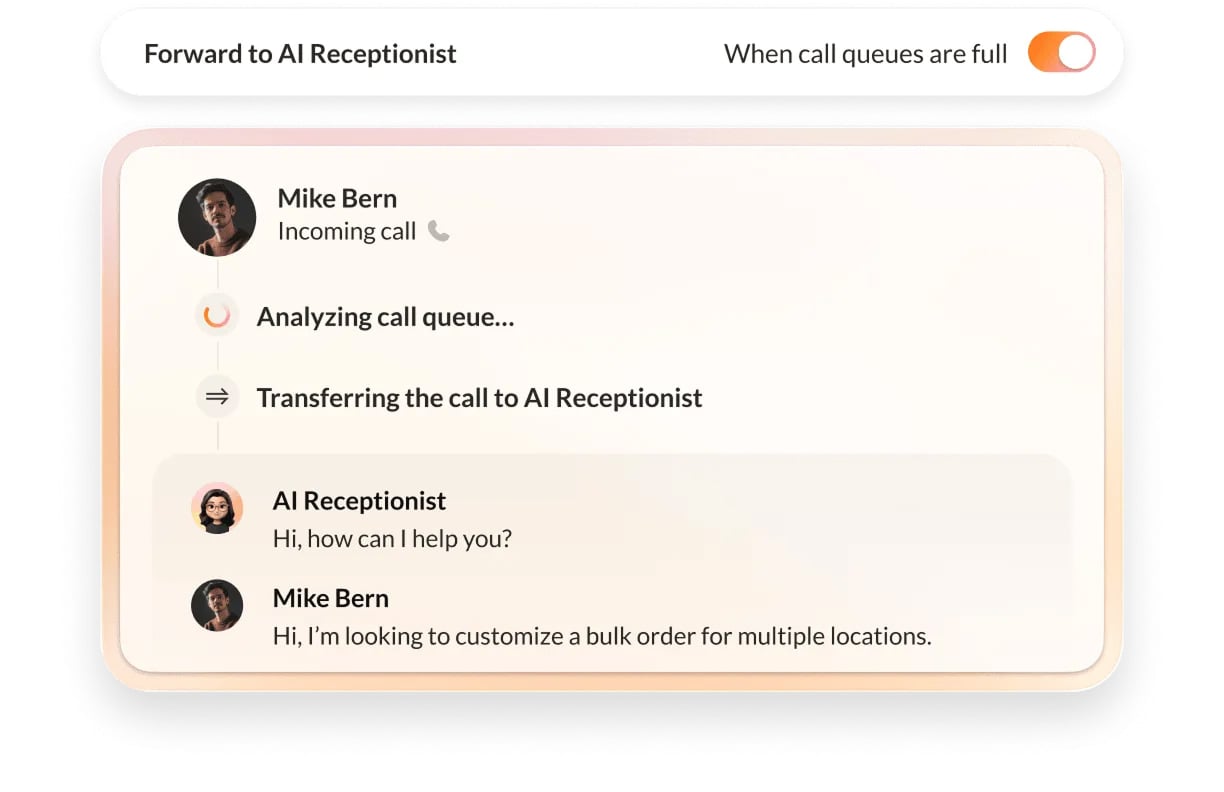
Instead of forcing callers through rigid, numbered menus, AIR utilizes context-aware routing driven by sophisticated AI. This allows the system to understand the caller’s intent and direct the call appropriately, whether it’s an urgent repair request, a routine scheduling inquiry, or a supplier confirmation. The AI’s ability to interpret natural language significantly improves the caller experience, reducing frustration and increasing the likelihood of successful engagement.
Critically, for calls that translate into business, AIR automates the capture of lead details. This eliminates the variability and potential for error associated with human agents trying to hear information over shop noise or during hurried conversations. Job information is accurately recorded and, importantly, AIR supports direct appointment scheduling during the call itself. This allows customers to book a specific time without the cumbersome process of callbacks, emails, or further phone tag, streamlining the conversion of interest into a confirmed job.
By handling every call with consistent precision, AIR ensures that intake processes are standardized across every shift, every location, and every crew. This directly addresses the inconsistency problem that often plagues basic answering setups, especially as a contracting business grows. The system provides a reliable, scalable, and intelligent communication hub, freeing contractors and their teams to focus on their core competencies—delivering quality service in the field—while knowing that every potential lead is being professionally managed.
Industry Perspectives and Future Outlook
The adoption of advanced answering services, particularly AI-driven solutions, is not merely a tactical improvement but a strategic imperative for contractors aiming for sustainable growth. Industry analysts project continued rapid growth in the market for AI-powered customer service tools, with the home services sector identified as a key beneficiary. "The competitive edge for contractors is no longer solely about craftsmanship; it’s increasingly about responsiveness and the seamless customer experience," notes a hypothetical analyst from a prominent market research firm. "AI receptionists offer a democratizing force, allowing small and medium-sized businesses to compete on par with larger enterprises in terms of communication infrastructure."
Contractors who have embraced these technologies often report significant improvements in lead conversion rates and overall customer satisfaction. One inferred testimonial might highlight, "Before, we were missing 20-30% of our calls, and it felt like we were leaving money on the table. With an AI answering service, every call is answered, and critical information is captured. We’ve seen a tangible increase in booked jobs, especially after hours." This sentiment underscores the tangible return on investment that intelligent communication solutions offer.
Looking ahead, the integration of AI with other operational tools, such as advanced CRM systems, predictive analytics, and automated follow-up sequences, will become even more sophisticated. AI will likely move beyond just answering and scheduling to proactively identifying potential customer needs, optimizing scheduling based on traffic and technician availability, and even providing real-time support for common troubleshooting questions. The future of contractor communication points towards an ecosystem where AI acts as an intelligent layer, enhancing human efficiency and ensuring that no customer interaction, regardless of its nature or urgency, ever becomes a lost opportunity. This strategic embrace of technology will differentiate market leaders and redefine the standards of customer service in the trades.
Conclusion: Securing Every Opportunity in a Competitive Market
In an increasingly competitive and digitally-driven market, consistent call handling has evolved from a desirable feature to a baseline expectation. Just as customers anticipate a prompt quote or a technician arriving on time, they now expect their initial call to be answered efficiently and professionally. The decision of which model best suits a contractor’s needs—be it live, AI, or a hybrid approach—hinges on factors such as crew size, average call volume, and the proportion of emergency versus routine work.
Ultimately, the contractors who are winning more jobs are not necessarily those with the largest crews or the biggest marketing budgets. They are the ones whose phone never goes unanswered, who capture every lead, and who provide a seamless, reliable customer experience from the very first interaction. Embracing intelligent answering services represents a critical investment in operational efficiency, customer satisfaction, and sustained business growth, ensuring that every incoming call is transformed from a potential missed opportunity into a valuable booked job.
FAQs about Contractor Answering Services
Do contractors need a 24/7 answering service?
Most contractors, especially those in trades with high emergency call volumes like plumbing, HVAC, and electrical work, significantly benefit from around-the-clock coverage. Critical issues such as a burst pipe or a heating failure do not adhere to business hours, and the contractor who answers at 11 p.m. often secures the job by default due to immediate availability.
What is the difference between a live and an AI contractor answering service?
A live answering service routes calls to trained human agents, offering flexibility for unusual requests and empathy, but typically at a higher cost and with potential scalability issues during call spikes. An AI answering service uses artificial intelligence to answer every call consistently at any hour, providing a lower, more predictable cost and superior scalability, though it may have limitations with highly complex or emotionally charged scenarios that require human judgment.
Can an AI answering service schedule jobs for contractors?
Yes. Modern AI answering services, including advanced platforms like RingCentral AI Receptionist, are capable of supporting appointment scheduling directly during the call. This functionality allows customers to book a specific service time without requiring a separate callback or additional communication, streamlining the process and improving customer convenience.
How much does a contractor answering service typically cost?
The cost of a contractor answering service varies based on call volume, the chosen service model (live, AI, or hybrid), and the features included. Live answering services generally charge more per call or per minute due due to staffing expenses. In contrast, AI answering services typically offer more predictable pricing structures, often flat or usage-based, which remain consistent even as call volume fluctuates during busy seasons, making them a cost-effective option for scaling businesses.
Related posts: