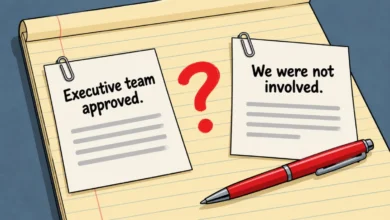
The Illusion of Alignment: Why Merging Control Inventories Does Not Equal Risk Governance


When two major financial institutions announce a merger, the immediate priority for the C-suite is the swift integration of disparate technology stacks and risk management frameworks. On paper, the process appears straightforward: technical teams map control inventories onto a single dashboard, align nomenclature, and mark the migration as complete. However, this administrative alignment often masks a significant governance failure. Vikram Isanaka, a director of technology risk and governance, cautions that mapping names to a common inventory does not establish that two distinct controls actually govern the same underlying risk. This discrepancy creates a "green-status" illusion—a scenario where a dashboard reports total compliance, yet the underlying reality reveals fragmented oversight, inconsistent evidence, and unaddressed vulnerabilities.
The core of the challenge lies in the distinction between nomenclature and operational scope. In the high-stakes environment of regulated financial services, information recorded in a control inventory must accurately represent the risk being managed. When two organizations merge, they frequently find that what one defines as a single, consolidated data access management control, the other has segmented into multiple, jurisdiction-specific controls. If these records are forced into a one-to-one mapping simply to clean up a dashboard, the organization risks losing the granular detail required to satisfy regulators and protect against operational failures.
The Chronology of Integration Failure
The lifecycle of a failed control integration typically follows a predictable, yet dangerous, trajectory. In the immediate post-merger phase—the "Day Zero" to "Day 90" window—integration teams are incentivized to demonstrate rapid progress. The focus is on consolidation: merging asset registers, standardizing control names, and establishing a unified reporting structure.
By the six-month mark, these teams often encounter the "evidence gap." While names are standardized, the supporting documentation—the trail of logs, assessments, and access reviews—remains siloed in legacy systems. By the one-year anniversary, organizations often face audit scrutiny where, despite a clean dashboard, the institution cannot produce evidence to substantiate the effectiveness of a control. This realization frequently triggers an urgent, costly scramble to re-map processes that were prematurely declared "integrated."
Data Integrity and the Problem of Non-Equivalence
The integration of technology risk frameworks requires more than just administrative software updates; it demands a forensic understanding of system architecture. In complex financial environments, multiple instances of the same application often run simultaneously across different regional branches or legacy subsidiaries.
Evidence from recent large-scale banking mergers suggests that matching application names is insufficient. Organizations must validate the specific "instances" of an application to ensure that the control scope truly covers all relevant data flows. If an organization assumes that a consolidated control covers all global instances of a banking platform without verifying the underlying configuration, they are essentially flying blind.
Furthermore, the quality of evidence varies wildly across legacy systems. One institution might utilize real-time automated data-quality triggers, while the other might rely on periodic, manual sampling. Forcing these into a single reporting metric ignores the fundamental difference in assurance levels. As noted in the Public Company Accounting Oversight Board (PCAOB) AS 2201 standard, which governs internal controls over financial reporting, the focus must remain on transaction flows and the role of IT in identifying where controls may be missing or inadequately designed. While AS 2201 specifically addresses financial reporting, the principle of "following the process flow" is increasingly viewed by risk experts as a gold standard for all technology integration projects.
The Human Element: Ownership and Accountability
A significant, yet frequently overlooked, risk in merger-related control integration is the erosion of clear ownership. A common pitfall is assigning a control to a platform team that operates the technology but lacks the authority to make business-level risk decisions.
When ownership is not explicitly defined, the "decision-making gap" widens. If a control fails or an exception is identified, it is often unclear who has the mandate to accept the risk or initiate remediation. Effective integration requires a "handoff" process that is documented in the control inventory. It is not enough to name an owner; the organization must ensure that the designated individual has the authority to act on the data. Without this, the control becomes a procedural box-ticking exercise rather than a functional governance mechanism.
Strategic Recommendations for Risk Governance
To move beyond the illusion of alignment, organizations must adopt a more rigorous validation methodology during the integration process.
- The "Traceability" Test: Before finalizing any mapping, integration teams should select a small, representative sample of material controls and trace them from the policy requirement down to the specific evidence. If an outsider cannot determine the population covered, the assessment basis, and the outcome of the last review using only the records, the mapping is insufficient.
- Visible Discrepancies: Instead of forcing a "clean" one-to-one mapping that masks differences, teams should be encouraged to maintain transparency. Where a consolidated control does not perfectly align with its predecessors, the mapping should clearly flag the discrepancy. This ensures that management remains aware of residual risk until a permanent solution is implemented.
- Dynamic Reporting: Reporting dashboards must distinguish between "mapped" and "validated" status. A control that is mapped is not necessarily a control that is effective. By utilizing states such as "effective," "deficient," "unassessed," and "uncertain," leadership receives a more accurate picture of the organization’s true risk profile.
- Denominator Integrity: When reporting trends, teams must account for scope changes. Adding new systems to a control inventory often leads to a temporary dip in "effectiveness" percentages. This is not necessarily a failure; it is an improvement in transparency. Organizations should clearly communicate these scope changes to stakeholders to avoid the false perception of deteriorating controls.
The Broader Impact on Financial Stability
The failure to integrate controls effectively has direct implications for regulatory standing and operational resilience. Financial regulators, including the Federal Reserve and the Office of the Comptroller of the Currency (OCC), have increasingly emphasized the importance of robust IT governance in the context of mergers and acquisitions.
When a large financial institution presents a consolidated risk dashboard that is built on flawed mapping, they risk significant regulatory fines, increased capital requirements, and, in severe cases, the suspension of further acquisition activity. Furthermore, from an operational perspective, fragmented controls are a primary target for cyber-attacks. Attackers look for the "seams" in an organization—the places where systems have been merged but processes have not been fully synchronized. These gaps are where access controls are weakest and where unauthorized data exfiltration is most likely to occur.
Conclusion: Moving Toward True Equivalence
The goal of any integration team should not be to reach a state of "done," but to reach a state of "validated." The objective is to build an environment where standardized inventory, clear ownership, defined technology scope, and traceable evidence requirements form a cohesive whole.
At the next integration steering committee meeting, leadership should ask a simple, piercing question: "If we lose our current head of technology, can the replacement look at these records and understand exactly what is being governed and how it is being verified?" If the answer is no, the integration is not a success; it is merely a postponement of a future, potentially catastrophic, audit or operational failure.
True governance, especially in the wake of a merger, requires the courage to acknowledge that different systems may not be equivalent and that different processes may require different oversight. By keeping these differences visible and focusing on the evidence that supports control conclusions, financial institutions can move from a state of superficial alignment to a position of genuine risk resilience. The goal is not just to clear the report to green, but to ensure that the green reflects a reality where every risk is accounted for, every control is tested, and every decision is documented.