Beyond the Monolith: Why Multinational Enterprises are Rethinking Two-Tier ERP Strategies

The pursuit of a single, standardized enterprise resource planning (ERP) system has long been considered the "gold standard" for large-scale corporate efficiency. For decades, the logic has remained largely unchallenged: by mandating common processes, centralized data governance, and unified control frameworks across every subsidiary and business unit, multinationals believe they can achieve economies of scale and seamless reporting. However, the reality of modern global operations is significantly more fragmented than the theory of monolithic architecture suggests. As organizations scale through aggressive acquisition, enter volatile emerging markets, and manage diverse product portfolios, the "one-size-fits-all" ERP model is increasingly viewed as a bottleneck rather than a catalyst for growth.
This shift in perspective was a focal point of the recent Sage Future for Partners event in Amsterdam, where industry leaders and analysts examined the evolving role of midmarket ERP solutions within the broader enterprise ecosystem. The discussion highlighted a critical strategic pivot: the emergence of "two-tier" ERP architectures as a viable, and often superior, alternative to the traditional, top-down implementation of Tier-1 legacy platforms like SAP or Oracle.
The Myth of Uniformity in a Fragmented Global Market
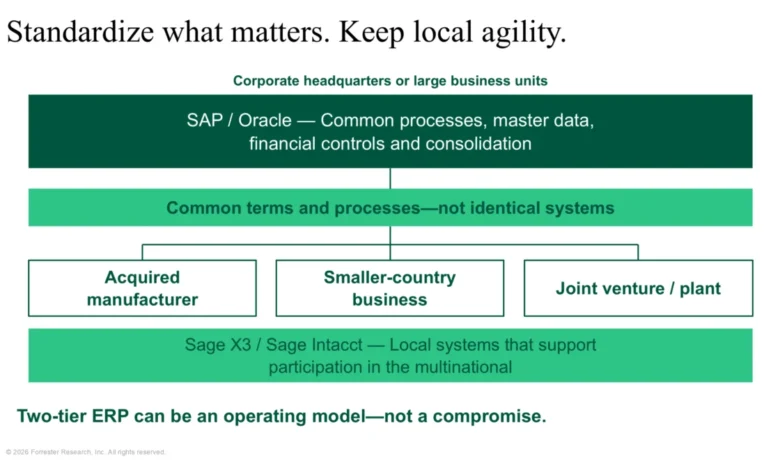
The corporate desire for ERP standardization often stems from a fundamental misunderstanding of the relationship between standardization and uniformity. While standardized data definitions and global reporting processes are undeniably necessary for the corporate center, they do not require every plant, regional office, or newly acquired subsidiary to operate on the same software instance.
When a multinational corporation—operating on a massive SAP or Oracle backbone—acquires a specialized manufacturer or a regional business entity with a distinct operational footprint, the instinctive reaction is to force a migration to the corporate standard. This architectural dogma, however, often overlooks the value proposition of the acquired entity. Companies are bought for their intellectual property, their established routes to market, their customer relationships, and their specific operational agility. Forcing these entities onto a Tier-1 platform prematurely can impose massive overhead, increase implementation costs, and cause operational friction that dilutes the very value the acquirer sought to purchase.
Chronology of the Two-Tier Shift
The concept of two-tier ERP is not entirely new, but its application has shifted significantly over the last fifteen years.
- 2005–2010: The era of "ERP Consolidation." During this period, global enterprises focused heavily on shutting down regional systems in favor of massive, global ERP deployments. The focus was on cost reduction through centralization.
- 2011–2018: The "Cloud Realization" phase. As cloud-native ERPs gained maturity, enterprises began to realize that hosting smaller business units on the corporate monolith was technically difficult and economically inefficient. Early adopters began experimenting with smaller, cloud-first systems for secondary units.
- 2019–Present: The "Agility and Integration" phase. Following the disruptions of the global pandemic and the acceleration of digital transformation, multinationals have shifted their focus toward "composable" architectures. The priority is no longer just cost reduction, but the ability to integrate smaller, agile systems (like Sage Intacct or X3) with the corporate core through robust APIs and middleware.
Supporting Data and Market Dynamics
Market data from recent industry surveys suggests that the "two-tier" approach is moving from a niche strategy to a mainstream architecture. Analysts note that approximately 60% of large-scale enterprises are currently managing at least two distinct ERP systems to serve different segments of their business.
The economic justification for this is found in deployment speed and total cost of ownership (TCO). A standard Tier-1 implementation for a mid-sized subsidiary can take 18 to 36 months, with costs spiraling into the millions due to the complexity of custom configurations. Conversely, midmarket solutions like Sage X3 or Sage Intacct can often be deployed in regional units in six to nine months. For joint ventures or temporary project-based subsidiaries, the ability to deploy quickly and retire the system without disrupting the corporate core provides an agility that Tier-1 systems simply cannot match.
Sage’s Strategic Positioning: Complementation Over Competition
The recent Sage Future for Partners event underscored that Sage is repositioning its portfolio—specifically Sage X3 and Sage Intacct—to act as the secondary tier for large enterprises. By positioning these products as tools that integrate into an existing SAP or Oracle environment, Sage is addressing a specific pain point: the "white space" left by Tier-1 providers.
This strategy is supported by real-world use cases. For instance, a multinational enterprise might maintain its global financial consolidation and procurement on an SAP platform, while utilizing Sage X3 to manage manufacturing processes in a newly acquired European subsidiary. Because X3 offers enterprise-level functionality—such as sophisticated supply chain management and multi-currency, multi-legislation compliance—it fulfills the operational needs of the subsidiary without requiring the heavy-duty maintenance and rigid infrastructure of the corporate Tier-1 system.
Sage’s leadership has emphasized that the integration of artificial intelligence (AI) into this ecosystem will further change the economics of the partner network. By automating the data synchronization between the midmarket tier and the global core, Sage aims to reduce the "integration tax" that previously made two-tier strategies technically challenging to maintain.
Fact-Based Analysis of Implications
The shift toward two-tier ERP systems carries several profound implications for Chief Information Officers (CIOs) and enterprise architects:
- Redefining "Standardization": CIOs must shift their focus from software uniformity to process uniformity. Standardizing the output and the data is the priority; the tool used to generate that output is secondary. This allows for greater flexibility in local decision-making.
- The Rise of the "Composability" Mindset: Enterprise architecture is moving away from the "Big Bang" approach toward a modular one. Future-proof architectures are built to be swapped or upgraded at the unit level, preventing the entire organization from becoming hostage to a single, monolithic upgrade cycle.
- Vendor Ecosystems: The role of the partner ecosystem is changing. Instead of simply being implementers of a monolithic system, partners are increasingly acting as architects of multi-vendor environments. Their value lies in their ability to bridge the gap between Tier-1 and midmarket solutions.
- Operational Resilience: Organizations running a two-tier strategy often report higher resilience. If the primary system experiences an outage, regional units running on a different platform can continue to operate, mitigating the risk of total business paralysis.
Conclusion: A Pragmatic Path Forward
The "ERP strategy on a page" that promises a single system for the entire multinational enterprise is increasingly becoming a relic of a less complex corporate era. While the logic of standardization remains sound, the execution must evolve. Multinational organizations that embrace the two-tier model—using Tier-1 systems for global control and specialized midmarket solutions like Sage for operational agility—are finding themselves better positioned to integrate new acquisitions, respond to local market demands, and maintain a competitive edge.
The takeaway from the Sage event is clear: success in the modern multinational landscape is defined by the ability to balance the need for global oversight with the requirement for local responsiveness. By moving beyond the obsession with uniformity and focusing on the strategic integration of diverse systems, enterprises can achieve a more sustainable, scalable, and efficient IT architecture. For organizations currently grappling with the inefficiencies of forcing a single ERP onto a diverse global footprint, the two-tier strategy is no longer just a technical option—it is a competitive necessity.