The True Cost of Workforce Reductions: Why Layoffs Are the Ultimate Test of Corporate Integrity

Layoffs are far more than a mere operational exercise or a balance-sheet recalibration; they represent the moment a company’s accumulated trust is placed on the most public of stages. In an era of radical transparency, where social media platforms and professional networks serve as town squares for employee sentiment, the way a firm treats its departing staff echoes long after the final severance check is processed. Stakeholders—including remaining employees, prospective talent, loyal customers, partners, and shareholders—are increasingly scrutinizing these moments to determine whether a company’s public-facing values are mere marketing slogans or genuine operational principles.
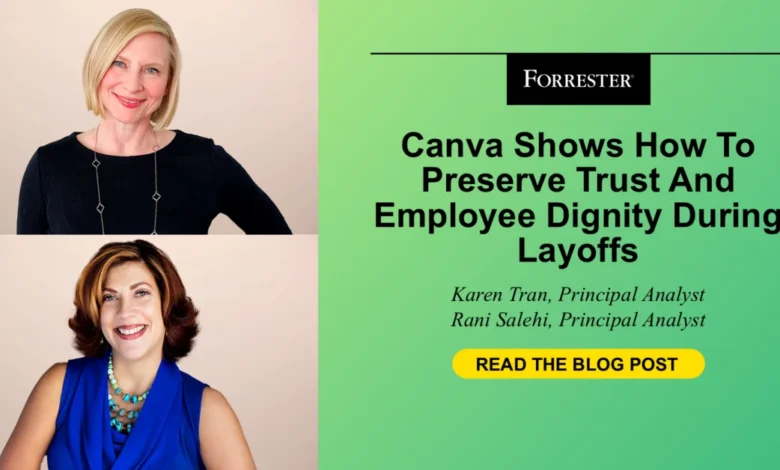
The recent workforce reductions at Canva serve as a definitive case study in how leadership teams can navigate the inherent volatility of organizational restructuring. By prioritizing transparency, empathy, and accountability, Canva has provided a roadmap for how corporations can manage painful transitions while preserving the foundational trust that keeps a brand resilient.
A Chronology of the Decision
Canva’s recent organizational changes did not occur in a vacuum but followed a period of intense scrutiny regarding the company’s growth trajectory and headcount expansion. After several years of rapid, venture-backed scaling, the global economic climate shifted, forcing the design platform to reconsider its operational efficiency.
In mid-2024, the leadership team initiated a comprehensive review of its business units. Following this internal audit, management concluded that the company’s structure had become overly complex, leading to fragmented communication and slowed decision-making. The decision to initiate a layoff was presented not as a knee-jerk reaction to market pressure, but as a strategic pivot to streamline operations for the next phase of the company’s evolution. Unlike companies that shroud such decisions in secrecy until the moment of termination, Canva’s leadership communicated the rationale behind the reorg to the entire organization, framing the shift as a necessary evolution of their business model.
The Anatomy of the Exit Experience
The traditional "termination notice" delivered via a cold, automated video call with minimal severance is increasingly viewed as a relic of an outdated corporate culture. Such an approach sends a clear, damaging signal: that employees were valued only for their utility. In contrast, the exit experience is now a critical touchpoint in a company’s brand lifecycle.
Data from the Society for Human Resource Management (SHRM) and various employment research firms suggest that the "alumni experience" is a significant driver of long-term brand equity. Employees who feel treated with dignity during a layoff are statistically more likely to speak positively about their former employer, which in turn impacts future recruitment efforts and consumer perception.
When an employee is forced to transition, the difference between "I was let go and abandoned" and "My role was eliminated, but the company provided a comprehensive transition package" is profound. The latter does not erase the trauma of losing a job, but it preserves the employee’s dignity and the employer’s reputation. The objective for modern leadership is not to "buy" silence or positive reviews, but to ensure that the departing employee’s story is one of professional transition rather than personal rejection.
The Metrics of Meaningful Support
What differentiates a standard layoff from one that upholds corporate integrity? The answer lies in the granularity of support. In the case of Canva, the support packages provided to affected individuals were designed to mitigate the immediate shock of job loss. These included extended health benefits, professional outplacement services, and in some instances, stock option vesting adjustments that recognized the tenure of the departing staff.
By providing these resources, the company demonstrated that its values—specifically its emphasis on being a "force for good"—extended to the very moment the employment contract ceased to exist. When empathy is backed by tangible financial and logistical support, it moves from being a soft skill to a measurable operational strategy. This practice creates a "soft landing" that protects the brand from the reputational damage often associated with mass redundancies.
The Ripple Effect: Trust as a Strategic Asset
The implications of how a company handles a layoff extend far beyond the departing cohort. For the employees who remain, the process is a litmus test for their own future at the firm. If the "survivors" of a layoff see their colleagues treated with cruelty or indifference, their commitment to the company often evaporates, leading to a phenomenon known as "survivor syndrome," characterized by decreased productivity, high anxiety, and increased attrition.
Furthermore, investors are increasingly looking at the "Social" component of ESG (Environmental, Social, and Governance) criteria, which includes workforce stability and labor relations. A company that handles a restructuring with transparent communication and fair severance is viewed as having stronger governance and lower operational risk. Conversely, firms that botched their layoffs—leading to public relations crises and internal dissent—often see a measurable dip in stock performance and a harder time securing top-tier talent in the subsequent quarters.
Treating the Exit as a Brand Experience
The paradigm shift in modern HR is to treat the termination process with the same level of intentionality as the recruitment process. Organizations that successfully navigate this transition typically adhere to a few core principles:
- Direct and Human Communication: Moving away from impersonal scripts and toward leadership-led, empathetic, and direct conversations.
- Radical Transparency regarding the "Why": Clearly articulating the business case for the reduction, ensuring that those remaining understand the strategic necessity of the move.
- Comprehensive Offboarding: Viewing the exit as a formal part of the employee lifecycle, providing resources that go beyond the legal minimum.
- Support for the Remaining Team: Acknowledging the grief and uncertainty of those who stay, and providing clear channels for feedback and questions to rebuild a sense of stability.
The Broader Implications for Global Business
As artificial intelligence and automation continue to reshape the labor market, the frequency of organizational restructuring is unlikely to diminish. Companies in the technology sector, in particular, are facing a period of "right-sizing" following the excess of the pandemic-era boom. The lessons provided by the Canva model are therefore timely.
We are moving into an era where "corporate culture" is no longer something that can be hidden behind closed office doors. Every decision, especially one as consequential as a layoff, is subject to a global audience. Companies that fail to recognize this will find themselves losing the "war for talent," as prospective employees increasingly favor organizations with proven track records of integrity during downturns.
Trust, by its nature, is fragile. It is not built by avoiding difficult decisions, but by demonstrating one’s values while making those decisions. A company’s reputation is not a static asset; it is a living, breathing thing that is shaped by every interaction an organization has with its people—even, and perhaps especially, when those people are leaving.
The employment relationship may be finite, but the employee’s experience of the brand is permanent. When a company treats its departing staff as partners in a transition rather than liabilities to be shed, it reinforces the very culture it claims to represent. In the final analysis, the way an organization handles its most difficult days serves as the most honest reflection of its character. As the business landscape continues to evolve, those that prioritize empathy alongside operational reality will not only survive the transition—they will emerge with their brand equity and employee trust intact.