AI is Not Rewriting the Rules of Enterprise Transformation, It’s Accelerating Them

The current wave of enthusiasm surrounding Artificial Intelligence (AI), particularly generative AI, has led many to believe that the fundamental principles of enterprise transformation are being rendered obsolete. However, industry experts contend that AI, while undeniably powerful, is not a revolutionary force that has rewritten the playbook for business change. Instead, it is a potent accelerant, amplifying existing strategies and demanding a more agile, real-time approach to execution. The core tenets of successful transformation remain steadfast, though the pace and expectations surrounding them have dramatically shifted.
The notion that AI has upended the established order of enterprise transformation is a misconception fueled by the sheer velocity of its capabilities. Autonomous agents, powered by advanced AI, can now execute complex tasks at machine speed. This unprecedented efficiency compels Chief Information Officers (CIOs) and other senior leaders to manage value, risk, and strategic alignment in a near real-time environment. While this represents a significant operational shift, it is an evolution of existing management paradigms rather than a complete departure. The fundamental challenges of steering a large organization through change, ensuring that initiatives deliver tangible business value, mitigating potential risks, and maintaining alignment across diverse stakeholders, are age-old concerns that are now being addressed under immense temporal pressure.
The Enduring Pillars of Transformation Success
Despite the dazzling advancements in AI, the critical ingredients that underpin successful enterprise transformation remain firmly in place. Strategy, the foundational element, is more crucial than ever. In an era where AI can rapidly identify and exploit market shifts, a poorly conceived strategy will now fail with alarming speed. The consequences of misalignment or an ill-defined vision are amplified, leading to wasted resources and missed opportunities much faster than before.
Measurable outcomes continue to be the bedrock of credibility for any transformation initiative. Stakeholders, from the board of directors to frontline employees, expect to see tangible evidence of progress and impact. AI’s ability to enhance data analysis and operational efficiency means that these outcomes are not only expected but are also anticipated to materialize at an accelerated pace. The benchmark for success has been raised, demanding quicker returns on investment and more immediate demonstrations of value.
Capability assessments, too, retain their paramount importance. Enterprises must now, however, broaden their definition of organizational capabilities to explicitly include generative AI and its associated enablers. This means not only understanding the potential of AI as a tool but also assessing the organization’s readiness to adopt, integrate, and leverage these technologies effectively. This includes evaluating existing skill sets, identifying talent gaps, and developing strategies for upskilling or reskilling the workforce. In essence, while the vocabulary of transformation has evolved to incorporate terms like "generative AI," "autonomous agents," and "real-time management," the underlying strategic and operational exercises remain fundamentally the same.
What, Then, Is Truly New?
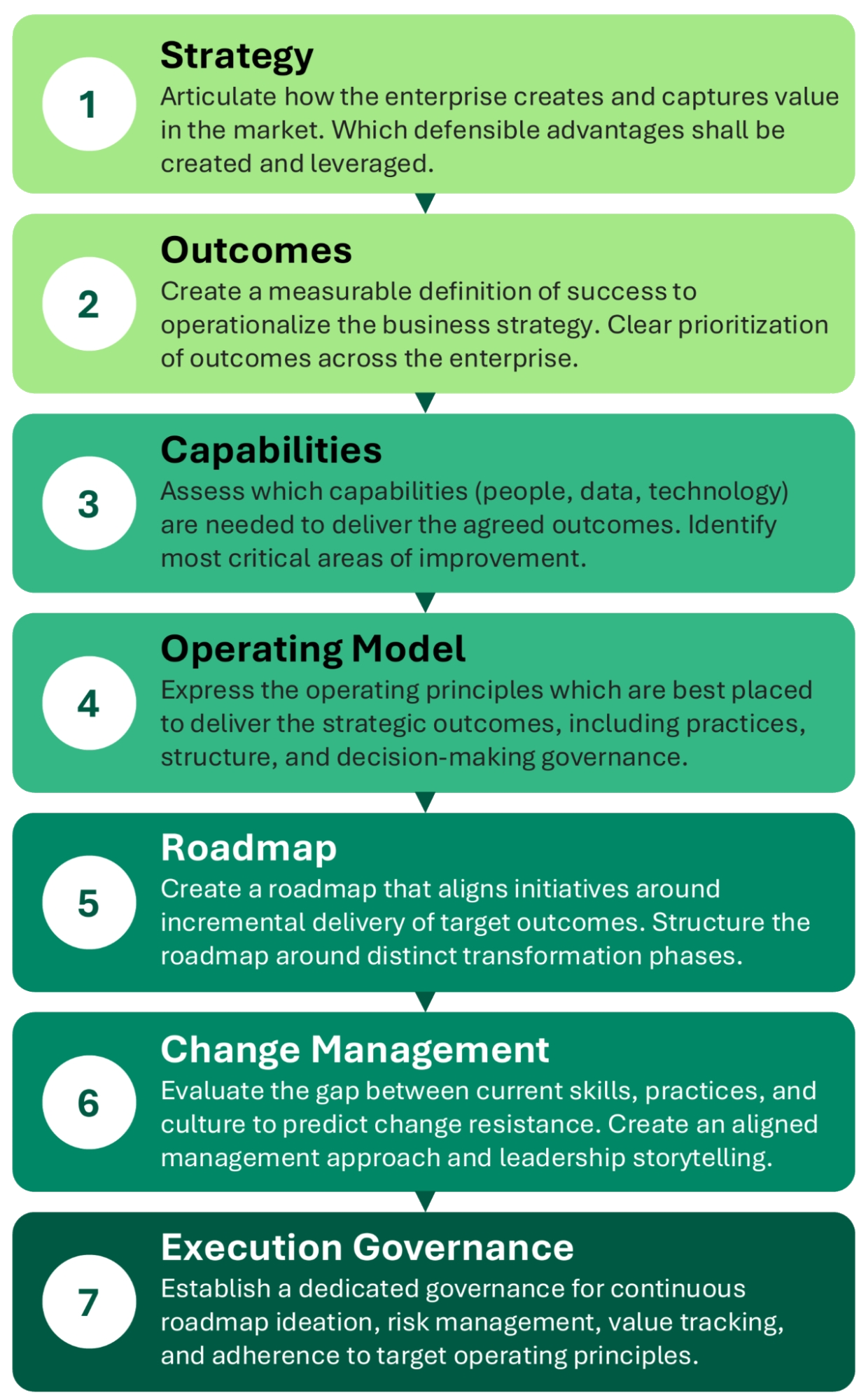
The true novelty lies not in a rewritten rulebook, but in the intensified demands placed upon existing frameworks by AI’s capabilities. As exciting as the potential of generative AI is, the established principles of successful transformation still apply. These principles, often visualized as a sequential process, remain the guiding light for achieving impactful change:
- Decide Where to Play: This initial strategic phase involves identifying the specific business areas, markets, or customer segments that the transformation will target. It requires a clear understanding of the organization’s competitive landscape and its strategic objectives.
- Define Outcomes: Once the strategic focus is established, the next critical step is to articulate precisely what success looks like. This involves setting clear, measurable, achievable, relevant, and time-bound (SMART) goals that align with the overarching strategy.
- Understand Your Capabilities: This stage involves a thorough assessment of the organization’s current strengths and weaknesses, including its technological infrastructure, human capital, processes, and culture. The inclusion of AI capabilities is a recent but vital addition to this assessment.
- Design Decision-Making Within the Operating Model: A robust operating model is essential for effective execution. This involves defining roles, responsibilities, governance structures, and, critically, the decision-making processes that will guide the transformation. AI’s speed necessitates a more agile and potentially decentralized decision-making framework.
- Execute in Increments: Large-scale transformations are best managed through iterative, phased approaches. This allows for learning, adaptation, and risk mitigation along the way. AI can accelerate the execution of these increments, but the principle of phased delivery remains crucial.
- Bring the Organization With You: Transformation is fundamentally a human endeavor. Effective change management, clear communication, and stakeholder engagement are vital to ensure buy-in and adoption across all levels of the organization. AI can assist in communication and training, but the core human element of leadership and engagement is irreplaceable.
The winners in this accelerated landscape will be those who excel at executing these "ordinary things extraordinarily well." The difference will be in the speed of execution and a reduced propensity for making excuses for delays or failures. The pressure is on to perform, and AI provides the tools to do so, but only if guided by sound strategic principles.
The Accelerating Impact of AI on Enterprise Transformation
The integration of AI into enterprise transformation is not a theoretical exercise; it is a present reality reshaping how businesses operate and compete. Data from various industry surveys highlights a significant increase in AI adoption across sectors. For instance, a recent report by Accenture indicated that by 2026, companies that have embraced AI at scale are projected to achieve 30% higher gross margins than their peers. This surge in AI investment is directly influencing transformation strategies, pushing them to become more agile and data-driven.
The timeline of AI’s influence on enterprise transformation can be traced back to the early 2010s with the rise of machine learning and big data analytics. However, the advent of generative AI in the early 2020s marked a paradigm shift, democratizing access to advanced AI capabilities and accelerating their adoption. This rapid evolution has compressed the typical timelines for transformation initiatives, forcing organizations to adapt their change management processes to accommodate near real-time feedback loops and continuous optimization.
Consider the implications for CIOs. Previously, strategic IT roadmaps might have been planned on a three- to five-year horizon. Today, the rapid advancements in AI necessitate a more dynamic approach. CIOs are increasingly tasked with managing value, risk, and alignment in a continuous cycle, often on a quarterly or even monthly basis. This requires a proactive stance, anticipating the next wave of AI-driven innovation and its potential impact on the organization’s strategic direction and operational capabilities.
Reactions and Perspectives from Industry Leaders
While the original content focuses on a foundational perspective, it is logical to infer the broader discourse surrounding this acceleration. Industry analysts and technology leaders have been vocal about the dual nature of AI’s impact. Many acknowledge the disruptive potential of AI but emphasize the enduring importance of strategic fundamentals.
"AI is a powerful amplifier," stated a senior analyst at a leading technology research firm in a recent webinar. "It can make good strategies great and bad strategies fail faster. The key is to have a solid strategic foundation before you try to leverage AI for acceleration. Without clear objectives and a well-defined path, AI can simply lead you down the wrong road at an unprecedented speed."
Similarly, chief executives of major enterprises have begun to articulate their evolving approaches. In recent earnings calls, several Fortune 500 CEOs have highlighted their focus on "AI-enabled agility," underscoring the need for organizations to be able to pivot quickly in response to market changes and technological advancements. This agility, they argue, is built upon a bedrock of clear strategic intent and robust operational capabilities, augmented by AI.
Broader Impact and Implications
The accelerated pace of enterprise transformation driven by AI has profound implications across various business functions and industries. For marketing and communications, as highlighted in the related Forrester content, AI is already reshaping investment priorities. B2B marketers, for instance, are reevaluating their reliance on agencies as AI-driven efficiencies allow them to bring more work in-house. This necessitates a re-evaluation of internal capabilities and a strategic approach to leveraging AI for brand building, content creation, and customer engagement.
The implications extend to talent management, supply chain optimization, customer service, and product development. Organizations that fail to adapt their transformation strategies to incorporate AI’s accelerating influence risk falling behind competitors who are more adept at leveraging these new capabilities. This doesn’t mean abandoning established principles, but rather integrating them into a more dynamic and responsive framework.
The core message is clear: AI is not a shortcut to transformation, nor is it a replacement for strategic thinking and disciplined execution. It is, however, an unprecedented catalyst that demands a more rapid, agile, and informed approach to achieving business objectives. The companies that will thrive in this new era are those that understand this distinction and are prepared to execute ordinary things extraordinarily well, at an accelerated pace, and with a heightened sense of urgency. The fundamental exercise of transformation has not changed, but the speed at which it must be conducted, and the tools available to achieve it, have been irrevocably altered.
Related posts: