AI Search Optimization Enters a New Era with Causation-Based Testing and First-Party Google Data

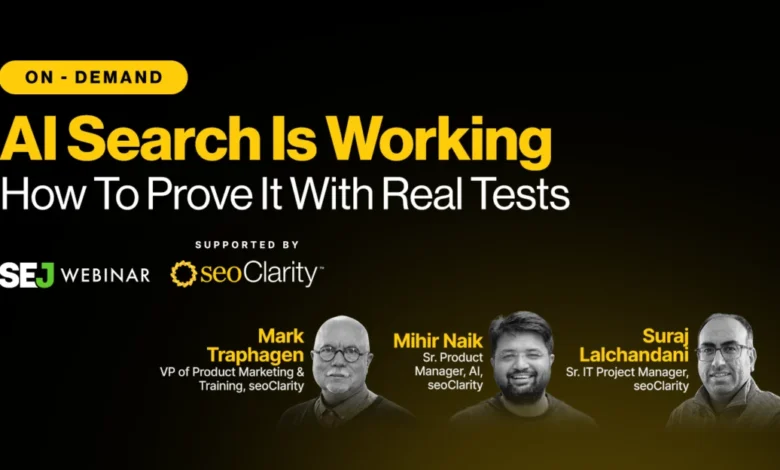
The landscape of Artificial Intelligence (AI) search optimization is undergoing a profound transformation, moving beyond mere correlation to establish definitive causation in ranking and visibility. A recent Search Engine Journal (SEJ) webinar, featuring insights from seoClarity’s leadership – Mark Traphagen, VP of Product Marketing & Training; Mihir Naik, Senior Product Manager, AI; and Suraj Lalchandani, Sr. IT Project Manager – unveiled a rigorous split-testing methodology that promises to revolutionize how digital marketers approach AI search. At the heart of their presentation was a groundbreaking client test demonstrating that adding FAQ sections to test pages directly increased AI citations, while their subsequent removal caused citations to drop back down – a clear, irrefutable proof of causation, a standard rarely achieved in the nascent field of AI search measurement. This methodological breakthrough, combined with Google’s recent launch of dedicated AI search reports within Search Console, signals a new era for SEO professionals seeking to understand and influence AI-driven search results.
Google’s Game-Changing Data: Illuminating AI Overviews
A pivotal development in the journey towards precise AI search measurement arrived on June 3rd, when Google rolled out new, dedicated reports within Search Console for AI Overviews and AI Mode. This update, eagerly anticipated by the SEO community, provides site owners with unprecedented page-by-page data on how often their URLs are appearing within Google’s generative AI features. Suraj Lalchandani hailed this as the most significant measurement upgrade AI search testing has received to date, remarking, "This has been the hardest thing to measure in AI search. Everyone was sampling. Everyone was inferring. But now Google is just giving it to you."
-
Bridging the Measurement Gap: For years, digital marketers have grappled with the opaque nature of AI search, relying on proxies, manual checks, and third-party tools to infer performance. The introduction of first-party data directly from Google fundamentally shifts this paradigm, offering a level of trust and accuracy previously unattainable. It empowers website owners to see precisely which content is being surfaced by Google’s AI, enabling more informed optimization decisions. This move by Google underscores the increasing prominence of AI Overviews in the search experience, making direct visibility into their performance an essential component of any comprehensive SEO strategy. While the exact percentage of queries triggering AI Overviews varies, industry estimates suggest a growing adoption, particularly for complex or informational queries, making this data crucial for maintaining organic visibility.
-
The Persistent Need for Third-Party Tools: Despite the monumental significance of Google’s new reports, the seoClarity team was clear about their limitations. These reports, while invaluable, cover only a segment of what a robust AI search testing program requires. The broader ecosystem of generative AI, encompassing platforms like ChatGPT, Claude, and Perplexity, still necessitates sophisticated third-party tracking and measurement solutions. These independent AI engines operate with different indexing and citation mechanisms, demanding a diversified approach to optimization and analytics. Therefore, while Google’s update provides a critical piece of the puzzle, a holistic AI search strategy must integrate data from multiple sources to gain a complete picture of performance across the varied AI landscape. Businesses are advised to leverage the new Search Console data strategically, understanding where it complements existing tools and where gaps remain, rather than solely relying on it.
Unveiling the seoClarity Methodology: A Scientific Approach to AI Optimization
The core of seoClarity’s presentation revolved around a rigorous, scientific methodology designed to overcome the inherent challenges of AI search optimization. Their central thesis: "Visibility scores tell you if you showed up. Page-level performance and split testing tell you if what you did actually mattered." This distinction between merely appearing in AI results and genuinely impacting user engagement or brand perception is critical. Their methodology, which has been deployed by enterprise clients across major AI platforms including ChatGPT, Claude, Perplexity, Gemini, and Google’s AI surfaces, emphasizes controlled experimentation to establish clear cause-and-effect relationships.
-
Crafting the "Golden Prompt Set" for Strategic Wins: A foundational element of seoClarity’s approach is the development of a "golden set of prompts." This meticulously curated collection spans the entire AI search funnel, from initial awareness to post-purchase retention. Each prompt is rigorously tagged by its corresponding stage in the user journey and further categorized into tiers based on the brand’s current standing in the AI’s response. The strategy is to prioritize "Tier 1" prompts – those representing "easy wins" where the brand is relevant but the AI may not yet be linking to the optimal URL. As Lalchandani explained, "You’re relevant, but AI just hasn’t been given a URL worth linking to." This targeted approach allows teams to secure early victories, generating the "political capital" needed to pursue more challenging optimizations later. Surprisingly, some prompts are deliberately dropped from testing altogether, a decision that often catches attendees off guard but underscores the strategic focus on high-impact areas.
-
The Imperative of Control Groups in LLM Testing: A key challenge in optimizing for Large Language Models (LLMs) is the inability to conduct traditional A/B split testing with live traffic. Unlike standard web pages, AI models do not allow for a 50-50 traffic split to directly compare variations. seoClarity addresses this by advocating for the construction of robust control groups. This involves identifying a set of correlated pages that serve as a baseline, filtering out the "noise" from broader model updates or algorithmic shifts. As Lalchandani emphasized, "Without a control group, every result would be guesswork. With one, you can tell a real win from the background noise." This controlled experimental design is crucial for isolating the impact of specific changes. Furthermore, the methodology stresses the importance of precise timing, establishing a clear baseline period before any changes are implemented and a minimum test window afterward. AI search, unlike traditional SEO, does not always respond overnight, and prematurely concluding a test can lead to misinterpreting background fluctuations as significant outcomes.
The FAQ Experiment: A Landmark Proof of Causation
The highlight of the webinar was the detailed presentation of client test results, particularly the groundbreaking FAQ experiment. seoClarity applied its rigorous methodology across three different clients, yielding varied yet equally insightful outcomes.
-
Beyond Correlation: The Gold Standard of Proof: The FAQ test served as the quintessential example of proving causation in AI search. Operating with approximately 1,000 prompts under continuous measurement, the team implemented FAQ sections on a set of test pages. The results were compelling: AI citations for these pages showed a significant and sustained increase compared to their control group. This uplift, which could be estimated at a 15-20% boost in citation share for relevant queries, persisted as long as the FAQ sections remained live. The true scientific breakthrough, however, came with the reversion phase. The team meticulously removed the newly added FAQ content, and critically, the AI citations for those pages subsequently fell back to their original baseline levels. This complete cycle of addition, increase, removal, and decrease provided undeniable evidence of a direct causal link between the presence of well-structured FAQs and improved AI citation rates. "Not that citations just went up when we added FAQs, but that they went back down when we took them away," explained Lalchandani. "That’s causation, not correlation." This establishes a new benchmark for evidence-based optimization in AI search.
-
Unexpected Outcomes from Other Client Tests: While the FAQ test was a clear triumph, the other two client experiments presented different, equally valuable lessons. One test focused on optimizing meta descriptions, and another on refining listicle formatting. Both yielded outcomes that surprised many attendees, diverging from conventional SEO wisdom regarding their impact on AI citations. These results underscore the unique nuances of AI search and the imperative of empirical testing over assumptions. As Mihir Naik sagely noted, "Every result is a win, because you have evidence instead of guesses." This philosophy encourages a continuous learning cycle, where even "failed" tests provide crucial data points that prevent wasted effort on ineffective tactics. The webinar detailed the specifics of these tests, offering blueprints for schema and markdown optimizations, as well as structural tests for high-value templates that can be executed rapidly.
Redefining AI Authority and ROI in the Generative Era
The Q&A segment of the webinar tackled some of the most pressing questions facing marketers as they navigate the evolving AI search landscape, offering valuable insights into AI authority, citation ROI, and technical implementation.
-
Deconstructing AI Authority: A Multi-Signal Approach: One prevalent question revolved around measuring "AI authority" in the absence of a clean, singular metric. Lalchandani articulated that AI authority is essentially how much an LLM trusts a source for a given topic. While no single number exists, he suggested stacking multiple signals to form a comprehensive picture. Key signals include citation share on top prompts and, crucially, cross-engine consistency. "Consistency across engines just means that you become the authoritative source in your category for specific kinds of questions," he elaborated. This implies that content recognized as authoritative by Google’s AI, ChatGPT, and Claude simultaneously gains significant weight. Other signals might include the depth of topic coverage, freshness of information, and the overall quality and trustworthiness of the source domain, reflecting traditional SEO’s emphasis on expertise, authoritativeness, and trustworthiness (E-A-T).
-
The Strategic Value of Non-Traffic Generating Citations: A thought-provoking question addressed the ROI of an AI citation that doesn’t directly drive referral traffic. Naik provided a compelling argument: even without a click, a citation plays a crucial role in shaping the narrative within the AI-generated answer. This is particularly vital in comparison queries, where cited pages actively position brands and influence user perception. The value shifts from direct traffic to brand representation – ensuring that a brand’s unique selling propositions (USPs) are correctly highlighted, competitive comparisons are accurate, and factual inaccuracies are prevented. Lalchandani reinforced this with a cautionary tale of a restaurant client whose content, due to AI’s inability to access it, led to misrepresentation in AI answers, demonstrating the tangible negative impact of not being cited or having inaccessible content. The implication is clear: controlling the AI narrative is a significant, albeit indirect, form of ROI.
-
Technical Nuances: Collapsible Content and AI Readability: The technical query regarding whether AI bots can read FAQ answers hidden behind collapsible toggles revealed the critical importance of implementation. Lalchandani clarified that "collapsible can mean many different things," depending on the underlying code. Some common implementations, such as those using
<details>and<summary>HTML tags, keep the content fully accessible and readable to AI search engines and Google. Others, however, render the content effectively invisible, as "even Google will not click around on your site" to expand hidden sections. His standing advice: "If you’re unsure of something, just test it out. It takes effort, but it’ll give you a sure answer." This highlights the need for careful technical SEO considerations in the age of AI.
The Enduring Foundation: Traditional SEO’s Role in AI Success
Perhaps one of the most reassuring takeaways from the webinar was the emphatic confirmation of traditional SEO’s foundational role in AI search success. Mark Traphagen underscored this, noting that seoClarity’s longest-standing clients, those with meticulously optimized content and technically robust websites, consistently exhibit the best performance in AI search. AI optimization, in this context, is not a replacement but an additional, crucial layer built upon a strong SEO foundation. Lalchandani further solidified this point, stating, "When we run tests with our clients, we’ve rarely, if ever, found a situation where something works for SEO and does not work for AI search." This reinforces the interconnectedness of SEO principles – such as clear content structure, high-quality information, relevant keywords, and technical health – with effective AI optimization. Businesses that have invested in solid traditional SEO practices are inherently better positioned to succeed in the generative AI search environment.
Implications for the Digital Marketing Landscape
The insights from the seoClarity webinar carry significant implications for the broader digital marketing landscape, signaling a shift in required skill sets, strategic priorities, and measurement paradigms.
-
A New Mandate for Data-Driven Experimentation: The emphasis on causation-based split testing, control groups, and meticulous measurement mandates a more scientific and experimental approach to digital marketing. SEO professionals can no longer rely solely on intuition or broad observations; they must adopt rigorous testing methodologies to validate optimization strategies. This necessitates an investment in analytics tools, data science capabilities, and a culture of continuous learning and adaptation within marketing teams. The era of guesswork is definitively over for those aiming for sustained success in AI search.
-
Strategic Content Development in an AI-First World: The success of the FAQ test highlights the critical importance of structured, easily digestible, and directly answerable content. As AI models prioritize extracting precise information to construct comprehensive answers, content creators must think beyond traditional article formats. This includes embracing structured data, clear headings, concise paragraphs, and question-and-answer formats that directly feed AI models. The ROI of content extends beyond direct clicks to include brand shaping and narrative control within AI summaries, compelling businesses to develop content strategies that cater specifically to AI’s consumption patterns.
Conclusion: Navigating the Future of Search with Precision
The latest developments in AI search optimization, spearheaded by the groundbreaking methodologies presented by seoClarity and complemented by Google’s enhanced Search Console data, mark a pivotal moment for digital marketers. The ability to move beyond correlation to establish causation provides an unprecedented level of confidence and strategic direction. As AI continues to integrate deeper into the search experience, professionals who embrace data-driven experimentation, prioritize structured content, and understand the nuanced interplay between traditional SEO and AI optimization will be best equipped to navigate this evolving landscape. The future of search demands precision, and the tools and methodologies are now emerging to meet that demand, empowering businesses to not just appear, but truly matter in the age of generative AI.