Tech Stack Consolidation: The Strategic Imperative for Modern Enterprise Efficiency

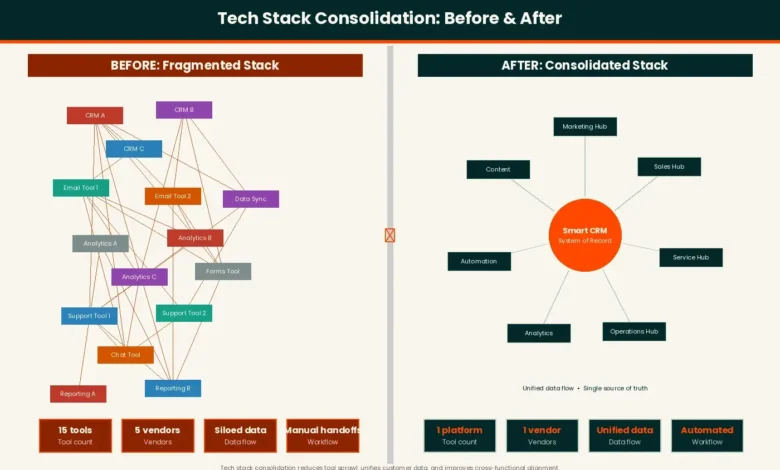
In an era defined by rapid digital transformation, organizations have increasingly fallen victim to "tool sprawl"—the unbridled accumulation of disparate software applications. Tech stack consolidation has emerged as the necessary corrective, a strategic process designed to reduce the number of software tools an organization operates, standardizing workflows on a smaller, more integrated set of systems. While the reduction of licensing costs is often the primary driver for executive approval, the long-term value lies in operational agility, data integrity, and the elimination of the "context gap" that plagues fragmented teams.
The evolution of the modern business tech stack has seen an explosion in SaaS (Software as a Service) adoption over the past decade. According to data from Gartner, global IT spending has continued to rise, yet the return on investment for many organizations has plateaued due to the friction caused by managing dozens of non-integrated tools. When data remains siloed, customer-facing teams—marketing, sales, and service—frequently operate with conflicting definitions of key performance indicators. This leads to redundant data entry, incomplete customer profiles, and a fragmented user experience that hampers growth.
The Anatomy of Tool Sprawl
Tool sprawl is rarely the result of a single bad decision; it is the byproduct of departmental autonomy. Marketing, sales, and customer success teams often procure niche solutions to solve immediate problems without consulting IT or procurement departments. This results in "shadow IT," where sensitive company data resides in unmanaged, unvetted applications.
True consolidation is not merely the act of canceling subscriptions. It requires a fundamental re-engineering of the "system of record"—the single platform that acts as the source of truth for all customer interactions. By establishing a central CRM (Customer Relationship Management) system as the foundation, organizations can ensure that every touchpoint, from the initial website visit to post-purchase support, is captured within a unified data environment. This transition effectively ends the era of manual reconciliation, where teams spend hours before board meetings attempting to align disparate datasets.
A Chronology of Implementation
For organizations attempting to reverse the trend of fragmentation, a structured 90-day plan is standard practice for modern RevOps (Revenue Operations) teams. The process begins with a comprehensive audit. During the first 30 days, teams must move beyond simple billing spreadsheets to build a master inventory that includes ownership, renewal dates, and utilization metrics for every piece of software in use.

The second phase, occurring between days 30 and 60, focuses on prioritization. Stakeholders must categorize tools into "keep," "retire," or "replace" groups. During this time, the focus shifts to defining the primary system of record. If a company uses three different tools to track customer support tickets and another three to manage lead scoring, the goal is to migrate those workflows into a singular, cohesive platform.
The final phase, spanning days 60 to 90, involves execution and governance. The "pilot" phase is critical; rather than a wholesale transition, teams often migrate a single department to test the integration of new workflows. Post-migration, the focus must shift to governance—establishing intake processes for future software requests to ensure that sprawl does not return within the typical 12 to 18-month cycle.
Quantifying the Benefits
The economic implications of consolidation are multifaceted. While software license savings are tangible, the most significant gains are often found in operational efficiency.
- Marketing Efficiency: Improved attribution models allow for a more precise calculation of ROI on advertising spend. When marketing tools are integrated with the core CRM, automated lead scoring and nurturing become more accurate, directly impacting conversion rates.
- Sales Velocity: Sales representatives who operate within a unified platform do not need to toggle between multiple applications to view a prospect’s history. This reduction in "context switching" has been shown to increase time-on-task, allowing reps to focus on high-value interactions.
- Support Continuity: Customer service agents gain a 360-degree view of the customer, including purchase history and previous complaints. This prevents the common frustration of customers having to repeat their issues to multiple agents.
- IT and Finance Oversight: By centralizing the procurement process, organizations significantly shrink their "attack surface"—the number of potential security vulnerabilities introduced by unvetted third-party apps—and gain better visibility into actual versus licensed software usage.
Addressing the Challenges of Resistance
Resistance to consolidation is an expected reaction from departmental leaders who feel a sense of ownership over their specific tools. Experts suggest that the most effective way to manage this friction is to lead with data-backed outcomes rather than cost-cutting mandates. When employees realize that the new system reduces their administrative workload and improves their performance metrics, buy-in increases.
Legacy edge cases present a unique challenge. Some departments may rely on highly specialized tools that do not have direct equivalents in a general-purpose CRM. In these instances, the recommended approach is not to force a migration, but to demand a clean, documented integration. If a tool cannot integrate with the system of record, its value must be questioned against the technical debt it creates.
The Role of Data Governance
Data quality is the silent killer of consolidation efforts. Simply moving data from a legacy system to a new platform without cleaning it—the "garbage in, garbage out" phenomenon—will only shift the problem, not solve it. Before migration begins, organizations must define data standards, such as naming conventions for fields, deduplication rules, and lifecycle stage definitions.

Furthermore, to prevent the return of sprawl, organizations are increasingly adopting a "Category Ownership" model. In this framework, a specific individual is assigned to oversee each category of software (e.g., email marketing, analytics, or project management). This owner is responsible for the tool’s renewal, user adoption, and compliance, ensuring that "nobody’s job" is no longer a valid excuse for unmanaged software growth.
The Broader Market Impact
The current shift toward consolidation is reflective of a larger trend in the global enterprise market: a move toward platformization. Large software vendors are increasingly competing to offer all-in-one suites that encompass marketing, sales, and service, effectively challenging the "best-of-breed" strategy that dominated the previous decade.
For many firms, the choice is between the complexity of managing a "Franken-stack"—a collection of disparate, complexly integrated tools—and the simplicity of a platform-first approach. While platformization carries the risk of vendor lock-in, modern enterprise software architectures that prioritize open APIs and strong partner ecosystems mitigate this danger.
Conclusion: Sustaining the Momentum
Tech stack consolidation is not a one-time project; it is a discipline. Organizations that treat it as a quarterly maintenance cycle—reviewing usage, pruning low-adoption tools, and enforcing strict intake procedures—are the ones that maintain long-term competitive advantages. By shifting the focus from "how many tools can we afford" to "how efficiently do our tools serve our customers," businesses can eliminate the technical friction that currently limits their growth potential.
The ultimate objective of a consolidated stack is not the software itself, but the human experience it enables. When technology is transparent and unified, teams can dedicate their energy to innovation, relationship building, and strategic decision-making, rather than the maintenance of an increasingly unstable digital infrastructure. As the digital landscape continues to evolve, the ability to maintain a lean, integrated, and high-performance stack will remain a defining characteristic of successful, data-driven organizations.