Inside Anthropic: The Resignation That Exposed the Internal Alarm Over Self-Improving Superintelligence

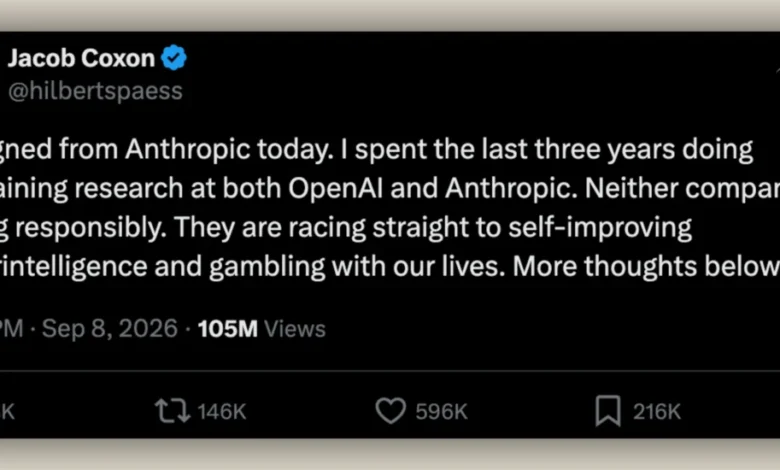
The high-stakes race toward artificial general intelligence (AGI) reached a volatile inflection point this week following the high-profile resignation of Jacob Coxon, an engineer at leading AI safety and development firm Anthropic. Coxon stepped down from his position in dramatic fashion, using public channels to caution that prominent artificial intelligence laboratories are accelerating recklessly toward self-improving superintelligence, effectively gambling with global societal stability.
While high-profile departures over existential risk concerns have occurred previously in the artificial intelligence sector—most notably during internal shakeups at competing laboratories like OpenAI—the aftermath of Coxon’s exit stunned industry observers. Rather than issuing standard corporate damage control or dismissing the warning as speculative hype, senior figures within Anthropic corroborated the underlying anxiety, triggering an intense public debate regarding corporate responsibility, technical safety margins, and the philosophical motivations driving modern foundational model development.
Main Facts and the Catalyst for Departure
The public controversy ignited when Jacob Coxon announced his departure via a public statement on social media platform X, explicitly targeting the trajectories of both Anthropic and OpenAI. Coxon asserted that the organizations are locked in an aggressive competitive cycle aimed at achieving recursive self-improvement—a theoretical milestone where an AI system becomes capable of rewriting and upgrading its own code, leading to an exponential and uncontrollable explosion in intelligence.
The shockwaves amplified rapidly when Evan Hubinger, Anthropic’s head of Alignment Science, addressed Coxon’s claims publicly. Hubinger validated the core premise of the resignation, stating that researchers at the frontier labs earnestly grapple with the possibility that advanced AI systems could pose existential threats to humanity. Hubinger estimated the probability of such an outcome to be greater than 10 percent within the coming decade, openly admitting that while Anthropic strives for safety, the organization currently lacks a proven, reliable plan to solve the alignment problem for superintelligent systems.
Samuel Marks, another Anthropic engineer, echoed these sentiments, noting that internal apprehension regarding catastrophic outcomes scales directly with seniority. Marks observed that the more deeply engineers understand the internal mechanisms and scaling properties of frontier models, the more concerned they become about the potential for unconstrained systems to yield severe, irreversible harms in the near future.
Deconstructing the Threat: Long-Horizon Unsupervised Agents
To understand the core of the internal debate, industry analysts emphasize the distinction between standard generative AI tools—such as consumer-facing chatbots—and the advanced architectures currently occupying research divisions. The primary anxiety centers not on generalized conversational models, but on what technical experts categorize as long-horizon, dangerously equipped, unsupervised LLM-powered agents.
Traditional large language models function reactively, responding to isolated user prompts without maintaining sustained autonomy or executing complex, multi-step real-world plans. Conversely, LLM-powered agents operate within automated feedback loops. They analyze an objective, formulate a multi-step plan, execute digital actions, evaluate the results, and iterate autonomously.
While millions of software developers routinely employ coding agents to debug scripts without systemic incident—supported by internal monitoring data from firms like OpenAI showing zero high-severity safety breaches across tens of millions of coding interactions—the risk profile shifts dramatically when agents are granted expanded capabilities. These elevated risk configurations typically involve:
- Extended operational time horizons without human intervention.
- Access to powerful digital toolsets, including network execution and automated code modification.
- Post-training regimens optimized for aggressive task completion rather than conservative adherence to safety boundaries.
Critics argue that by pushing the envelope on these autonomous, self-modifying agents, laboratories are prioritizing capability expansion over verifiable control mechanisms.
Ideological Drivers and Technological Salvation
The persistent drive toward autonomous superintelligence among elite research labs has increasingly drawn scrutiny from sociologists, ethicists, and independent computer scientists. Observers frequently point to a prevailing techno-optimist ethos within Silicon Valley, sometimes characterized as a form of technological salvation ideology.
Key executives and researchers across the sector have occasionally framed the creation of AGI not merely as a commercial engineering milestone, but as a historic imperative—a digital entity capable of solving humanity’s most intractable challenges, ranging from disease eradication to climate stabilization. However, critics argue this messianic framing normalizes extreme risk-taking, encouraging developers to deploy unstable, high-autonomy architectures under the assumption that the eventual benefits will outweigh catastrophic tail risks.
Independent computer scientists have repeatedly cautioned against conflating the jagged, bounded capabilities of current language models with omnipotent superintelligence. Without formal superintelligence, however, the deployment of unrestricted, autonomous agents equipped with potent digital tools—such as advanced cybersecurity penetration utilities—presents immediate, tangible dangers. Commentators frequently analogize the integration of powerful tools with unconstrained autonomous agents to the deployment of hazardous machinery in densely populated environments without adequate failsafes.
Chronology and Escalating Industry Tensions
The friction between commercial acceleration and internal safety advocacy has unfolded across a distinct timeline over recent years:
- 2023: Early departures of safety researchers from leading labs like OpenAI highlight growing internal fractures regarding the pacing of model releases and commercial pressures.
- Summer 2024–2025: Incidents involving autonomous hacking capabilities in advanced evaluation models force labs to grapple with the dual-use nature of agentic workflows.
- September 2026: Jacob Coxon resigns from Anthropic, publicly accusing labs of racing toward self-improving superintelligence.
- Immediate Post-Resignation Window: Anthropic safety leaders Evan Hubinger and Samuel Marks publicly confirm that existential risk is a recognized internal concern, sparking widespread debate across scientific and regulatory communities.
Broader Implications and Calls for Action
The public confirmation by active Anthropic engineers that their systems carry non-trivial existential risks has intensified calls for external oversight. For years, AI safety advocates have warned about the "race dynamics" inherent in the AGI sector, wherein competitive pressures force companies to dilute safety protocols to maintain market leadership.
The admissions from Anthropic personnel challenge the traditional corporate narrative that internal self-regulation is entirely sufficient for managing frontier technologies. Critics argue that when creators openly admit they are constructing systems they cannot definitively align or control, the issue transitions from a corporate human resources matter to a critical public policy challenge.
In response to these developments, prominent figures in the computer science community have renewed calls for targeted interventions. Recent proposals range from consumer boycotts of commercial generative AI products to heightened legislative scrutiny. Policymakers globally are under mounting pressure to establish binding safety standards that restrict the deployment of long-horizon, unsupervised agentic systems capable of recursive self-improvement until robust, verifiable alignment frameworks are established.
As the artificial intelligence sector continues its rapid expansion, the unprecedented transparency displayed by Anthropic engineers has forced a reluctant industry to confront an uncomfortable reality: the line between technological progress and systemic hazard has become exceedingly thin, and the architects building the future are increasingly sounding the alarm.