A Comprehensive Guide to Answer Engine Optimization and the Rise of AEO Checker Tools

The fundamental architecture of the internet is undergoing a profound transformation as generative artificial intelligence shifts the primary mode of information discovery from a list of blue links to synthesized, conversational summaries. For businesses that have spent decades optimizing for traditional search engine results pages (SERPs), this shift—often referred to as Answer Engine Optimization (AEO)—presents both a significant risk and a strategic opportunity. As users increasingly rely on platforms like ChatGPT, Perplexity, and Google’s AI Overviews to answer complex queries, the ability to appear as a cited source within an AI-generated response has become a critical component of digital visibility.
The decline of the traditional "click-through" model is statistically significant. Recent industry data suggests that as much as 40% of search volume is increasingly satisfied by zero-click interactions, where the AI provides a comprehensive answer that renders further navigation unnecessary. This evolution demands a new class of analytics software: the AEO checker. These tools provide the necessary diagnostics to track brand mentions, source citations, and the sentiment of AI-generated responses, effectively bridging the gap between legacy SEO and the new era of generative search.
![AEO checker tools that measure answer engine visibility [2026]](https://53.fs1.hubspotusercontent-na1.net/hubfs/53/aeo-checker-1-20260903-3858273.webp)
The Genesis of the AI Search Shift
The transition toward answer-first search began in earnest with the rapid adoption of large language models (LLMs) in 2023. While Google had experimented with "featured snippets" for years, the deployment of AI Overviews in May 2024 marked a formal pivot. By integrating real-time web retrieval with LLM-driven synthesis, Google and its competitors fundamentally altered the user journey.
In this new environment, the goal of a brand is no longer just to "rank" for a keyword, but to be "retrieved" as a verifiable authority. Answer engines function by parsing vast datasets and selecting sources that demonstrate high topical authority, clear semantic structure, and direct relevance to the user’s intent. Consequently, if a brand’s content is not structured for machine readability, it effectively becomes invisible to the millions of users relying on AI assistants for product research and service discovery.
How AEO Checkers Bridge the Visibility Gap
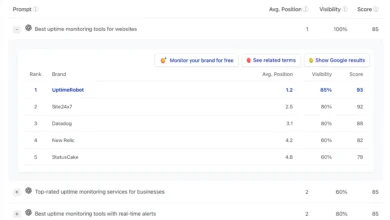
An AEO checker functions by simulating user queries across various AI platforms to determine if a brand is mentioned or cited. Unlike standard SEO tools that monitor keyword rankings, an AEO checker operates on a diagnostic loop: it measures, diagnoses, prioritizes, and reports.
![AEO checker tools that measure answer engine visibility [2026]](https://no-cache.hubspot.com/cta/default/53/9dd5e54b-fbef-4dd0-bc44-1689feb1ea18.png)
The technical requirements for these tools are demanding. Because AI responses are non-deterministic—meaning the same query can yield different results across different sessions or regions—AEO checkers must utilize multi-session sampling to provide statistically significant data. A robust tool typically tracks:
- Citation Frequency: How often the brand is explicitly linked as a source.
- Brand Mentions: Instances where the brand is named in the text, even without a direct hyperlink.
- Competitor Benchmarking: Identifying which rivals are being cited for the same informational queries.
- Entity Accuracy: Monitoring whether the engine is providing correct or outdated information about the brand’s offerings.
Chronology of AI Search Evolution
The rapid acceleration of these technologies can be traced through several key milestones:
- Late 2022: The public release of ChatGPT triggers a surge in interest regarding AI’s potential to displace traditional search.
- Early 2023: Perplexity AI gains traction by emphasizing citation-heavy responses, establishing the "cited-answer" as the industry gold standard.
- May 2024: Google launches AI Overviews (AIO), formally institutionalizing the "answer-first" model for the world’s most popular search engine.
- June 2026: Google introduces dedicated generative AI performance reporting, signaling that major search providers are finally ready to provide publishers with granular data regarding AI traffic.
Despite these advancements, the industry remains in a period of transition. Google’s internal reporting is still limited, and many publishers are forced to rely on third-party AEO software to fill the data void left by platforms that prioritize user experience over publisher analytics.
![AEO checker tools that measure answer engine visibility [2026]](https://53.fs1.hubspotusercontent-na1.net/hubfs/53/aeo-checker-2-20260903-852936.webp)
Strategic Implications for Digital Marketing
The emergence of AEO necessitates a fundamental shift in content strategy. The "link-bait" tactics of the early 2010s are increasingly ineffective. Instead, answer engines favor "information-dense" content. This includes clear, schema-rich data, FAQs that directly address user pain points, and primary research that acts as an authoritative source for AI training data.
Industry analysts note that SEO and AEO are not mutually exclusive. In fact, they are deeply symbiotic. A page that lacks strong technical SEO foundations—such as poor crawlability, slow load times, or weak backlink profiles—is unlikely to be selected by an AI engine as a source. Therefore, the "classic" SEO work of the past remains the bedrock upon which AEO success is built.
Evaluating the Competitive Landscape
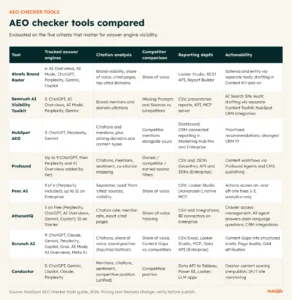
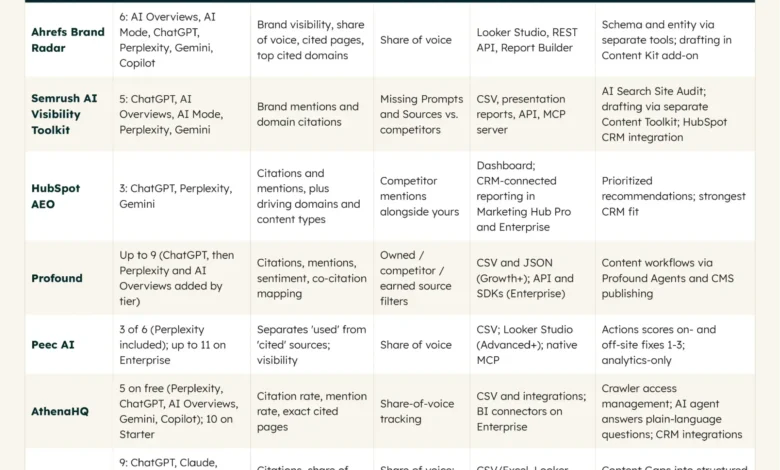
The market for AEO tools is currently segmented by the specific engines they monitor. Ahrefs and Semrush have leveraged their massive historical search databases to offer AI visibility toolkits that highlight which traditional ranking keywords are now triggering AI Overviews. These tools are ideal for organizations looking to protect their existing traffic share.
![AEO checker tools that measure answer engine visibility [2026]](https://53.fs1.hubspotusercontent-na1.net/hubfs/53/aeo-checker-3-20260903-8904553.webp)
Conversely, newer, specialized players like Profound and Peec AI focus on the nuances of generative responses, such as sentiment analysis and citation context. For enterprise-level organizations, platforms like HubSpot have integrated AEO directly into their CRM and Content Hubs. This integration is a significant advancement because it allows for "closed-loop" optimization: the software detects an AI visibility gap, recommends a content update, and provides the generative tools to draft that content, all within a single ecosystem.
Data-Driven Metrics for Success
For businesses adopting an AEO framework, success should be measured through a specific set of KPIs:
- Share of Voice (AI): The percentage of relevant industry queries where the brand is cited compared to key competitors.
- Citation Consistency: The frequency with which a brand appears in a specific query across repeated sessions.
- Referral Quality: Monitoring the conversion rate of traffic that originates from AI citations, which often carries higher intent than standard organic traffic.
It is important to acknowledge the limitations of these metrics. Because many AI interactions result in "zero-click" engagement, traditional conversion tracking may underestimate the value of a brand mention. A user who reads a brand’s name in an AI answer but does not click the link may still develop brand affinity or perform a separate, direct search later. Companies must treat AEO as both a direct traffic driver and a top-of-funnel branding exercise.
![AEO checker tools that measure answer engine visibility [2026]](https://53.fs1.hubspotusercontent-na1.net/hubfs/53/aeo-checker-4-20260903-6212698.webp)
Future Outlook and Challenges
As generative search continues to mature, we can expect two major trends: the consolidation of AEO metrics into standard search consoles and an increase in "content-gated" AI environments. If search engines begin to prioritize "walled-garden" data, the importance of third-party AEO checkers will only increase.
Furthermore, the legal and ethical landscape of AI training data remains a subject of intense debate. Publishers are increasingly concerned about their content being used to train the very systems that threaten their traffic. However, from a practical standpoint, the adoption of AEO is a defensive necessity. By optimizing for citations, brands are effectively securing their seat at the table in the future of information discovery.
In conclusion, while the transition to answer-based search is challenging, it offers a path toward higher-quality traffic and improved brand authority. The businesses that thrive will be those that view AI not as an adversary to be blocked, but as a distribution partner to be optimized for. Investing in the right AEO checker is the first step in maintaining visibility in an era where the answers are becoming just as important as the links that lead to them.
Related posts: