Bridging the Front Desk Gap: How Small Businesses Choose Between Auto Attendants, Virtual Receptionists, and AI Call Handlers


Every missed telephone call represents a fracture in the foundation of customer acquisition and retention for small and mid-sized enterprises. In the modern business environment, when a prospective client encounters a perpetually ringing line, a convoluted keypad menu, or an abrupt hang-up due to staff unavailability, they rarely leave a voicemail. Instead, they typically pivot to a competitor listed a mere swipe away on a mobile search engine. For resource-constrained organizations, this friction creates a persistent revenue leak, prompting leadership teams to reevaluate traditional communications infrastructure.
The traditional business phone apparatus has long relied on two primary mechanisms to manage inbound traffic: the auto attendant and the live human receptionist. However, as labor costs rise and consumer expectations for instantaneous, 24/7 service accelerate, business owners increasingly find themselves navigating a technological inflection point. Understanding the operational boundaries, cost structures, and technological evolution of automated call management has become paramount for scaling businesses safely without bloating front-desk payroll.
The Anatomy of Inbound Call Attrition
The core dilemma facing small business operations is not merely a lack of incoming interest, but rather the inability to capture and service high volumes of traffic during peak operational hours or after standard business operations cease. Historically, businesses deployed standard auto attendants—colloquially known as "press one for sales" menus—to distribute inbound volume. While effective at directing callers who already possess explicit knowledge of a department or internal extension, these systems suffer from a critical functional limitation: they are incapable of closing an interaction.
An auto attendant functions strictly as a directional signpost. It cannot answer localized inquiries, qualify a prospective lead, process a payment, or schedule a verified appointment. When a caller requires substantive assistance beyond a basic departmental transfer, the rigid structure of a standard phone tree inevitably breaks down, resulting in abandoned calls and uncaptured revenue. This operational gap has catalyzed the adoption of advanced communication tools designed to finish conversations rather than merely passing them along.

Defining the Communications Hierarchy
To construct an effective call-handling strategy, enterprise leaders must first distinguish between three frequently conflated technological categories: auto attendants, virtual receptionists, and artificial intelligence-driven call handlers.
An auto attendant operates as a deterministic, automated audio menu. Upon connection, a synthesized or recorded voice greets the caller and prompts them to select a keypad or voice-activated destination. While integrated as a foundational feature within modern cloud-based business telephony platforms like RingEX, its utility remains strictly bound to routing. It cannot pivot outside its programmed routing matrix or adapt to nuanced human queries.
Conversely, a virtual receptionist service actively manages the substance of the interaction. Historically, this meant employing remote human agents through third-party call centers who answered calls off-site, transcribed messages, and booked calendars on behalf of the business. While effective at providing a human touch, traditional live virtual services introduce significant hourly overhead and variable scaling costs that can strain tight operating budgets.
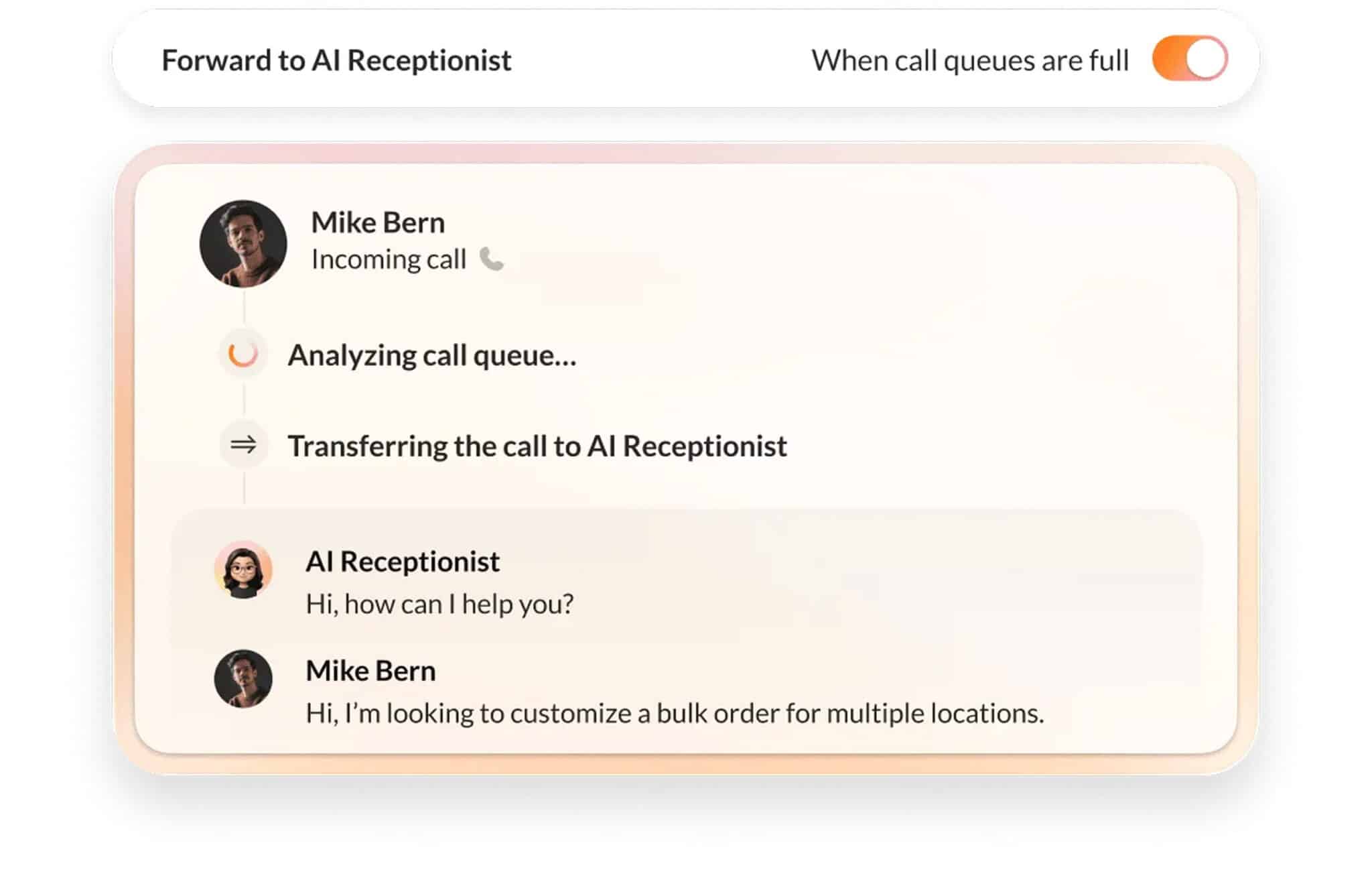
The modern evolution of this capability arrives via artificial intelligence. An AI receptionist bridges the technological divide by synthesizing the perpetual availability of an auto attendant with the conversational depth and comprehension of a live receptionist. Utilizing advanced voice-first generative models, these systems maintain spoken dialogues, answer detailed frequently asked questions, capture critical customer data, and execute scheduling tasks autonomously.
Industry Data and the Shift Toward Conversational Automation
Market research underscores a profound acceleration in the adoption of conversational automation tools across commercial sectors. According to empirical data compiled in a comprehensive survey of 187 customer service leaders conducted by technology research firm Gartner, approximately 85 percent of enterprises confirmed plans to actively explore or pilot customer-facing conversational generative artificial intelligence solutions.
This surging interest is most acute among environments characterized by high telephonic volume and restricted staffing resources—the exact operational profile of small-business front desks, boutique medical practices, and professional service firms. Furthermore, long-term prognostications from Gartner indicate that by 2029, autonomous agentic artificial intelligence systems will successfully resolve up to 80 percent of common customer service inquiries without requiring direct human intervention. For lean operating teams, this projected leap in technological autonomy marks the distinction between a telephone system that merely routes inquiries and one that actively drives business growth.
Strategic Evaluation: Matching Technology to Operational Demands
Choosing the appropriate call-handling architecture requires a systematic audit of a company’s inbound traffic patterns, staffing constraints, and customer conversion cycles. Business owners evaluating their communications infrastructure must weigh several fundamental operational metrics:
- Inbound Volume and Peak Timing: Quantify the exact frequency of calls arriving outside of standard operating hours or during concurrent internal staff engagements. If a high percentage of missed opportunities cluster during lunch hours or late evenings, static routing solutions will prove inadequate.
- The Complexity of Caller Inquiries: Analyze the nature of incoming questions. If callers frequently demand real-time inventory checks, appointment confirmations, or pricing structures, a traditional auto attendant will frustrate the user base and drive them toward competitors.
- Cost Versus Revenue Recovery: Contrast the predictable subscription costs of advanced software receptionists against the measurable financial loss of dropped customer leads. While human virtual receptionists offer a personal touch at a higher price point, AI-driven alternatives provide scalable, cost-effective coverage that expands automatically alongside call volume.
- Integration Capabilities: Ensure that any deployed call-handling technology seamlessly interfaces with existing customer relationship management (CRM) software, calendar scheduling applications, and unified communication suites without necessitating extensive staff retraining or complex hardware overhauls.
Technological Implementation and Future Outlook
Modern implementations—such as RingCentral’s AI Receptionist (AIR) add-on for cloud telephony architectures—demonstrate how automated systems can integrate directly into legacy workflows. By connecting conversational intelligence layers directly to existing business numbers and back-end calendars, these platforms operate continuously to intercept calls that would otherwise default to silent voicemails.
By capturing caller intent, executing dynamic scheduling, and routing complex cases exclusively to human agents when necessary, such tools mitigate the operational strain on front-desk personnel. As artificial intelligence models mature and voice synthesis achieves near-human parity, the debate over front-desk automation will shift permanently from whether businesses should adopt conversational tools to how rapidly they can deploy them to secure a competitive advantage in an increasingly demanding marketplace.