Salesforce Accelerates AI Efficiency With The Launch Of Koa Decisions To Revolutionize Enterprise Workflows

The landscape of generative artificial intelligence is undergoing a significant transition from broad, creative text generation to precise, operational decision-making. As enterprises move beyond the experimental phase of AI adoption, the demand for specialized, high-speed, and cost-effective models has reached a fever pitch. In this climate, Salesforce has officially introduced Koa Decisions, the latest iteration of its HyperClassifier technology, designed to handle the critical, split-second routing and categorization tasks that underpin modern enterprise agents.
This launch arrives amidst a broader industry trend toward "right-sizing" AI. Throughout mid-to-late 2024 and into 2025, a wave of specialized decision models has emerged, challenging the dominance of monolithic Large Language Models (LLMs). Companies such as TypeSafe AI, with its Jev model, and OpenAI, via its Decisions API, have signaled a collective industry pivot toward models built specifically for classification, scoring, and workflow routing. By decoupling these tasks from expensive, general-purpose LLMs, companies are successfully reducing inference costs while simultaneously improving the latency of their automated systems.
The Evolution of the Decision Model
For years, Salesforce has quietly refined its internal classification engines. The precursor to the current launch, HyperClassifier, served as the engine room for the company’s Agentforce platform. It functioned as an intelligent traffic controller, routing customer inquiries to the appropriate specialized sub-agent—whether that involved handling a "Where is my package?" query or facilitating a complex account escalation.
The chronological progression of these tools highlights a shift in development philosophy. Historically, building a classification model required a laborious lifecycle: defining outcomes, sourcing and labeling massive datasets, training a custom predictive machine learning model, and conducting iterative accuracy checks. This process often took months. With the introduction of Koa Decisions, Salesforce has transitioned to an approach rooted in "post-training" techniques applied to Google’s Gemma open-weight architecture. By leveraging the latent knowledge already present in a pre-trained language model, developers can now add new categories and deploy production-ready systems in a matter of hours rather than months.

Engineering Efficiency: The Architecture of Speed
The technical distinction between an LLM and a decision model is foundational. A standard LLM operates autoregressively, generating text one token at a time; each subsequent word is dependent on the probability distribution of the preceding sequence. This is a computationally intensive process that inherently introduces latency.
Koa Decisions, conversely, is designed to ingest a full request—whether text, audio, or image—and produce a singular, definitive output in one step. The performance data released by Salesforce indicates a stark disparity in efficiency: while a general-purpose LLM might take approximately 1.4 seconds to process a complex routing request, the Koa Decisions model completes the same task in roughly 26 milliseconds. This represents a performance gain of more than 50 times in terms of speed, a critical metric for enterprise-grade applications where millisecond delays can degrade the user experience in high-volume customer service environments.
By offloading these "quick calls" to Koa Decisions, Salesforce preserves the expensive compute cycles of larger LLMs for tasks that require genuine reasoning, creative writing, or complex synthesis. This architectural partitioning is expected to become the industry standard for scalable AI deployment.
Broader Impact on Enterprise Ecosystems
The implications for Salesforce builders and developers are profound. By integrating Koa Decisions into Flows, Apex, and prompt templates, the company is democratizing access to high-performance classification. Instead of requiring a data science team to manage custom models for every specific business process, administrators can utilize the platform’s native capabilities to trigger actions across the CRM.
Consider a scenario involving a high-value sales deal. When signs of churn or risk appear in the CRM data, Koa Decisions can instantly categorize the risk level and route an alert to the appropriate success team. Simultaneously, a more robust LLM can be triggered to generate a comprehensive summary of the account history. By the time a human account manager opens the notification, the system has already performed the triage and synthesized the necessary context.
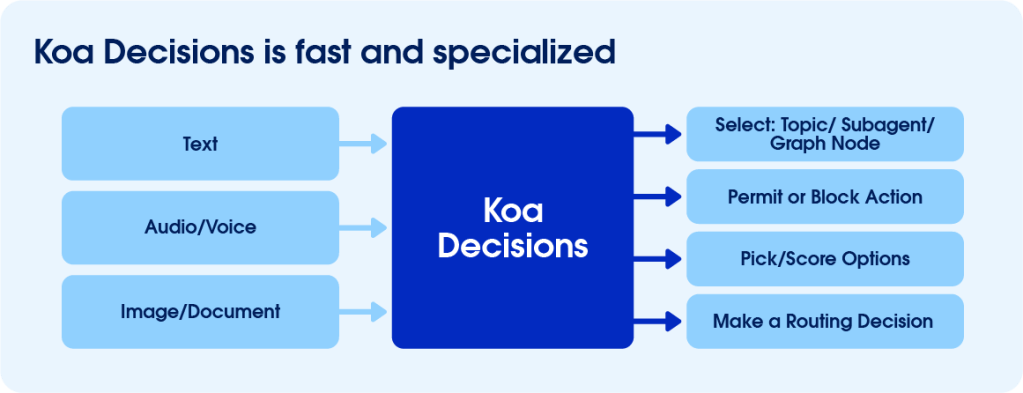
This modular approach addresses one of the most persistent hurdles in enterprise AI: the "black box" nature of general models. Because Koa Decisions returns clear, category-based choices—often accompanied by confidence scores—it provides a level of transparency and predictability that business stakeholders demand. If a model returns a low confidence score, the system can be configured to escalate the inquiry to a human agent, providing a safety net that is often difficult to implement with traditional LLMs.
Industry Context and Competitive Dynamics
The competition to own the "decision layer" of the enterprise stack is heating up. With OpenAI’s entry into the space, the race is no longer just about who has the smartest model, but who has the most efficient one. Analysts suggest that we are entering an era of "model specialization," where the most successful platforms will be those that offer an orchestration layer capable of routing queries to the most cost-effective model for the job.
Salesforce’s commitment to the Koa family, which also includes a separate reasoning model developed in partnership with NVIDIA, reflects a multi-model strategy. Rather than betting on a single "master" model, the company is building a distributed intelligence architecture. This allows for horizontal scalability; as business requirements evolve, new models can be swapped into the workflow without disrupting the underlying application logic.
For those looking to evaluate the technology, Salesforce has made a demo environment available via its Trailhead platform. This hands-on approach is designed to demystify the transition from traditional, manually coded business rules to AI-driven classification. The ability to retrain or update these models without the need for extensive code changes represents a significant shift in how enterprise software is maintained and updated.
Future Implications and Operational Realities
While the adoption of decision models offers clear advantages in terms of cost and speed, it also necessitates a shift in how organizations manage their AI infrastructure. As businesses scale these models across diverse departments—from HR and finance to marketing and sales—governance becomes paramount. Ensuring that these decision models are tuned correctly and that they operate within the constraints of organizational policies will be the next major challenge for CIOs.

Furthermore, the introduction of multimodal support—the ability for Koa Decisions to ingest audio and images—opens the door for more sophisticated automation. In the near future, we may see these models classifying images of damaged products in claims processing or identifying the sentiment of voice calls in real-time, all while maintaining the sub-100-millisecond response times that are currently proving so elusive for standard generative models.
As the industry matures, the "moment" that decision models are currently having may prove to be a permanent shift. The era of the "all-knowing" LLM is being superseded by the era of the "all-capable" agent, supported by a specialized team of models that know exactly which task they are best suited to perform. For Salesforce, Koa Decisions is the latest piece of a larger, long-term strategy to make AI not just an add-on feature, but a foundational element of the enterprise technology stack. With its focus on speed, integration, and ease of use, the company is positioning itself to lead the transition into this more efficient, agent-centric future.