In the modern corporate landscape, data is frequently heralded as the new currency, yet the raw material is rarely ready for consumption. Analysts, financial modelers, and business intelligence professionals spend countless hours grappling with fragmented spreadsheets, inconsistent formatting, and manual data-cleaning processes that drain productivity and introduce human error. To combat this widespread operational bottleneck, the Corporate Finance Institute (CFI) has officially launched its Level 3 professional training program, titled Introduction to Power Query. Designed to provide a practical, analyst-friendly foundation in data preparation, the five-hour, 100 percent online course aims to bridge the gap between raw data chaos and streamlined, automated reporting workflows in Microsoft Excel and Power BI.
The launch comes at a time when data literacy and automation are no longer optional skills for finance and corporate professionals. Industry surveys consistently reveal that business analysts spend up to 80 percent of their working time simply collecting, cleaning, and preparing data, leaving a fraction of their hours for actual high-value analysis and strategic decision-making. By introducing structured training centered on Power Query—a powerful data integration and transformation engine built directly into Microsoft Excel (for Windows and Mac) and Power BI—CFI is addressing a critical competency gap in the corporate workforce. The curriculum moves learners away from fragile, error-prone manual copy-pasting routines and toward robust, refreshable pipelines that update with a single click.
Core Curriculum and Structured Learning Path
The newly unveiled curriculum is meticulously structured to guide absolute beginners and intermediate spreadsheet users from foundational concepts to advanced, repeatable workflows. Taught by expert instructor Joseph Yeates, the self-paced program is divided into distinct, progressive modules that combine theoretical instruction with hands-on exercises utilizing real-world sample datasets.
The learning journey begins with an essential introduction to the Power Query interface, familiarizing students with the Power Query Editor, the Query pane, and the formula bar where the proprietary M language operates under the hood. From there, the curriculum transitions into basic transformations, teaching participants how to promote headers, change data types, filter rows, and select specific columns.
As students progress deeper into the course, the modules address more complex data challenges. The cleaning and transforming data section tackles pervasive corporate data maladies, such as handling null values, removing duplicates, trimming rogue whitespace, and unpivoting cross-tabulated reports into normalized, database-ready structures. Furthermore, the reshaping and combining data module equips analysts with the skills to merge and append multiple tables from disparate sources—such as CSV files, relational databases, and web feeds—without writing complex Visual Basic for Applications (VBA) code or convoluted nested formulas.
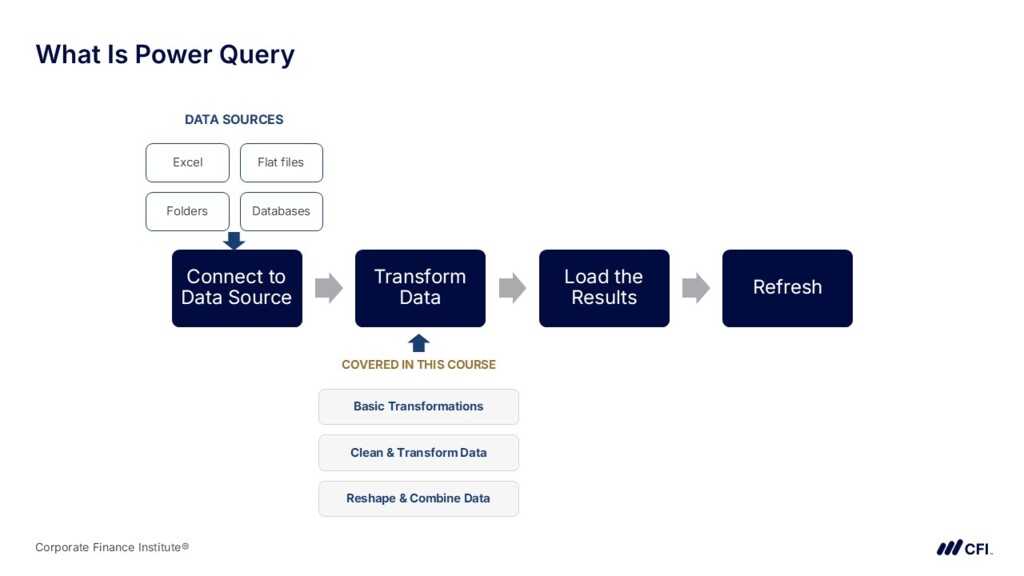
The ultimate culmination of the course focuses on building repeatable workflows. Participants learn how Power Query records every single transformation step as a distinct applied step, creating a transparent, auditable, and easily modifiable audit trail. When source data is updated or replaced next month, the workflow simply reapplies the recorded steps automatically, slashing reporting cycle times from hours to mere seconds. The program concludes with a comprehensive course wrap-up and a qualified assessment requiring an 80 percent passing grade, ensuring that graduates possess verifiable competence before receiving their certificate of completion.
Integration Within Broader Professional Certifications
Rather than existing as an isolated module, the Introduction to Power Query course has been strategically integrated into several of CFI’s most prestigious professional career paths and specializations. Recognizing that modern business intelligence requires a multidisciplinary skill set, CFI has embedded the course into programs such as the Data Analysis in Excel Specialization, the Business Intelligence Analyst Specialization, the Financial Planning & Analysis (FP&A) Professional track, the Macabacus Specialist program, and the cutting-edge AI Finance Professional (AIFP) Certification.
This strategic integration acknowledges that financial modeling and artificial intelligence applications in finance are only as good as the underlying data inputs. By standardizing data preparation techniques across these specializations, CFI ensures that professionals pursuing holistic career advancement are thoroughly grounded in best practices for data hygiene and pipeline management. Additionally, because CFI is accredited by the National Association of State Boards of Accountancy (NASBA) in the United States and CPA institutions in Canada, eligible professionals completing the course can earn valuable Continuing Professional Education (CPE) credits toward maintaining their CPA charters.
Technical Accessibility and System Requirements
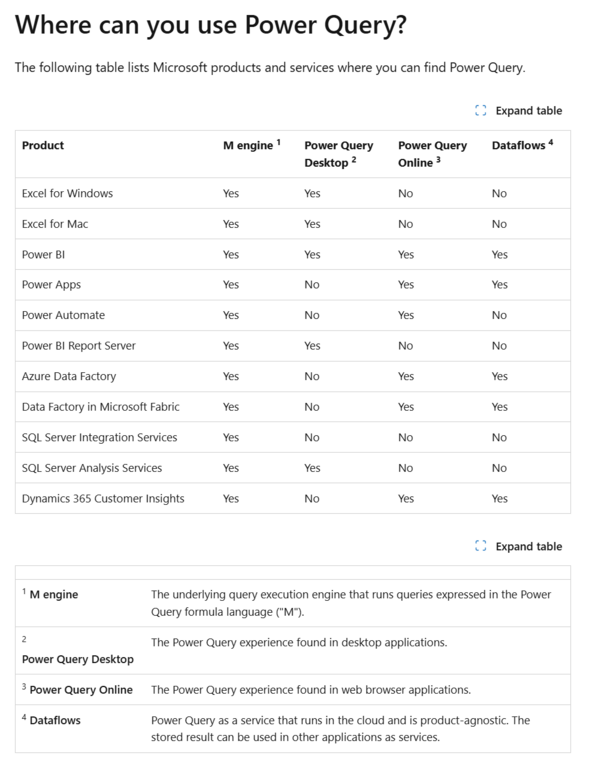
In developing the course, CFI placed a strong emphasis on platform accessibility and technical feasibility. Because Power Query is natively integrated into modern versions of the Microsoft ecosystem—including Microsoft Excel 2016 and newer for Windows, Excel for Mac, and Microsoft Power BI—students do not need to procure expensive, third-party software licenses to participate.
However, course administrators note that minor feature variations exist across different operating systems and product versions. For instance, while Windows users enjoy the most robust and complete Power Query toolset, Mac users have seen significant feature parity improvements in recent years. To ensure a seamless learning experience, CFI mandates that students verify their software compatibility using Microsoft’s official technical documentation prior to enrollment. Additionally, students are provided with comprehensive downloadable course files, financial modeling templates, and step-by-step documentation via their student dashboards, allowing them to replicate every exercise locally on their own machines.
Student Reception and Industry Implications
Early feedback from students who transitioned from CFI’s legacy data fundamentals training to the new Introduction to Power Query course has been overwhelmingly positive. Early adopters have praised the curriculum’s direct applicability to their day-to-day corporate responsibilities.
Owen Crichlow, a program participant, noted the immediate professional utility of the updated material, stating that the course introduced numerous advanced techniques that could be directly deployed in his current job role to streamline legacy reporting processes. Another student, Steve McKenzie, emphasized the eye-opening nature of the software, highlighting how Power Query fundamentally transforms data analysis from a tedious chore into an efficient, automated science.
From an industry perspective, the proliferation of specialized training courses like CFI’s reflects a broader macroeconomic shift toward digital transformation and operational efficiency. In an economic climate marked by cost containment and high labor costs, organizations are increasingly pressuring finance and analytical departments to do more with less. Manual data wrangling is increasingly viewed as an inefficient use of highly compensated analytical talent. By upskilling employees to build self-sustaining data pipelines, organizations can significantly reduce operational risk, eliminate key-person dependencies associated with complex, macro-driven spreadsheets, and accelerate decision-making cycles.
Furthermore, the integration of Power Query training into artificial intelligence and business intelligence curricula underscores the foundational role data preparation plays in advanced analytics. As corporations race to adopt generative AI, predictive modeling, and automated dashboarding, clean and structured data remains the critical prerequisite. Garbage in, garbage out remains an immutable law of computing; courses that teach analysts how to sanitize and structure data at the source are indispensable building blocks for the future of corporate finance.
Enrollment, Pricing, and Support Options
The Introduction to Power Query course is available immediately on a 100 percent online, self-paced basis through CFI’s flexible subscription platform. Students retain yearly access to the course materials, updates, and exercise files as long as their subscription remains active, allowing them to learn at their own pace without the pressure of rigid academic deadlines.
CFI offers various enrollment tiers, ranging from self-study bundles to full immersion packages that include premium email support with in-house subject matter experts. Technical requirements are minimal, requiring only a stable internet connection, a PC or Mac, and a compatible version of the Microsoft Office suite.
As corporate data volumes continue to expand exponentially, the ability to tame unruly spreadsheets and build resilient data pipelines will remain a defining career differentiator for financial analysts and business intelligence professionals. With the launch of this targeted training program, the Corporate Finance Institute has once again reinforced its commitment to equipping the global workforce with the practical, job-ready skills required to thrive in a data-driven economy.