Salesforce and Microsoft unveil Copilotforce to bridge CRM intelligence with enterprise productivity ecosystems


The landscape of enterprise software underwent a significant transformation on November 17, 2026, as Salesforce and Microsoft jointly announced the launch of Copilotforce at the Microsoft Ignite conference in San Francisco and Redmond. This strategic partnership represents a milestone in the integration of Customer Relationship Management (CRM) workflows directly into the Microsoft 365 ecosystem. By leveraging the advanced AI capabilities of both organizations, the collaboration seeks to eliminate the "context switching" that has historically hampered sales productivity, allowing employees to access, analyze, and act upon Salesforce data without leaving their daily communication and collaboration environments.
The Strategic Foundation of Copilotforce
At its core, Copilotforce is designed to act as an intelligence layer that connects Salesforce’s deep customer data with Microsoft’s pervasive productivity tools. For years, the enterprise software market has struggled with data silos; sellers often found themselves jumping between Outlook for email, Microsoft Teams for communication, and Salesforce for deal tracking. Copilotforce effectively dissolves these boundaries. Through the new integration, Salesforce’s customer context—including opportunity stages, account history, and recent interactions—is surfaced directly within Microsoft Copilot.
This integration is powered by "AIforce," a live interface layer that enables Salesforce’s proprietary AI models to function within external environments. By grounding Microsoft’s large language models in the highly specific, secure data held within Salesforce’s Data 360, the system provides sellers with actionable, context-aware insights. For example, a salesperson preparing for a client meeting can now ask Microsoft Copilot to summarize the current state of an opportunity, generate a pre-meeting briefing based on recent Teams chats, and suggest specific actions to move the deal forward, all while remaining within the Teams interface.
A Chronology of Integration
The path to Copilotforce began with a series of incremental steps aimed at closing the gap between the two software giants. The precursor to this announcement was the pilot of "Sales Cloud in Teams," which was unveiled during the Dreamforce conference. That initial project laid the groundwork by demonstrating that basic CRM insights could be successfully surfaced in a collaborative environment.
Following the success of the pilot, the technical teams at Salesforce and Microsoft focused on the deeper architectural challenges of data governance and interoperability. By mid-2026, the focus shifted to bidirectional connectivity. The resulting integration, announced today, represents the culmination of this work, moving from simple data viewing to complex, bidirectional workflows. This includes "writeback" capabilities, where a user can update a CRM opportunity directly from a Teams window, with the system ensuring that all changes respect the original validation rules and compliance protocols established in the Salesforce backend.
Technical Infrastructure: The Zero-Copy Paradigm
One of the most significant technical hurdles in enterprise AI is the management of data duplication. Traditionally, syncing data between a CRM and a data warehouse required brittle Extract, Transform, Load (ETL) pipelines, which are not only slow but create security vulnerabilities through data proliferation.
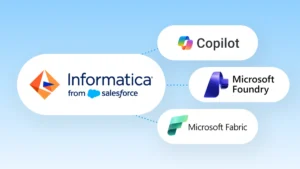
Copilotforce addresses this through bidirectional zero-copy data access between Salesforce Data 360 and Microsoft Fabric. This architecture allows organizations to query Fabric data natively within Salesforce and vice-versa, without moving the underlying files. By keeping the data at the source, companies can maintain strict governance and security policies while enabling AI models to access a "single source of truth." This is particularly critical for large enterprises that must comply with GDPR, CCPA, and other regional data privacy regulations. Because the integration does not involve physical data movement, it reduces the risk of data leakage and ensures that the most current, authorized information is always being used to inform AI-driven decisions.
Official Responses and the Role of Accenture
The scale of this collaboration is reflected in the involvement of Accenture as both a design partner and "Customer Zero." Accenture, which manages a workforce of over 740,000 employees and maintains one of the world’s largest Salesforce implementations, is currently deploying these integrations internally. This real-world testing serves as a validation mechanism for the technology, allowing the developers to refine the user experience before the broader market rollout.
Miguel Milano, President and COO of Salesforce, framed the partnership as a necessary evolution for the modern enterprise. "By bringing together the #1 CRM with the #1 productivity surface, we’re transforming AI from a standalone tool into a powerful driver of productivity," Milano stated. His perspective was echoed by Judson Althoff, CEO of Microsoft Commercial Business, who emphasized the importance of data grounding. Althoff noted that AI is only as effective as the context provided to it, suggesting that the synergy between Salesforce’s customer insights and Microsoft’s work context will provide a competitive advantage for users who require high-confidence decision-making in real-time.
Julie Sweet, Chair and CEO of Accenture, highlighted the practical implications for global sales organizations. By acting as the pilot site for the technology, Accenture aims to provide a blueprint for other multinational firms, demonstrating how to scale AI-assisted sales workflows without disrupting existing operational hierarchies.
Implications for Enterprise AI
The broader implications of the Copilotforce partnership extend beyond just sales productivity. It signals a shift in the enterprise software market toward "ecosystem interoperability." For the past decade, vendors have competed to be the "all-in-one" solution. This partnership acknowledges that in the modern enterprise, no single vendor can own the entire stack. Instead, success is defined by how well different platforms communicate.
By integrating Informatica’s plugin for Copilot, the partnership also addresses the "trust gap" in AI. Business users can now verify the authoritativeness of data through natural-language queries, ensuring that the AI is not hallucinating based on faulty or outdated information. For data engineers, the expanded Fabric scanning capabilities provide much-needed visibility into data lineage, making it easier to track how data flows from a Salesforce lead to a Microsoft-powered analytical report.
Market Impact and Future Outlook
Analysts suggest that this collaboration will likely pressure other CRM and productivity software providers to pursue similar integration strategies. As AI becomes the standard interface for work, the value of an application will be increasingly determined by its ability to act as a "good citizen" within a broader, multi-vendor software ecosystem.
For the end user—the sales representative—the transition to an AI-augmented workflow is expected to be significant. By automating the mundane tasks of data entry, meeting preparation, and document retrieval, the hope is that sellers can redirect their focus toward high-value activities, such as relationship building and strategic planning.
However, the success of Copilotforce will depend heavily on adoption rates and the ability of organizations to manage the change in culture. The technology is currently being rolled out in phases, with detailed roadmaps provided to enterprise clients to assist in their transition. While pricing and packaging details remain subject to change, the current consensus is that the partnership provides a clear path for companies to derive more value from their existing technology investments without the need for massive, disruptive infrastructure migrations.
As organizations prepare for the 2027 fiscal year, the integration of Salesforce and Microsoft represents a significant maturation of the enterprise AI market. It moves the conversation away from the hype of "generative AI" and toward the practical, governed, and secure implementation of AI as a standard operational tool. By combining the strengths of two of the largest players in the tech industry, Copilotforce provides a framework for the future of work—one where the software adapts to the employee, rather than the employee adapting to the software.