RingCentral Bridges Communications and Artificial Intelligence with New MCP Connectors for Claude and ChatGPT

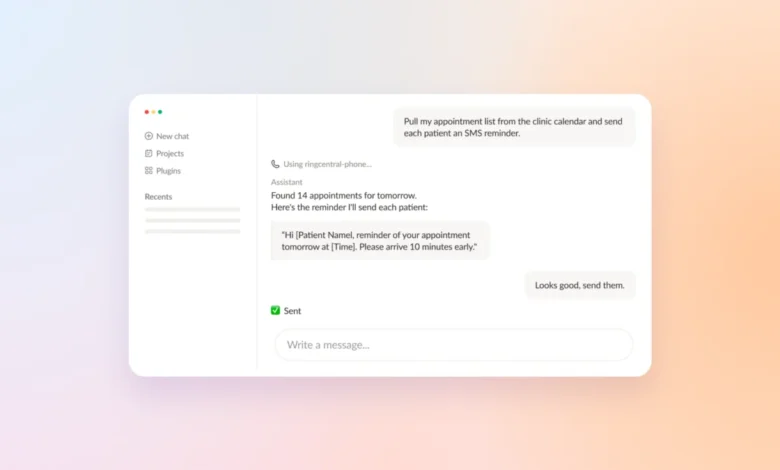
In an era defined by rapid advancements in artificial intelligence and enterprise productivity, RingCentral has announced a major technological integration designed to bridge the gap between unified communications and generative AI. By leveraging Model Context Protocol (MCP) connectors and dedicated plugins, RingCentral now allows business users to seamlessly connect their RingEX communication data—including voice calls, text messages, voicemails, and team chats—directly into advanced large language models (LLMs) such as OpenAI’s ChatGPT and Anthropic’s Claude. This development marks a significant shift in how enterprises manage, analyze, and act upon unstructured conversational data, transforming isolated communication silos into a unified, intelligent knowledge base.
Main Facts and Technological Foundation
The core of this integration relies on the Model Context Protocol (MCP), an emerging open standard that facilitates secure, bidirectional communication between AI models and enterprise data sources. Traditionally, enterprise workers have had to manually switch contexts, copy-pasting transcripts or searching through fragmented software logs to piece together the history of a customer relationship or project update.
With the deployment of the RingEX plugin for ChatGPT and the RingCentral connector for Claude, the workflow changes fundamentally. Once authenticated via standard OAuth protocols, the LLMs gain read and action capabilities over authorized RingCentral data repositories. An AI assistant can now pull historical call records, parse message histories, draft SMS replies, and synthesize multi-touchpoint interactions entirely within the user’s preferred chat interface.
Crucially, this integration is designed to respect enterprise security and governance frameworks. The underlying communication data remains secured within RingCentral’s existing administrative architecture, ensuring compliance with corporate policies without requiring extensive developer intervention or complex infrastructure overhauls. For existing RingCentral subscribers, these plugins and connectors are provided at no additional software licensing cost, though users remain responsible for individual LLM platform token usage and standard RingCentral messaging fees.
Background Context and the Evolution of AI in the Workplace
To understand the significance of RingCentral’s latest deployment, one must examine the broader evolution of workplace technology over the past decade. Enterprise communications have historically suffered from fragmentation. A single business relationship often spans phone calls, SMS text chains, internal team chats, and formal emails. While unified communications-as-a-service (UCaaS) platforms like RingCentral successfully brought many of these channels under a single application umbrella, extracting actionable intelligence from the aggregate data historically required manual review or complex, custom-built API integrations.

Concurrently, the explosive growth of generative AI and LLMs created a demand for context-aware digital assistants. However, early iterations of enterprise AI tools were limited by their isolation from real-time operational communications. An LLM could summarize a static document, but it lacked visibility into the nuanced context of a customer service call or a quick text check-in between a project manager and a client.
The introduction of MCP by industry pioneers in late 2024 and 2025 provided the standardized plumbing needed to connect AI models safely to live operational data. Recognizing this shift, RingCentral accelerated its strategy to embed its communication graph directly into the ecosystems where knowledge workers spend a significant portion of their day. By targeting Claude and ChatGPT—two of the dominant generative AI interfaces in the enterprise market—RingCentral has positioned its platform as an active participant in the modern AI-driven workflow rather than a passive repository of historical logs.
Chronology and Deployment Details
The rollout of RingCentral’s LLM connectors follows a structured timeline focused on enterprise readiness, security compliance, and user accessibility:
- Initial Discovery and Prototyping: RingCentral engineering teams evaluated emerging protocols for secure LLM data sharing, identifying Model Context Protocol as the optimal framework for maintaining enterprise-grade security while enabling contextual AI memory.
- Marketplace Integration: Development of dedicated applications for the ChatGPT marketplace and Claude’s connector settings, ensuring streamlined installation pathways that bypass the need for custom API scripting.
- Security and Compliance Validation: Implementation of OAuth-based authentication models aligned with enterprise admin policies, ensuring that role-based permissions and data governance standards remain strictly enforced.
- General Availability: Official launch of the free RingEX ChatGPT plugin and Claude connector, accompanied by comprehensive administrative support documentation and video walkthroughs to drive rapid organizational adoption.
Official Responses and Industry Stakeholder Perspectives
While specific direct quotes from executive leadership regarding this exact deployment remain part of broader ongoing corporate communications, industry analysts and enterprise technology experts have widely praised the move toward contextual interoperability.
Enterprise software analysts note that the primary bottleneck in digital transformation is no longer the generation of data, but its accessibility and synthesis. By removing the friction between communication archives and generative reasoning engines, RingCentral addresses a persistent enterprise pain point. Observers suggest that solutions requiring users to leave their primary AI workspaces to look up phone logs or message histories face high friction and low adoption rates. Conversely, native protocol integration encourages natural, conversational querying that saves hours of administrative overhead weekly.
Furthermore, security and compliance officers have responded favorably to RingCentral’s adherence to standard OAuth login frameworks and existing administrative policies. In an era marked by heightened scrutiny over corporate data privacy and shadow AI usage, maintaining centralized control over who accesses call logs and message histories is considered a mandatory baseline for enterprise adoption.

Broader Impact and Implications Across Business Departments
The integration of RingCentral data into LLMs extends far beyond traditional customer service and sales departments, offering measurable utility across multiple organizational functions:
- Sales and Business Development: Sales professionals can prompt their AI assistant to summarize the last three phone conversations with a prospective client, identify unresolved questions, and draft a follow-up text message—all within seconds and without manually reviewing audio recordings or transcript files.
- Customer Support and Success: Support agents and account managers gain a continuous, chronological view of client sentiment and history, reducing resolution times and ensuring that recurring issues are identified and addressed proactively.
- Product and Engineering Teams: Product managers often conduct user interviews, stakeholder check-ins, and support triage calls. By connecting communication archives to Claude or ChatGPT, product teams can quickly synthesize qualitative feedback from dozens of voice and text interactions into actionable feature requests or bug reports.
- Executive Leadership and Operations: Management personnel can query operational communication trends, assess team responsiveness, and generate high-level summaries of critical negotiations or project bottlenecks without wading through raw data streams.
Fact-Based Analysis of Implementation Challenges and Future Outlook
Despite the clear productivity advantages, enterprise adoption of LLM-powered communication tools presents unique considerations that organizations must navigate.
First, data hygiene and privacy awareness remain paramount. While RingCentral’s connectors respect existing administrative policies and OAuth permissions, organizations must ensure that employees are trained on proper data stewardship when feeding enterprise communications into third-party AI platforms. Understanding how external LLM providers handle data retention, model training, and privacy compliance is a critical step for corporate IT departments.
Second, accuracy and hallucinations—common phenomena in generative AI—require human oversight. While an LLM can rapidly synthesize a call log or draft a message, the final accountability for customer communication and business decisions rests with human operators. RingCentral’s design philosophy reflects this reality by positioning the AI as a co-pilot that assists with drafting, summarizing, and retrieval, rather than an autonomous actor operating completely without supervision.
Looking forward, the convergence of unified communications and generative artificial intelligence is poised to accelerate. As protocols like MCP mature and expand, the boundaries between communication platforms, productivity software, and artificial intelligence will continue to blur. RingCentral’s proactive integration strategy ensures that its user base is well-equipped to leverage these transformative technologies securely, efficiently, and with minimal friction in their day-to-day operations.
Related posts: