Navigating the Complexities of Lead Qualification: How Modern B2B Organizations Fix Pipeline Drag and Drive Revenue Growth

In the fast-paced ecosystem of modern business-to-business (B2B) commerce, the difference between a thriving revenue pipeline and stagnant sales performance often boils down to a single, critical operational mechanism: lead qualification. Across industries, sales and marketing organizations increasingly find themselves grappling with systemic inefficiencies that impede growth. Chief among these hurdles are ambiguous qualification criteria, incomplete data profiles, antiquated scoring models, and sluggish follow-up cadences. Together, these friction points create what sales leaders refer to as pipeline drag—a phenomenon where sales representatives invest precious hours pursuing low-potential prospects while high-value opportunities languish unworked.
To understand the mechanics of pipeline drag and explore viable solutions, industry experts frequently look to real-world operational transitions. One such case study involves Belkins.io, a prominent B2B lead generation agency that has anchored its sales infrastructure on HubSpot’s CRM platform since 2020. Insights shared by Kseniia Drachuk and Thomas Hendrix of Belkins reveal how rigorous internal audits and strategic pivots transformed their approach to qualification, offering a blueprint for organizations seeking to align marketing and sales functions.
The Anatomy of Pipeline Drag: Key Qualification Hurdles
Comprehensive lead qualification requires a delicate evaluation of three primary dimensions: fit, intent, and timing. When organizations fail to establish clear boundaries across these categories, the entire revenue engine suffers. Disorganization during the handoff process from marketing to sales slows momentum, while incomplete data obscures critical buying signals.

A historical review of Belkins’ operational evolution illustrates that organizations must actively identify and dismantle rigid, outdated assumptions to maintain a healthy pipeline. The most prevalent challenges obstructing modern sales teams typically manifest in four distinct areas.
Unclear Criteria and Inconsistent Representative Judgment
In the absence of standardized, documented definitions for what constitutes a qualified lead, sales representatives inevitably default to subjective judgment. Consequently, a prospect deemed high-potential by one representative might be dismissed by another, resulting in an unpredictable pipeline characterized by erratic handoffs and suboptimal deal allocations.
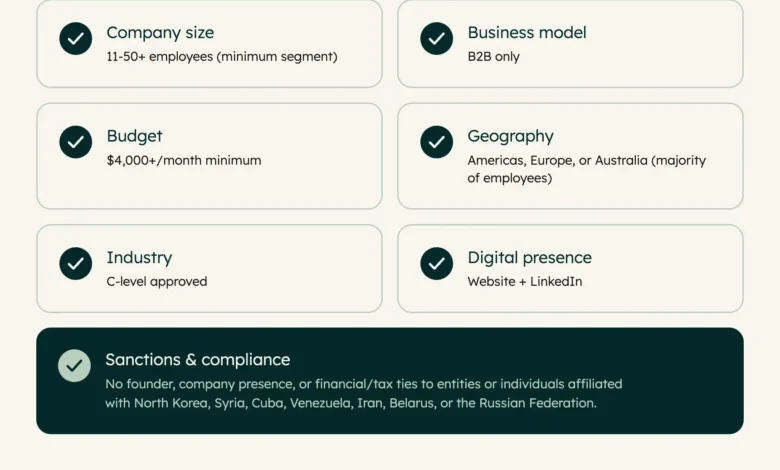
The remedy for this inconsistency is rigorous documentation. According to Drachuk and Hendrix, Belkins implemented strict, documented qualification criteria establishing specific fit thresholds. However, meeting baseline eligibility—such as Ideal Customer Profile (ICP) alignment, geographic boundaries, industry compliance, and a minimum budget threshold of $4,000 per month—is insufficient on its own. Prospects must also demonstrate a genuine business need aligned with agency services, alongside a willingness to discuss specific project requirements, goals, and timelines during the initial qualification phase. No single factor can serve as a substitute for the collective criteria.
Weak Service-Level Agreements and Flawed Handoffs

Marketing-generated leads possess a finite shelf life. Without formalized service-level agreements (SLAs) governing response times, lead ownership, and follow-up cadences, inquiries frequently languish in shared inboxes. By the time a representative initiates contact, the prospect’s attention has often waned. SLAs assign named points of contact across both marketing and sales divisions, establishing accountability and pre-determining corrective actions if commitments are missed.
Furthermore, poor handoffs generate redundant requalification friction. When sales teams lack visibility into a prospect’s prior marketing engagement history, they are forced to restart the qualification process from scratch. Providing sales personnel with comprehensive contact details, historical engagement data, and preliminary notes ensures a seamless continuation of the buyer’s journey.
Outdated Lead Scoring Models Detached from Real-World Data
Lead scoring models frequently fail when they rely on unverified assumptions rather than empirical evidence. For an extended period, Belkins enforced a rigid exclusion policy, disqualifying companies with fewer than 50 employees under the assumption that smaller organizations lacked the requisite budgets for outbound campaigns.
However, a comprehensive audit of a full year’s worth of closed-won data revealed a counterintuitive reality: a substantial share of United States-based companies with 11 to 50 employees possessed adequate budgets, coupled with a pressing internal deficit of Specialized Development Representative (SDR) capacity. By reintroducing this segment into their ICP, Belkins expanded deal volume without sacrificing win rates. Modern predictive lead scoring must continuously reflect actual closed-won patterns rather than static, initial hypotheses.

Data Deficits and Accelerated Response Timelines
The presence of missing firmographic or contact data forces sales representatives to halt their workflows and conduct manual research. Every minute spent chasing basic organizational metrics—such as company size, verified LinkedIn profiles, or industry classification—extends the speed-to-lead window. Because buyer engagement peaks shortly after initial contact, prolonged response intervals directly depress conversion probabilities. Automated data enrichment tools can dynamically populate these missing fields, allowing qualification protocols to initiate immediately upon lead arrival.
Redefining the Boundary Between Disqualification and Lead Recycling
A recurring operational error in B2B sales is the permanent disqualification of prospects who fail to match immediate structural requirements, rather than routing them into a recycling queue. At Belkins, prospects preferring a pay-per-appointment engagement model or organizations falling slightly outside primary headcount parameters were historically written off entirely.
Industry leaders emphasize a vital operational distinction: if the fundamental economic fit, organizational need, and budgetary capacity are sound, a temporary mismatch in timing or delivery structure should prompt lead recycling rather than outright dismissal. Disqualification should be reserved exclusively for fundamental failures in core alignment.

Systemic Solutions: Frameworks, Routing, and Automation
Addressing lead qualification challenges requires a systematic overhaul of organizational infrastructure, characterized by shared definitions, enforceable handoff checklists, and dynamic routing rules.
First, establishing standardized definitions ensures that a lead must systematically clear predetermined thresholds before advancing from marketing interest to sales readiness. Second, implementing automated routing rules guarantees that inquiries reach the most appropriate personnel instantly. Enterprise-tier accounts, for instance, are routed to experienced Account Executives, while mismatched leads are directed to external partner networks based on geographic or budgetary parameters.
Finally, continuous auditing of lead scoring models prevents revenue leakage caused by stale parameters. Rather than relying on fixed calendar schedules, organizations must periodically cross-reference their scoring metrics against closed-won analytics to ensure alignment with shifting market dynamics.
Strategic Implications for Long-Term Revenue Growth

Ultimately, lead qualification inefficiencies rarely stem from isolated operational errors; rather, they represent the cumulative impact of misaligned criteria, absent SLAs, and unverified scoring assumptions. By codifying definitions, automating handoffs through integrated platforms like HubSpot Smart CRM, and leveraging predictive enrichment tools, enterprises can transform their pipeline management from a reactive bottleneck into a predictable engine for sustainable revenue growth.