J. Crew revolutionizes digital retail with the launch of an AI-powered Style Advisor utilizing Anthropic’s Claude technology.

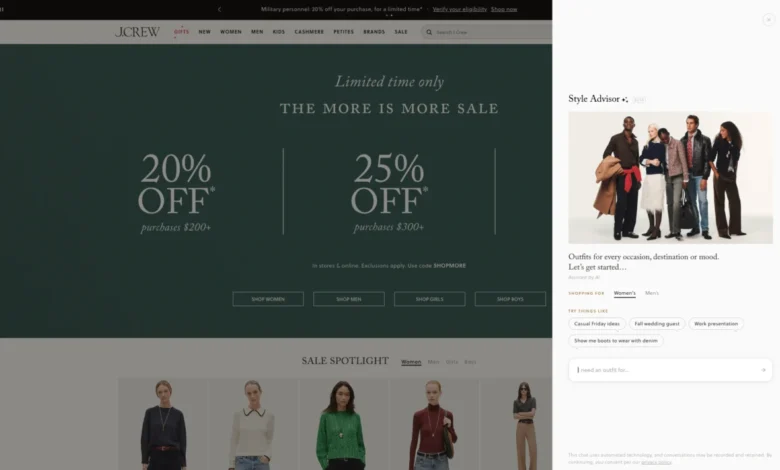
The fashion retail landscape is undergoing a profound transformation as J. Crew Group officially integrates artificial intelligence into its e-commerce ecosystem. On November 12, the retailer announced the deployment of its new "Style Advisor" tool, a sophisticated digital assistant designed to replicate the nuances of a high-end personal styling session. Powered by Anthropic’s advanced Claude artificial intelligence models, the platform represents a strategic shift from static, search-based shopping toward a dynamic, conversational retail experience. This launch marks a significant milestone for J. Crew, which is currently ranked No. 80 in the Top 1000 Database, a comprehensive index tracking the largest online retailers in North America by annual e-commerce revenue.
The Technological Architecture Behind Style Advisor
The development of the Style Advisor was a multi-stage engineering endeavor that leveraged various iterations of Anthropic’s model family. According to internal reports from the J. Crew product team, the development cycle began with the utilization of Claude Code and Claude Opus 5.5 to create a functional prototype. This initial phase allowed engineers to test the logic of the assistant, ensuring it could interpret complex fashion-related queries with a high degree of semantic accuracy.
Once the foundational logic was established, the production environment shifted to a tiered model approach. The system currently utilizes Claude Fable 5.1, a model specifically engineered for complex, open-ended tasks, to anchor the core decision-making and recommendation engine. For real-time interactivity, the system employs Claude Sonnet 5.5 to process user prompts and generate nuanced, style-focused feedback. To maintain high performance and low latency, the tool incorporates Claude Haiku 5.5, which handles shorter, more focused tasks. This architecture allows J. Crew to balance the "intelligence" of its platform with the speed required to satisfy modern consumer expectations for instantaneous digital service.
Chronology of Implementation
The rollout of Style Advisor follows a broader trend of investment in AI capabilities by major retail entities. J. Crew’s recent move has solidified its position in the competitive retail tech space, earning the brand a ranking of No. 135 in the Digital Commerce 360 and ReFiBuy AI Commerce Rankings.
The timeline for the project accelerated throughout the latter half of 2024. Following initial internal testing in the summer, the engineering team focused on "brand alignment"—a process of fine-tuning the AI to ensure that its aesthetic recommendations remain strictly consistent with J. Crew’s long-standing design ethos. By November, the tool was deemed ready for a public-facing beta, appearing as an accessible menu option on the primary J. Crew website. The interface is designed to be intuitive, presenting users with a series of suggested prompts that guide them through wardrobe building, seasonal styling, and occasion-specific outfit selection.
Strategic Vision and Leadership Perspectives
Libby Wadle, CEO of J. Crew Group, has framed the launch not merely as a tech upgrade, but as a fundamental reevaluation of the consumer-retailer relationship. In a public statement following the launch, Wadle emphasized that the company is actively moving away from the traditional, transactional model of online shopping—where a customer searches for a specific item—toward a model that prioritizes inspiration and discovery.
"For a long time, we’ve been thinking about how customers will want to shop in the future, and how we can lead that evolution rather than react to it," Wadle stated. By synthesizing decades of the brand’s internal merchandising data and creative expertise, the AI is programmed to act as a digital extension of the company’s human stylists. The goal, according to Wadle, is to merge the efficiency of machine learning with the distinct, recognizable "point of view" that has defined J. Crew’s market presence for decades.
Anthropic, the developer behind the Claude ecosystem, has highlighted the partnership as a case study in practical AI implementation. Paul Smith, Chief Commercial Officer at Anthropic, noted that the success of the collaboration rests on the retailer’s ability to use "frontier" models for complex reasoning while delegating repetitive tasks to more efficient versions of the software. This approach ensures that the styling advice provided is both deeply informed and remarkably fast, addressing a common pain point in previous generations of chatbots that often struggled with relevance and latency.
Implications for the Retail Industry
The integration of generative AI into retail interfaces like J. Crew’s Style Advisor has significant implications for the broader e-commerce sector. Industry analysts observe that the move away from traditional keyword-based search is becoming an imperative for retailers looking to improve conversion rates and average order values. By providing personalized, context-aware styling advice, retailers can effectively lower the "cognitive load" on shoppers, who are often overwhelmed by the breadth of inventory in large online catalogs.
Furthermore, this development underscores a shift in how retail brands protect their brand identity. In the past, automated tools often felt disconnected from a company’s voice, leading to disjointed customer experiences. By grounding the Claude-powered tool in J. Crew’s specific styling data and internal expertise, the company is demonstrating a methodology for "brand-safe" AI deployment. This creates a competitive moat; while many retailers may adopt generic AI chatbots, those that successfully train models on their proprietary brand knowledge will likely see higher customer retention.
Data-Driven Retail Strategy
The necessity for such tools is backed by current market data. As e-commerce competition intensifies, the cost of customer acquisition has risen, making retention and increased engagement on the storefront critical. Data from the Top 1000 Database indicates that top-performing retailers are increasingly allocating capital toward personalization engines. J. Crew’s ranking in the AI Commerce database suggests that the firm is prioritizing technological infrastructure as a primary driver of future growth.
The ability of the Style Advisor to analyze user preferences and suggest items that "go together" encourages cross-selling, a vital metric for retail profitability. By shifting from a list of products to a narrative of style, the platform mimics the experience of a personal shopper, which has historically been a service reserved for high-net-worth clients or in-store boutique experiences. Scaling this service to every online shopper creates a significant opportunity for J. Crew to differentiate itself from mass-market competitors.
Future Outlook and Technical Evolution
As J. Crew continues to iterate on its Style Advisor, the industry will be watching to see how user data influences the model’s future behavior. The current version is designed to be consistent with the brand’s priorities, but as machine learning models evolve, the potential for hyper-personalization grows. Future iterations could theoretically incorporate past purchase history, regional weather data, and real-time inventory levels to offer even more precise recommendations.
However, the success of such tools remains contingent on the user’s trust in the technology. The transparency with which J. Crew has communicated the role of Claude in their platform is a positive signal for consumer adoption. By clearly defining the tool as a styling assistant and maintaining the brand’s human-curated influence, the company manages the expectations of its user base while showcasing its commitment to innovation.
The launch of the Style Advisor serves as a clear indicator that the "future of retail" is no longer a theoretical concept but an active, ongoing process of integration. As J. Crew continues to refine its AI capabilities, it is setting a benchmark for how established heritage brands can utilize frontier-level artificial intelligence to revitalize their digital presence, enhance customer loyalty, and ultimately redefine the shopping experience for the modern, tech-savvy consumer. Whether this will lead to a sustained increase in market share remains to be seen, but for the present, J. Crew has successfully positioned itself at the forefront of the AI-retail revolution.