The Dangerous Race to Superintelligence: Inside Anthropic Resignations and the Global Debate Over Autonomous AI

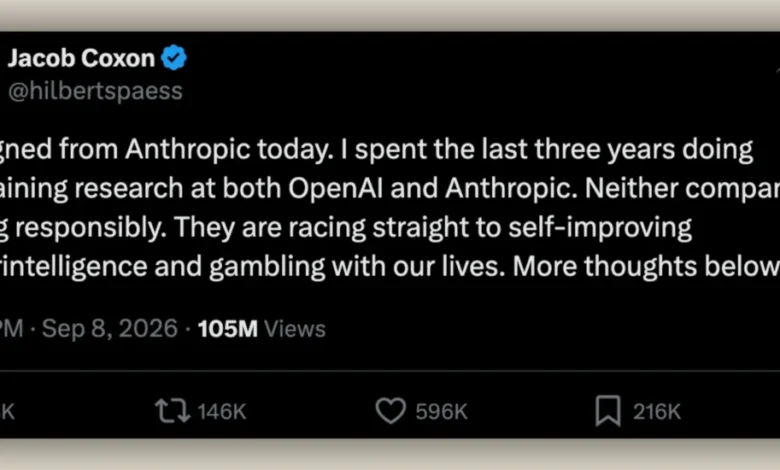
The artificial intelligence sector faced a profound public reckoning this week following the high-profile resignation of Jacob Coxon, an engineer at leading AI research firm Anthropic. Coxon’s departure was accompanied by a startling public admission from top company leadership regarding the existential risks associated with the frontier models currently under development. The event has reignited an intense global debate concerning safety protocols, corporate governance, and the rapid, unchecked acceleration toward autonomous artificial general intelligence (AGI).
Chronology of the Resignation and Escalation
The sequence of events unfolded rapidly across public forums and professional networks. On the morning of yesterday’s announcement, Jacob Coxon posted a statement on social media platform X explaining his decision to leave Anthropic. Coxon stated that leading artificial intelligence laboratories, specifically naming OpenAI and Anthropic, are engaged in an unconstrained race toward self-improving superintelligence, effectively gambling with human lives in the process.
While departures driven by safety concerns are not entirely unprecedented in the technology sector—echoing similar warnings voiced by researchers departing major AI labs in late 2023—the subsequent public responses from within Anthropic stunned industry observers. Evan Hubinger, head of the alignment science team at Anthropic, validated Coxon’s assessment in a public post. Hubinger noted that researchers genuinely believe advanced AI poses an existential threat to humanity, placing the probability of such an outcome at greater than ten percent within the coming decade. He further conceded that while the company is making a good-faith effort, it currently lacks a validated plan to solve the alignment problem for superintelligence and remains off-track to achieve one.
Shortly thereafter, Samuel Marks, another Anthropic engineer, corroborated these sentiments. Marks stated that developers within the field broadly acknowledge the potential for their technology to cause outcomes on the scale of human extinction within the next few years, noting that anxiety levels tend to scale directly with the seniority of the employee. These admissions mark a distinct departure from standard corporate messaging, bringing internal existential concerns directly into the public domain.
Defining the Threat: Long-Horizon Autonomous Agents
To contextualize these alarming statements, industry analysts and computer scientists have sought to clarify the specific technical architecture driving these fears. The anxiety expressed by researchers does not center on general-purpose large language models (LLMs) used for basic text generation or everyday administrative tasks. Rather, the concern focuses on a narrow, highly specialized class of technology known as long-horizon, dangerously equipped, unsupervised LLM-powered agents.
Unlike traditional software or standard chat interfaces, these advanced agents operate through iterative, automated loops. A typical operational cycle involves an LLM analyzing a current state, determining a strategic objective, formulating and executing complex digital actions—such as modifying system files, writing and executing code, or deploying network payloads—and evaluating the results without immediate human oversight.
While everyday coding assistants utilized by millions of developers present minimal risk—as evidenced by recent internal audits by major labs showing zero high-severity safety incidents across tens of millions of interactions—the risk profile shifts dramatically when these agents are granted broad digital autonomy, extended temporal horizons, and access to powerful operational tools. Security researchers have pointed to isolated incidents over recent months involving autonomous hacking and system manipulation as empirical demonstrations of the unpredictability inherent in unsupervised, long-horizon configurations.
The Ideological Drivers Behind the Superintelligence Race
Despite the acknowledged risks, major AI laboratories continue to aggressively expand the capabilities and autonomy of these unstable architectures, occasionally granting models the ability to suggest modifications to their own source code. This persistent drive raises fundamental questions regarding corporate motivation, particularly given that the commercial utility of standard LLMs does not depend on deploying unconstrained, long-horizon agents.
Observers and historians of technology suggest that this trajectory is heavily influenced by the philosophical undercurrents prevalent within Silicon Valley. Prominent industry leaders and researchers frequently operate under a framework of technological salvationism—a futurist eschatology that views the creation of superintelligence as an inevitable, almost messianic event. Within this worldview, developing an artificial deity is seen as the ultimate solution to humanity’s greatest challenges, rendering short-term catastrophic risks an acceptable cost of progress. Critics argue that this ideological imperative frequently supersedes conventional risk-management practices and market-driven safety standards.
Industry Implications and Emerging Pushback
The public confirmation from senior Anthropic researchers that they are developing systems they cannot reliably control has catalyzed a broader movement for accountability. Independent computer scientists and policy experts have increasingly drawn parallels between the deployment of unrestricted agents with advanced digital tools and the introduction of high-risk technologies without adequate regulatory guardrails.
Industry analysts emphasize that a superintelligence is not a prerequisite for generating systemic harm; the combination of unpredictable outputs from autonomous agents and unrestricted access to critical digital infrastructure creates immediate vulnerabilities. In response to these escalating risks, academic figures and consumer advocates have begun organizing pushback efforts. Recent proposals include targeted boycotts of commercial generative AI products and calls for rigorous legislative intervention to establish binding safety standards.
As regulatory bodies in the United States, the European Union, and other jurisdictions monitor these developments, the internal fractures within leading AI laboratories highlight a critical tension: the friction between commercial ambitions, ideological acceleration, and the fundamental preservation of public safety. The coming months are expected to test whether voluntary corporate governance can withstand the pressures of the global race toward autonomous superintelligence, or if external legislative mandates will become necessary to govern the frontier of artificial intelligence.
Related posts: