Navigating AI Search Volatility: How Marketing Teams Can Distinguish Between Strategy Flaws and Algorithmic Shifts

For SEO managers and digital marketers, the concept of volatility is a familiar, if unwelcome, companion. For over a decade, Google’s search algorithm updates have periodically reshaped the digital landscape, forcing teams to pivot their content strategies overnight. However, the emergence of Answer Engine Optimization (AEO) has introduced a new, more opaque layer of complexity. Unlike traditional search engine optimization, where a rank tracker can provide a definitive snapshot of a page’s position, AI-driven search results are non-deterministic, inconsistent, and highly prone to sudden, dramatic shifts.
As of early 2026, the industry has reached a critical tipping point. According to the HubSpot State of AEO report, 58% of marketers are now actively optimizing their content specifically for answer engines such as ChatGPT, Gemini, and Perplexity. Yet, these professionals face a significant challenge: when visibility metrics or referral traffic from these AI tools plummet, it is often unclear whether the decline is the result of a misaligned content strategy or an internal update within the large language models (LLMs) themselves.
Understanding the Mechanics of AI Volatility
AI search volatility refers to the inherent instability in how generative AI platforms select, mention, and cite brands in response to user queries. While traditional SEO volatility is tethered to search engine result page (SERP) rankings, AI volatility focuses on the frequency and quality of brand mentions within a conversational interface.
The fundamental issue is that LLMs are not built to provide static, uniform answers. Research from SparkToro and Gumshoe.ai conducted in late 2025 demonstrated that when the same recommendation prompts were submitted repeatedly to major AI platforms, there was less than a 1-in-100 chance of the model returning the same brand list twice. This "non-deterministic" nature means that a sudden drop in a brand’s visibility in an AI response is rarely a reflection of poor content quality; it is, more often than not, a byproduct of the underlying model’s probabilistic design.

Chronology and the Rise of AI-Driven Search
The shift toward AI-centric discovery has been rapid. Following the widespread adoption of AI Overviews and AI-powered search features throughout 2025, the SEO industry began to pivot away from traditional keyword-based tracking. By the summer of 2026, major search players had fully integrated generative AI into their primary search interfaces.
The timeline of this transition highlights why confusion persists. In March 2025, data from the Pew Research Center indicated that users were becoming significantly less likely to click on traditional links when an AI summary was present, with click-through rates dropping from 15% to 8%. As Google and competitors began "folding" AI-generated performance data into standard search reports, the ability for marketers to isolate and measure the impact of AI visibility became increasingly difficult. By mid-2026, the release of advanced models like the GPT-6 Astra suite further compounded this, as updates to these models often triggered immediate, site-wide fluctuations in how brands were surfaced, cited, or ignored.
Distinguishing Between Market-Wide Shifts and Internal Errors
When a brand observes a downward trend in AI-referred traffic, the most vital step is to determine the scope of the problem. If a company treats every fluctuation as a crisis of content quality, they risk wasting resources on unnecessary site overhauls.
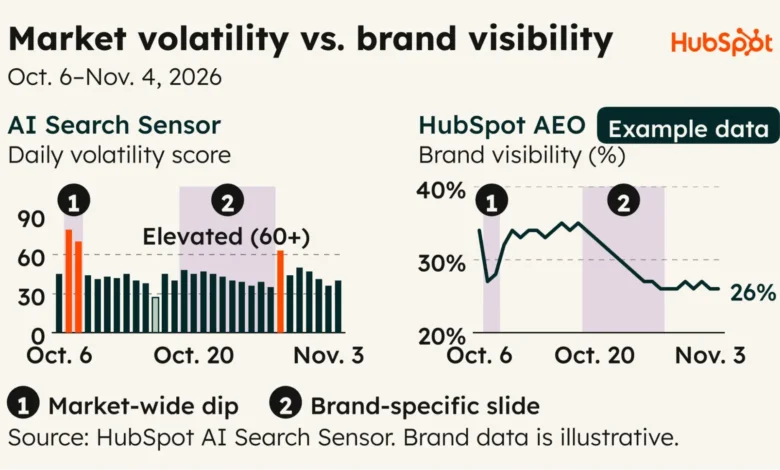
The primary method for diagnosing these swings involves comparing a brand’s internal AEO data against a market-wide benchmark. Tools like the AI Search Sensor provide a daily volatility score, which tracks four key signals: mention rate, citation rate, citation type, and AI-referred traffic.
If the industry-wide benchmark reflects a similar decline during the same period, the organization is likely witnessing a broader market shift—often triggered by an update to the answer engine’s logic. In these instances, the most recommended course of action is to wait. Reacting too quickly to engine-level volatility frequently creates more long-term disruption than the shift itself. Conversely, if the benchmark remains stable while the individual brand’s visibility continues to slide, the issue is likely localized to that specific domain, warranting a thorough audit of the site’s technical SEO and content structure.

The Divergence of SEO and AEO Metrics
It is a common misconception that traditional SEO ranking tools can adequately monitor AI performance. A traditional SERP volatility tracker, such as the Semrush Sensor, measures the movement of web pages in standard search results. While there is a proven correlation between high organic search rankings and higher citation rates in AI answers, the two metrics are not interchangeable.
A page can maintain its position in traditional organic results while simultaneously losing its standing within an AI-generated summary. Because AI Overviews and AI Mode are dynamic, they prioritize different factors than the standard Google algorithm. For instance, data suggests that comparison-based content performs exceptionally well in ChatGPT, whereas blog-style, informative content may hold more weight in Google’s AI Overviews. Consequently, a team relying solely on organic search rank as a key performance indicator (KPI) will miss critical gaps in their AI visibility strategy.
Reporting AI Volatility to Leadership
For marketing leaders, the challenge is communicating these abstract fluctuations to executive teams who demand clear, actionable insights. In the 2026 State of AEO report, 23% of B2B marketers identified the measurement of AEO success as their most significant hurdle.
To bridge this gap, reporting should be structured to emphasize business outcomes over raw vanity metrics. An effective report for leadership should include:
- Impact Assessment: Directly state whether the volatility has affected leads, pipeline, or revenue.
- Contextual Benchmarking: Plot the brand’s visibility trend against the market-wide volatility score to demonstrate that the fluctuation is, or is not, systemic.
- Attribution Analysis: Utilize "How did you hear about us?" form fields and custom CRM source rules to track conversions that originated from AI interactions, which often fail to appear in standard analytics software.
- Strategic Recommendations: Outline specific, evidence-based adjustments to content types or topics rather than broad, reactive changes.
Broader Implications and Future Outlook
The industry is currently in a state of adjustment. As answer engines continue to evolve, the reliance on traditional traffic-based metrics is proving to be increasingly insufficient. MarketingProfs CCO Ann Handley has noted that while traffic remains a useful indicator of reach, it is misleading when utilized in isolation, especially as AI-driven discovery becomes the default for many consumers.

Looking ahead, the integration of generative AI into search will likely continue to disrupt the traditional funnel. Organizations that successfully navigate this era of volatility will be those that prioritize high-quality, authoritative content that provides clear, actionable answers to user queries, while simultaneously maintaining a robust data infrastructure to monitor their visibility across multiple, non-deterministic platforms.
The volatility seen today is not a temporary anomaly; it is a fundamental characteristic of the next generation of search. By adopting a mindset that values market context over day-to-day fluctuations, marketing teams can move beyond the "panic-and-react" cycle and build a resilient strategy capable of thriving in an increasingly automated digital landscape.
Related posts: