Salesforce Announces Definitive Agreement to Acquire Customer Engagement Leader Braze for $5.66 Billion

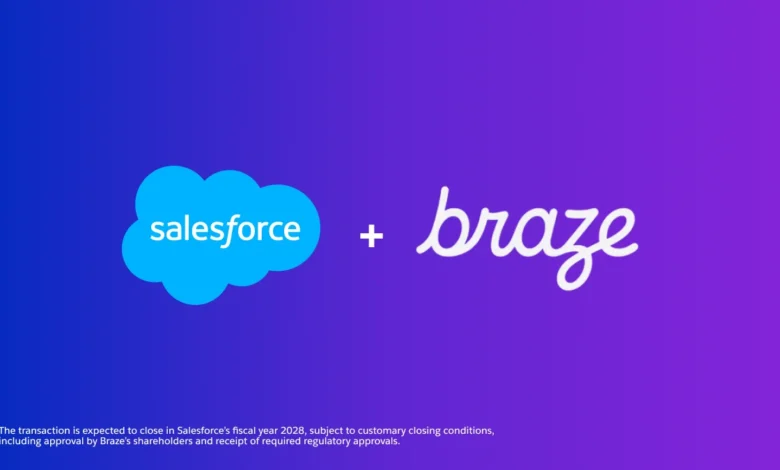
In a landmark consolidation of the marketing technology landscape, Salesforce (NYSE: CRM) has officially announced a definitive agreement to acquire Braze (NASDAQ: BRZE), a premier customer engagement platform, in an all-cash transaction valued at approximately $5.66 billion. Under the terms of the agreement, Salesforce will acquire all outstanding shares of Braze Class A common stock at a price of $47.50 per share. This strategic move marks one of the most significant acquisitions in the software-as-a-service (SaaS) sector in recent years, signaling Salesforce’s aggressive pivot toward "agentic" marketing—a paradigm where AI agents autonomously manage complex, multi-channel customer interactions.
The acquisition is designed to integrate Braze’s high-volume, real-time engagement capabilities directly into the Salesforce ecosystem, specifically bolstering the Marketing Cloud, Data 360, and the newly unveiled Agentforce architecture. For the approximately 2,770 customers currently utilizing Braze, the integration promises a more seamless transition between raw data insights and personalized, real-time messaging across mobile, web, email, SMS, and WhatsApp platforms.
Strategic Rationale and The Shift to Agentic Marketing
The impetus behind this multi-billion-dollar deal lies in the rapidly evolving expectations of consumers and the technological requirements of modern enterprises. As brands face the challenge of managing trillions of data points, traditional static marketing automation has become insufficient. Salesforce is betting that the future of customer relationship management (CRM) is not merely predictive, but reactive and agentic.
Braze’s cloud-native, event-streaming architecture is engineered for this exact purpose. Unlike legacy systems that rely on batch processing, Braze’s infrastructure allows for immediate, sub-second responses to customer behavior. When this capability is combined with Salesforce’s "Customer 360" data backbone, the resulting synergy enables brands to deliver hyper-personalized experiences at a global scale. By acquiring Braze, Salesforce effectively secures a "brain" for its marketing operations that can process, decide, and act without constant human intervention, aligning perfectly with the industry-wide push toward autonomous AI agents.
A Chronology of Growth: The Path to Acquisition
The acquisition follows years of significant expansion for both organizations. Braze, founded in 2011 by Bill Magnuson and Jon Hyman, spent over a decade refining its focus on mobile-first engagement and cross-channel orchestration. Throughout the early 2020s, Braze solidified its market position by capturing a high-profile client roster that includes industry leaders such as Canva, Instacart, Urban Outfitters, and Venmo.
For Salesforce, the acquisition is the culmination of a broader M&A strategy that prioritizes the "four layers" of its current architecture: Data 360, Customer 360, Agentforce, and SIForce. The deal reflects a pattern of calculated expansion; Salesforce has consistently sought to integrate best-in-class point solutions into its comprehensive suite, much like its historical acquisitions of Slack, Tableau, and MuleSoft.
Negotiations between the two parties intensified throughout the current fiscal year as both companies recognized the potential for a unified, "open and composable" platform. Following the close of the deal—expected in Salesforce’s fiscal year 2028—Braze will cease to trade as an independent entity, with its operations being absorbed into the broader Salesforce Marketing Cloud division.
Market Impact and Financial Implications
From a financial perspective, the $47.50 per-share offer represents a premium that reflects the high growth trajectory of Braze within the marketing technology sector. For Salesforce, the acquisition is structured to avoid disruptions to its existing guidance. The company has confirmed that there is no anticipated change to its FY27 guidance and that it remains committed to its long-term financial targets.
Industry analysts suggest that this merger will place immense pressure on competitors in the marketing automation space, such as Adobe and Oracle. By consolidating Braze’s real-time engagement engine with Salesforce’s massive distribution network, Salesforce creates a formidable barrier to entry for smaller competitors. The "open" approach touted by both companies suggests that they intend to maintain a flexible architecture, which is a critical selling point for large-scale enterprise clients who rely on complex stacks of data tools and disparate third-party integrations.
Official Statements and Leadership Perspectives
The leadership teams of both companies have framed the acquisition as a transformative moment for the marketing profession. Patrick Stokes, President of Applications and Marketing at Salesforce, emphasized the "wow" factor of real-time responsiveness. "Most of that ‘wow’ comes from knowing your customer and responding at just the right moment," Stokes noted. "Braze was built to turn live customer behavior into personalized engagement at scale. Bringing that capability together with Salesforce Marketing Cloud will deliver that moment in every customer interaction."
Bill Magnuson, CEO and Co-Founder of Braze, echoed this sentiment, highlighting the shared vision for the role of the marketer. "Braze was built on the conviction that marketers and their creativity are a brand’s ultimate competitive advantage," Magnuson stated. "Salesforce shares our commitment to marketers, and we’ll continue building as Braze, leveraging their platform to innovate faster. Together, we’ll help marketers around the world build deeper, more lasting relationships."
Broader Implications for the Enterprise Software Landscape
The acquisition serves as a case study for the current state of enterprise software: the convergence of data, AI, and execution. As AI tools move from the "experimental" phase to the "operational" phase, the value of platforms that can provide a "closed-loop" system—where data is analyzed and an action is executed within the same workflow—has skyrocketed.
For the average enterprise, the integration of Braze into Salesforce means a reduction in "tech debt." Many companies currently maintain separate contracts and integrations for their CRM and their customer engagement platforms. By collapsing these into a single, unified, AI-driven architecture, organizations stand to realize significant efficiencies in operational costs and time-to-market for campaigns.
Furthermore, the emphasis on "agentic solutions" suggests that Salesforce is preparing for a future where the marketing stack is managed by AI agents that can negotiate channels, timing, and content optimization autonomously. This represents a significant shift from the previous decade, where the emphasis was on "omnichannel" marketing managed by human teams using software tools. Now, the software is the agent.
Regulatory and Procedural Outlook
The path to completion is subject to standard regulatory scrutiny and shareholder approval. J.P. Morgan Securities LLC is acting as the exclusive financial advisor to Salesforce, with legal counsel provided by Wachtell, Lipton, Rosen & Katz and Covington & Burling LLP. On the sell side, Qatalyst Partners is serving as the exclusive financial advisor to Braze, with legal guidance from Davis Polk & Wardwell LLP.
Given the size of the deal and the dominance of Salesforce in the CRM space, regulatory bodies will likely examine the competitive impact of the merger, particularly regarding the concentration of marketing data and the potential for "walled garden" effects. However, both companies have stressed their commitment to an open and composable approach, which may mitigate some antitrust concerns by ensuring that customers retain the ability to use third-party tools alongside the combined Salesforce-Braze platform.
Looking Ahead
As the transaction proceeds through the regulatory pipeline, the tech industry will be watching closely to see how the integration of Braze’s unique architecture influences Salesforce’s broader product roadmap. The goal of building a more complete "Customer 360" remains the primary driver, but the success of this acquisition will ultimately be measured by the ability of the combined entity to deliver on its promise of "autonomous, 1:1 personalized experiences" at the scale of hundreds of millions of users.
For Braze employees and partners, the announcement marks the end of a chapter as a standalone public company and the beginning of a role within a global enterprise technology powerhouse. For Salesforce, it represents a bold investment in the next generation of AI-driven customer success, further cementing its position as the world’s #1 AI CRM. As the fiscal year 2028 approaches, the industry anticipates a shift in how marketing budgets are allocated, with a greater focus on real-time decisioning platforms that can effectively leverage the power of generative and agentic AI.