Marketers frequently use the terms Answer Engine Optimization (AEO) and Generative Engine Optimization (GEO) interchangeably, but a crucial distinction exists between these two critical strategies in the modern digital landscape. In essence, AEO is designed to optimize content for direct answers found in search engine answer boxes and voice search results, while GEO specifically targets brand citations within AI chatbot responses and AI-generated summaries. Understanding and implementing both are now indispensable for comprehensive digital visibility.
The rapid evolution of search technology, driven by advancements in artificial intelligence and natural language processing, has fundamentally reshaped how users discover information and interact with brands online. What began as a quest for "blue links" has transformed into an expectation of immediate, synthesized answers and authoritative recommendations. This shift necessitates a refined approach to digital marketing, moving beyond traditional Search Engine Optimization (SEO) to embrace the specialized tactics of AEO and GEO.
The Evolution of Search: From Links to Answers and Citations
For decades, Search Engine Optimization (SEO) primarily revolved around improving a website’s ranking in traditional search engine results pages (SERPs). The goal was to secure a top position, driving organic traffic through clicks on hyperlinked titles. SEO specialists focused on keywords, backlinks, technical site health, and content relevance to achieve this.
However, the late 2010s saw a significant shift with the rise of "answer engines." Google, in particular, began prioritizing direct answers, aiming to satisfy user queries without requiring a click to an external website. This manifested in features like:
- Featured Snippets: Short, extracted answers displayed prominently at the top of SERPs.
- People Also Ask (PAA) boxes: Lists of related questions with collapsible answers.
- Knowledge Panels: Information boxes about entities (people, places, things) drawing from various sources.
- Voice Search: Personal assistants like Google Assistant, Alexa, and Siri often pull direct answers for spoken queries.
This era marked the emergence of Answer Engine Optimization (AEO). AEO became the practice of structuring content specifically so that search engines could easily extract and present it as direct answers. Clarity, conciseness, and direct question-answering became paramount.
The most recent and profound transformation arrived with the mainstream adoption of generative AI models, such as ChatGPT, Google Gemini (formerly Bard), and Perplexity AI. These large language models (LLMs) don’t just extract answers; they generate comprehensive summaries, comparisons, and recommendations based on vast amounts of web data. This innovation gave birth to Generative Engine Optimization (GEO). GEO’s objective is to ensure that a brand’s products, services, or expertise are accurately and favorably cited within these AI-generated responses. Unlike AEO, which often aims for a direct snippet, GEO seeks to be recognized as an authoritative source that an AI model will reference, even if a direct click isn’t the immediate outcome.
A Clearer Distinction: AEO vs. GEO vs. SEO
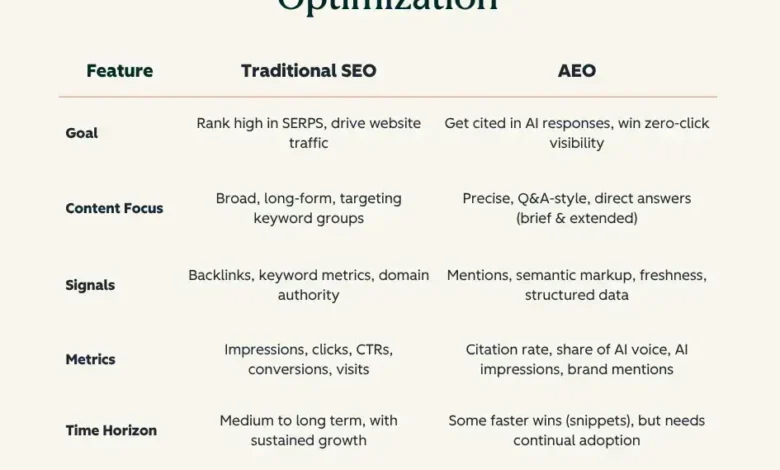
While all three acronyms fall under the broader umbrella of digital visibility, their primary goals and manifestations differ significantly.
-
Traditional SEO:

- Primary Goal: Earn rankings and organic traffic through clickable links.
- How it Shows Up: Traditional blue links in search engine results.
- What it Optimizes For: Relevance, authority (backlinks), technical performance, user experience.
- Best Use Case: Long-term audience acquisition and overall website traffic growth.
-
Answer Engine Optimization (AEO):
- Primary Goal: Deliver direct answers in search results.
- How it Shows Up: Featured snippets, People Also Ask boxes, AI short answers, voice search results.
- What it Optimizes For: Clarity, structured content, comprehensive question coverage, directness in answering.
- Best Use Case: High-intent, question-driven queries where users seek immediate information.
-
Generative Engine Optimization (GEO):
- Primary Goal: Earn brand citations and positive mentions within AI-generated summaries and conversational responses.
- How it Shows Up: Google AI Overviews, ChatGPT summaries, Perplexity AI citations, Gemini recommendations.
- What it Optimizes For: Authority, entity clarity, quotable insights, consistent messaging across the web.
- Best Use Case: Research queries and informational discovery, influencing user perception at the initial stages of the buying journey.
In the simplest terms, AEO aims for your content to be the answer, while GEO strives for your brand to be a cited authority. Both are crucial because they address different, yet interconnected, aspects of the modern user’s information-seeking behavior.
The Strategic Imperative: Why Both AEO and GEO are Essential
The data unequivocally points to the increasing reliance on AI-powered search. According to the HubSpot Consumer Trends Report, a significant 72% of surveyed consumers indicated their intention to use AI-powered search more frequently for shopping. This statistic alone underscores the immediate need for brands to adapt their digital strategies.
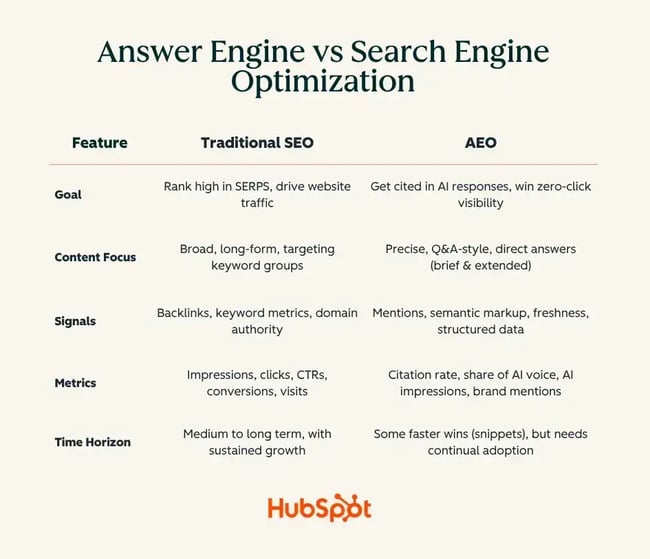
Relying solely on traditional SEO, while still foundational, is no longer sufficient. The customer journey is increasingly starting not on a search engine’s blue links, but within an AI chatbot or a comprehensive AI overview. If a brand is absent from these generative responses, it risks becoming invisible at the critical "top of funnel" stage where initial discovery and solution comparison occur.
Industry experts widely concur that a comprehensive digital strategy must now encompass these specialized optimizations. "The shift we’re seeing isn’t just a trend; it’s a fundamental change in how information is accessed and consumed," notes Sarah Jensen, a leading digital marketing analyst. "Brands that proactively optimize for both direct answers and AI citations will gain a significant competitive advantage by being present at every stage of the evolving customer journey."
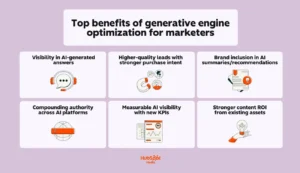
AEO ensures that a website’s content is extractable, structured, and eligible for direct answers, capturing immediate informational needs. GEO, on the other hand, is about establishing authority and trustworthiness such that when an AI model compiles a list of recommendations, comparisons, or best-of lists, your brand is prominently included as a credible source. The synergistic effect of both strategies ensures that brands are not only found but also trusted and cited by the very systems influencing consumer decisions.
Shared Tactics for Dominating Modern Search Visibility
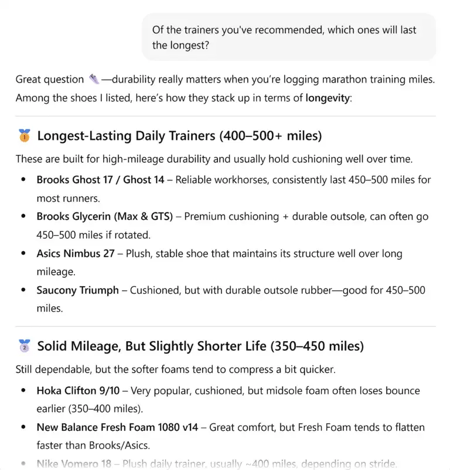
While AEO and GEO have distinct goals, they are powered by many of the same foundational content and technical practices. Brands that excel in AI-powered search are those that build structured, answer-first content and maintain robust entity clarity across their digital footprint.
-
Answer-First Content Structuring:
This tactic involves presenting the most straightforward answer to a user’s question immediately, followed by supporting details, examples, and context. It mirrors the "inverted pyramid" style of journalism, where the most critical information (the "who, what, when, where, why") is at the beginning. For AEO, this increases the likelihood of content being pulled into featured snippets. For GEO, it provides AI models with clear, unambiguous passages they can confidently extract and cite. Content writers must prioritize direct answers in the opening sentences, making it easy for both human readers and AI systems to grasp the core message without ambiguity. -
Entity Management and Consistency:
An "entity" can be a person, product, concept, or organization. Entity management is the process of defining these key entities and ensuring their consistent representation across all digital touchpoints. This consistency is vital for AI models, which rely on a robust understanding of entities and their relationships to accurately synthesize information. If a brand’s product features are described differently across its website, press releases, and third-party reviews, AI models may struggle to form a coherent understanding, potentially leading to inaccurate citations or exclusion from summaries. Maintaining a unified narrative across owned and earned media strengthens AI’s confidence in citing a brand as an authoritative source. -
Quotable Insights and Data Passages:
AI models thrive on authoritative, easily digestible statements and data points. Crafting "quotable insights"—short, impactful sentences or brief data summaries—significantly increases the chances of a brand’s content being used in AI-generated responses. These insights should be self-contained and clear, allowing AI engines to lift them directly without needing extensive rephrasing. This practice directly supports both AEO (for concise answers) and GEO (for authoritative citations), while also bolstering a brand’s E-E-A-T (Experience, Expertise, Authoritativeness, Trustworthiness) signals to search engines. -
Schema and Structured Markup Implementation:
Schema markup is a form of structured data that helps search engines and AI models understand the meaning and context of content. By adding specific code (like JSON-LD) to web pages, marketers can explicitly define entities, relationships, and content types (e.g., FAQPage, Product, Service, Organization, HowTo). This "machine-readable" layer is invaluable for AEO, as it enhances eligibility for rich results and direct answers. For GEO, schema reinforces entity consistency and provides AI models with verifiable information, increasing the likelihood of accurate citations. It acts as a universal translator, ensuring AI systems correctly interpret and leverage a brand’s content. -
Reinforcement Through Repetition (Across Credible Sources):
This tactic is not about keyword stuffing but about establishing factual consensus. AI models don’t take a single website’s claims at face value; they triangulate information by looking for consistent assertions across multiple reputable sources. If a brand’s key claims (e.g., "our software reduces operational costs by 25%") are consistently echoed across its website, industry publications, partner sites, and credible third-party reviews, AI models are far more likely to adopt these as verified facts and cite the brand accordingly. This multi-channel reinforcement builds trust and authority in the eyes of generative AI.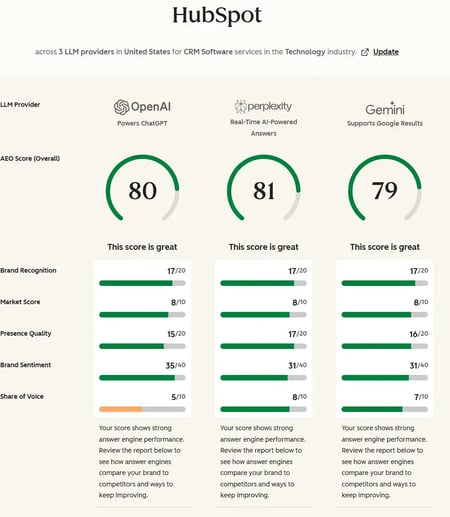
Measuring Impact in the AI-First Era
Traditional SEO metrics like keyword rankings and organic traffic, while still important, no longer provide a complete picture of digital performance. Measuring AEO and GEO success requires a shift towards new metrics that reflect visibility within AI-generated answers and summaries.
-
AI Visibility and Citation Coverage:
This metric tracks how often a brand’s content appears in AI Overviews, ChatGPT responses, Perplexity AI summaries, and other generative search experiences. It goes beyond clicks to assess whether AI systems are actively pulling and referencing a brand’s information. Tools like HubSpot’s AI Search Grader offer a critical advantage here, analyzing domains to show where a brand is earning citations, identifying content gaps, and suggesting improvements for generative search traction. Monitoring for both positive and negative sentiment in AI mentions is also crucial. -
Content Quality and Answer Readiness:
This metric evaluates how effectively content meets the structural, clarity, and formatting requirements essential for AEO and GEO. It assesses whether pages are written in an answer-first manner, are well-researched, and maintain entity consistency. Tools like HubSpot’s Content Hub and Breeze Content Assistant can help marketers efficiently create and refine AEO-ready passages, FAQs, and structured updates, ensuring content is optimized for AI consumption. Regular content audits should check for clarity, conciseness, formatting, and the use of quotable insights. -
Conversions and Revenue Influenced by AEO/GEO:
Ultimately, digital marketing aims to drive business growth. This metric measures how AI-powered search influences the sales pipeline, whether through direct clicks leading to conversions, form submissions, or brand awareness that results in later direct traffic. While direct attribution from AI-generated summaries can be challenging (as many users may not click immediately), tracking referrals from AI platforms (e.g., ChatGPT, Perplexity) in analytics tools like Looker Studio provides valuable insights into the quality and volume of AI-influenced traffic and subsequent conversions. Qualifying leads with specific questions (e.g., "How did you hear about us?") can also uncover AI’s indirect influence.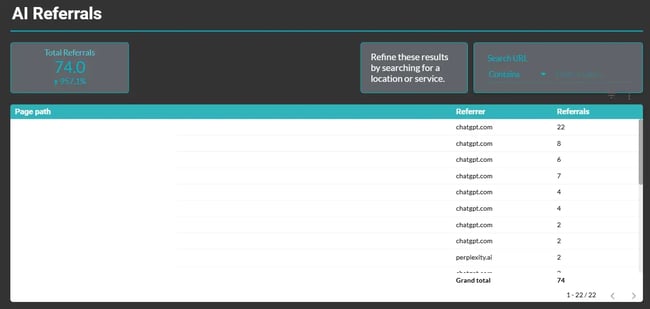
-
Lead Quality from AI-Influenced Discovery:
AEO and GEO don’t just expand visibility; they can significantly improve the quality of leads. When content appears in highly contextual AI answers or recommendations, the resulting traffic is often warmer, more targeted, and already primed with a clear understanding of their problem and potential solutions. AI-sourced leads often exhibit stronger fit scores, higher qualification rates, and faster progression through the sales funnel. Marketers should analyze these metrics, potentially using advanced lead scoring systems like HubSpot’s, to compare AI-influenced leads with those from traditional organic search and quantify the strategic value of AEO/GEO. -
Page Performance and User Behavior (from AI Referrals):
Analyzing the behavior of users who arrive from AI sources provides actionable insights. By monitoring sessions where the referrer is an AI tool, marketers can identify which pages are most frequently recommended and how visitors interact with them. Key metrics include bounce rate, time on page, pages per session, and conversion rates for AI-referred traffic. This data helps prioritize further optimization efforts, indicating which content resonates most effectively with AI-influenced audiences and where schema enhancements or content restructuring might yield the greatest returns.
The Future of AEO & GEO: Key Trends
The AI search landscape continues its dynamic evolution, but several trends are emerging as definitive shapers of its next phase.
-
AI Discovery Will Become the New "Top of Funnel":
The consumer journey is irrevocably shifting. A significant portion of buyers will initiate their research within conversational AI tools, making the AI’s initial summary or recommendation the de facto "first impression" of a brand. This means that a brand’s homepage may no longer be the initial touchpoint; instead, its presence and reputation within AI models will dictate early-stage brand perception. AEO and GEO success, driven by robust question coverage, strategic schema implementation, and broad content distribution, will be paramount for capturing this crucial top-of-funnel engagement. The example of HubSpot being recommended in Google AI Overviews for "best free CRM for small business," even with a third-party citation (Zapier), perfectly illustrates the power of consistent brand messaging and credible web presence in shaping AI-driven discovery.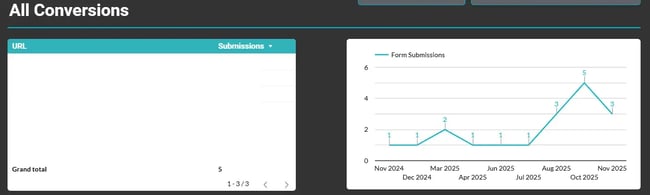
-
The Search Industry Will Settle Down (But AI’s Impact Will Endure):
While the initial "hype cycle" around large language models and generative AI may be plateauing, as suggested by industry experts like Mark Williams-Cook, this does not diminish its long-term importance. Data from sources like Datos’ State of Search Q3 2025 indicates that visits to AI tools, while steady at around 1.3% of total search activity, represent a permanent and impactful segment. The explosive growth phase may be normalizing, but the foundational changes to search behavior are here to stay. This stabilization will allow marketers to move beyond reactive adjustments to more strategic, long-term integration of AEO and GEO. -
SEO Teams Will Report on AEO and GEO as Standard:
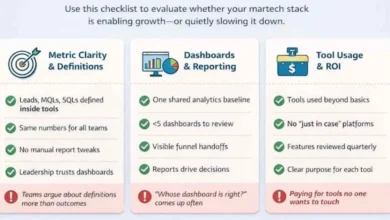
The days of ignoring AI-driven visibility in performance reports are rapidly coming to an end. AEO and GEO metrics are transitioning from optional additions to essential components of every SEO audit and reporting workflow. Just as core web vitals, keyword rankings, and backlink profiles are routinely assessed, so too must AI visibility, citation frequency, entity consistency, and AI-originating sessions. Businesses that fail to integrate these metrics into their monthly reporting cadence risk significant performance gaps and a diminished understanding of their true digital footprint. Proactive marketers are already embedding AEO and GEO performance indicators into their Looker Studio dashboards and client reports, ensuring comprehensive visibility and enabling agile optimization strategies.
AEO and GEO are not merely trendy add-ons; they represent the new, indispensable layers of brand visibility in an AI-first world. AEO secures direct answers, capturing immediate informational needs, while GEO earns crucial citations, influencing trust and authority within generative AI responses. Together, they orchestrate how potential customers discover, evaluate, and ultimately decide on a brand’s solutions. Marketers who prioritize answer-first content, meticulously manage entities, and cultivate a broad, authoritative digital presence will be best positioned to dominate this evolving search landscape. Tools like HubSpot’s AI Search Grader, Content Hub, and Marketing Hub are designed to empower marketers in this new era, enabling them to create, manage, and measure their search visibility across every modern platform. By embracing this integrated approach, brands can ensure they are not just found, but truly understood and trusted by both human users and the intelligent systems that guide them.