Decoding the B2B Paid Search Surge: Why Same-Keyword Google Ads CPCs Climbed 21 Percent

The cost of acquiring traffic through Google Ads Search campaigns has long been a central concern for digital marketers, digital agencies, and enterprise-level financial planners alike. A landmark industry research report published in October by the B2B-focused search marketing agency Grey Matter has shed new light on the mechanics of cost-per-click (CPC) inflation. By tracking 14 dedicated business-to-business advertisers over a six-quarter window spanning from April 2025 to September 2026, the agency attempted to answer a deceptively simple question: How much more expensive is it to purchase the exact same non-branded search terms year-over-year?
According to Grey Matter’s findings, the cost for the exact same non-branded keywords increased by approximately 21% between April and September 2026 compared to the corresponding period in the prior year. This figure, adjusted carefully to account for individual shifts in advertiser spending, shifts in ad positioning, and fluctuations in Quality Score, highlights a persistent upward trend in digital advertising overhead. However, because the study draws exclusively from a curated client subset managed by a single agency, the report emphasizes that its headline finding comes with a broad statistical confidence interval—placing the likely market increase anywhere from 1% to 44%.
Background and Context: Isolating Market Inflation From Strategy Changes
For years, digital marketers evaluating search engine marketing (SEM) benchmarks have relied on broad, macro-level averages published by platform providers or third-party aggregators. These standard industry benchmarks, while useful for establishing a general baseline, inherently suffer from a critical analytical flaw: they conflate market-driven price inflation with internal strategic choices made by individual advertisers. When an account’s average CPC rises, it is frequently unclear whether competitors are simply driving up the cost of the auction, or if the advertiser itself has intentionally pivoted toward more expensive match types, riskier keywords, or aggressive bidding strategies.
Andy Hendricks, Grey Matter’s head of search and the primary author of the report, designed the study to decouple these variables. By holding the specific keyword and the individual account constant, the agency sought to isolate external market pressures from internal operational changes. To maintain data integrity and ensure clean comparisons, Grey Matter rigorously filtered its dataset. The research team excluded broad match keywords—whose underlying search queries naturally fluctuate over time—alongside campaigns operating under "Maximize Clicks" strategies, as well as all brand-specific and competitor-targeted keywords.
Ultimately, the study tracked 1,349 distinct non-brand keywords distributed across 14 distinct B2B accounts. The core year-over-year comparison evaluated performance data from April through September 2026 against the identical six-month timeframe in 2025.
Chronology and Methodology of the Analysis
The analytical framework utilized a sophisticated regression model designed to weight every participating advertiser equally, regardless of their total monthly ad spend. This methodological choice prevented large enterprise budgets from skewing the aggregated market trend.
When the research team analyzed the raw data without applying any statistical controls, the cost of the exact same keywords showed a staggering 29% increase year-over-year. As the agency introduced spend-related controls into the regression model, that figure adjusted downward to 22%. Finally, incorporating controls for top-of-page ad positioning and Quality Score yielded the final baseline estimate of a 21% increase.
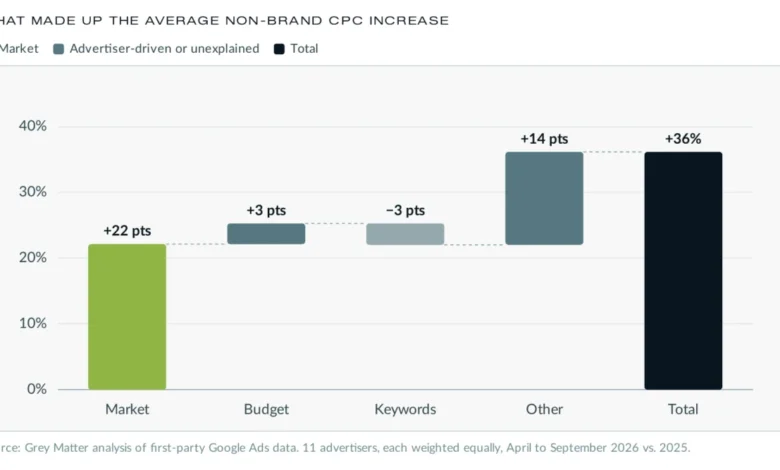
To cross-verify these findings, Grey Matter implemented a secondary estimation technique known as a keyword price index. This index specifically monitored 11 advertisers within the cohort who maintained a sufficient volume of matching keywords across consecutive quarters. For this specific subset of 11 advertisers, the total observed year-over-year increase in average non-brand CPC reached a notable 36%.
When broken down via a waterfall analysis, the 36% overall spike was attributed to several distinct factors:

- Market Inflation: Accounted for 22 percentage points of the increase.
- Increased Campaign Spending: Contributed an additional 3 percentage points.
- Keyword and Match Type Adjustments: Provided a 3 percentage point downward deduction as advertisers optimized their portfolios.
- Unexplained Residuals: Left a remaining 14 percentage points unaccounted for by the first three variables, largely concentrated within a small handful of accounts experiencing intense vertical competition.
The Correlation Between Campaign Spend and Rising CPCs
One of the most revealing insights uncovered by Grey Matter’s regression model centers on the direct relationship between budget scaling and rising click costs. The report establishes that every 10% increase in overall campaign spend correlates with an estimated 1.4% rise in CPCs, completely independent of broader market inflation. Consequently, an advertiser that doubles its search budget can mathematically expect to face roughly an 11% premium on the exact same keywords simply due to the mechanics of automated auction participation.
Extreme outliers within the study further validated this dynamic. In the most pronounced case recorded in the sample, an advertiser nearly quadrupled its non-brand search budget year-over-year, resulting in a 132% surge in its same-keyword CPCs. Interestingly, the same advertiser maintained a flat budget for its branded search terms, which experienced a modest, expected increase of only 4% during the third quarter.
Industry analysts attribute this phenomenon largely to the widespread adoption of automated bidding algorithms. Modern smart-bidding frameworks—such as strategies designed to maximize conversions or target specific acquisition costs—automatically expand an account’s footprint into auctions it might have previously avoided. By bidding more aggressively, these algorithms push campaigns into higher-cost ad positions, more competitive search queries, and pricier day-parts, naturally driving up the average cost per click.
Broader Industry Implications and Alternative Perspectives
While Grey Matter’s findings offer a granular look at B2B search economics, industry experts urge caution when interpreting the data in a vacuum. Because the report does not incorporate conversion rates, lead quality metrics, or overall cost-per-acquisition (CPA) figures, a higher CPC does not inherently equate to diminished marketing efficiency.
Writing previously in Search Engine Journal, digital marketing strategist Jyll Saskin Gales addressed the "high-CPC paradox," noting that under modern smart-bidding regimes, an elevated cost-per-click is frequently an indicator of a healthy, aggressive, and conversion-optimized account. Advertisers, she argued, should evaluate campaign success through downstream metrics like return on ad spend (ROAS) rather than focusing exclusively on top-line CPC inflation.
Furthermore, the findings present an interesting contrast to macroeconomic data published by Google’s parent company, Alphabet. In its third-quarter financial filings for 2026, Alphabet reported that its company-wide cost-per-click across Google Search and associated properties rose by a modest 4% year-over-year. Alphabet’s metric measures total click-driven revenue divided by total paid clicks across global consumer and enterprise properties, incorporating shifts in device usage, regional geography, and product mix. Because Alphabet’s metric evaluates a vastly different pool of variables, industry experts stress that the two datasets do not directly contradict one another, but rather operate at entirely different levels of economic granularity.
Strategic Recommendations for 2027 Budget Planning
As digital marketing teams finalize their expenditure forecasts, the Grey Matter report offers practical guidance for navigating an increasingly expensive search landscape.
First, the research advises advertisers to approach budget scaling incrementally. Rather than implementing massive year-over-year budget expansions that trigger automated bidding penalties, marketing teams should scale spend gradually while continuously auditing the marginal cost of additional clicks.
Second, for campaigns reliant on automated bidding architectures like Maximize Conversions, the report recommends establishing clear financial guardrails. Advertisers should determine the precise target value of incremental conversions before greenlighting budget increases, aligning their automated targets with the realities of modern auction pressure.
Ultimately, while the 21% benchmark serves as a helpful reference point for non-brand B2B search inflation, the wide statistical variance—ranging from a 2% decline to a 40% increase when outliers are adjusted—underscores the need for individualized account auditing. As search auctions grow increasingly sophisticated, understanding the structural gap between broader market inflation and internal bidding behavior remains an essential competency for modern media buyers.