The Evolution of the Creator Economy: How Neil Waller and Whalar Group are Redefining Brand Partnerships in the Age of AI

A decade ago, the corporate world viewed Instagram and similar nascent social platforms with a healthy dose of skepticism. Marketing departments spent countless hours debating the return on investment for social media presence, often treating influencer engagement as a peripheral, experimental experiment rather than a core business pillar. Today, that landscape has undergone a seismic shift. Creators are no longer just external talent hired to push a product; they are central architects of brand strategy, equity holders in startups, and the driving force behind modern media empires. This transformation has fundamentally altered the expectations placed on both brands and the individual creators they seek to engage.
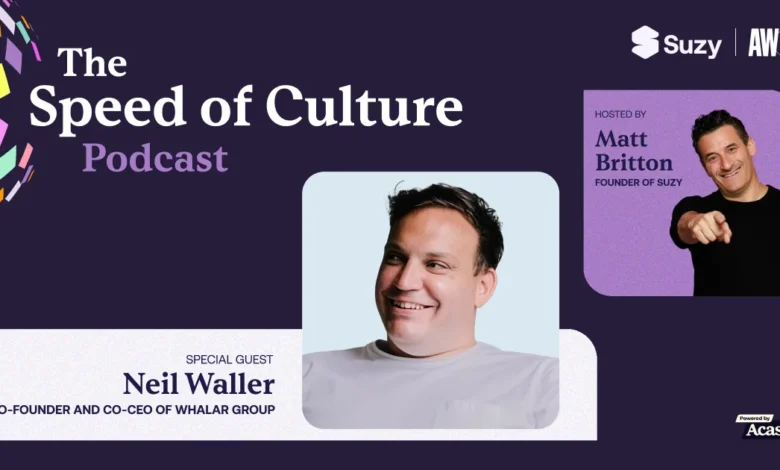
In a recent episode of The Speed of Culture podcast, Neil Waller, the co-founder and co-CEO of the Whalar Group, sat down with host Matt Britton to discuss the maturation of the creator economy. Their conversation underscored that the industry has moved past the “wild west” phase, entering a period defined by operational rigor, mutual respect, and the strategic deployment of human curation in an era increasingly saturated by artificial intelligence.
From Direct-to-Consumer Roots to Ecosystem Architecture
To understand the trajectory of Whalar Group, one must look back to 2016. Before the company became a six-entity powerhouse, Waller and his co-founder, James, were practitioners in the direct-to-consumer (DTC) space. Operating their own brands on Shopify, they didn’t rely on theoretical marketing frameworks; they relied on the tangible performance of creator-led content.
During their time building e-commerce brands, they observed a phenomenon that would become their foundational thesis: content created by trusted individuals consistently outperformed traditional ad creative in driving conversions. By the time they launched Whalar, the “proof of concept” was already in their ledger. This origin story serves as a critical lesson for modern marketers: the most credible strategies are those built on the foundation of firsthand testing. Rather than relying on agency-crafted decks or abstract predictions, the Whalar model was forged in the heat of operational experience.
The company’s growth from a boutique influencer agency to a multifaceted ecosystem reflects the broader growth of the industry. Data from industry analysts suggests the creator economy is now worth over $250 billion, with projections indicating it could reach nearly $500 billion by 2027. Whalar’s evolution into a group of companies covering talent management, creative production, and data intelligence mirrors this massive market expansion.
The Death of Prediction and the Rise of Iterative Experimentation
One of the most persistent myths in digital marketing is that success is the result of long-term, rigid forecasting. Waller argues the inverse: in a market as volatile as the creator economy, experimentation consistently beats prediction. When the founders were building their initial watch brand, they did not have a crystal ball. They had an iterative process.
By testing multiple creative assets, measuring real-time feedback, and aggressively pivoting toward what resonated with the audience, they bypassed the trap of "analysis paralysis." This approach—failing fast and doubling down on success—is now a requirement for any brand attempting to maintain relevance. In the current environment, a brand’s ability to remain agile is more valuable than its ability to draft a five-year social media strategy. The market changes too quickly; therefore, operational flexibility is the ultimate competitive advantage.
Reframing Authenticity: The Case for Mutual Respect
For years, the marketing world has been obsessed with the concept of "authenticity." It has become a buzzword, often stripped of its meaning. Waller proposes a more pragmatic framework: mutual respect.
Authenticity is often framed as a creator being "real," but in a commercial context, this can lead to friction. If a creator leans too far into their own persona, the brand message is diluted; if the brand exerts too much control, the content feels disingenuous and loses audience trust. The solution, according to Waller, lies in the middle ground. Brands must respect the creator’s unique voice and their deep understanding of their specific audience, while creators must respect the brand’s business objectives and regulatory requirements.
This balance is becoming increasingly vital as creators evolve into business partners. The industry is witnessing a trend where creators are taking equity stakes in the companies they promote, moving from transactional relationships to long-term partnerships. When a creator has "skin in the game," the incentive structure changes, leading to more thoughtful, long-term brand building rather than short-term cash grabs.
The Need for Operational Rigor
While creativity and audience connection are the fuel of the creator economy, Waller is adamant that they are not enough to sustain a business long-term. As creator businesses grow in complexity—managing multi-platform distribution, merchandise lines, and, in some cases, private equity investments—the need for operational infrastructure has become non-negotiable.
This professionalization is a turning point for the sector. We are seeing a shift from the "individual freelancer" model to the "small business" model. Successful creators are increasingly hiring professional teams to manage logistics, finance, and data analytics. Brands are likewise demanding more sophisticated reporting, clear KPIs, and consistent output. The era of the "unpredictable influencer" is waning, replaced by the "creative entrepreneur" who understands that professional execution is what transforms viral momentum into a sustainable, scalable business.
The AI Paradox: Why Human Taste Becomes the Ultimate Currency
Perhaps the most compelling part of the discussion with Waller concerns the role of Artificial Intelligence. As generative AI makes it easier and cheaper to produce high-quality, generic content, the market is set to be flooded with a sea of synthetic material. Logic would suggest that this makes human creators less relevant; however, Waller posits the opposite.
He describes a "barbell" model of content consumption. At one end of the barbell, AI drives an explosion of cheap, personalized, and abundant content. At the other end, human taste, curation, and trust become exponentially more valuable. As consumers grow fatigued by AI-generated noise, they will naturally gravitate toward "tastemakers"—individuals who have earned the right to direct their attention.
This creates a high-stakes environment for the middle tier: generic content creators who lack a distinct point of view will struggle to compete with the sheer volume and efficiency of AI. To remain viable, creators and brands must double down on the very things AI cannot replicate: the nuance of human experience, the weight of personal reputation, and the ability to act as a curator in a world of infinite choice.
Broader Implications and Future Outlook
The implications of these shifts are profound. For brands, the lesson is clear: stop treating creators as a distribution channel and start treating them as strategic partners. The traditional advertising agency model is being challenged by a landscape where influence is decentralized and business value is tied to individual reputation.
For the creators themselves, the path forward requires a transition from "content creator" to "business operator." The creators who will thrive in the next decade are those who can balance the creative spark with the cold, hard reality of operational and financial discipline.
As the creator economy continues to mature, the distinction between a "media company" and an "influencer" will continue to blur. Whether it is a traditional celebrity launching a beverage line or a niche YouTuber building a subscription-based media platform, the underlying mechanics remain the same: building a loyal, engaged audience and providing them with value that transcends a 30-second sponsored clip.
Ultimately, Neil Waller’s insights reinforce a fundamental truth of the digital age: while technology may change how we reach people, the mechanics of influence—trust, relevance, and consistency—remain unchanged. The next phase of the creator economy will not be defined by who has the most followers, but by who can build the most robust, respectful, and operationally sound businesses. In a world of AI-generated abundance, the human element is no longer just a component of the strategy; it is the strategy itself.