The Indispensable Role of Integrated Outbound Sales Tools in Driving Modern Revenue Growth

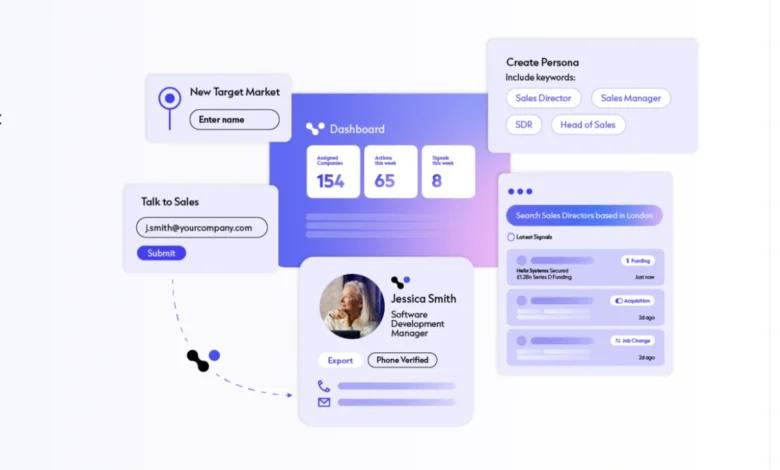
Outbound sales tools are essential software platforms that empower sales teams to proactively engage prospects across various channels, including email, phone, and social media, often through structured, multi-channel sequences. However, the true efficacy of these tools hinges entirely on their ability to seamlessly integrate with and feed accurate, real-time data back to the Customer Relationship Management (CRM) system. This fundamental connection is not merely a convenience but a critical determinant of sales productivity, reporting accuracy, and ultimately, revenue generation in today’s competitive B2B landscape.
The Evolving Landscape of Outbound Sales and the Productivity Gap
In an era defined by digital transformation and increasingly informed buyers, the role of outbound sales has evolved from a brute-force numbers game to a sophisticated, data-driven discipline. Modern B2B buyers expect personalized, relevant interactions, making targeted and strategic outreach more important than ever. Industry research consistently underscores the enduring significance of outbound efforts. For instance, Sopro’s 2025 research indicates that a substantial 81% of B2B companies actively engage in outbound lead generation, and remarkably, 80% of B2B buyers express a willingness to hear from sellers during their decision-making process. This highlights a clear opportunity for proactive engagement.
Despite this recognized importance, sales professionals frequently grapple with significant inefficiencies. A telling statistic from Salesforce’s State of Sales report reveals that sales representatives spend as much as 60% of their time on non-selling tasks. For outbound teams, this alarming figure often worsens when their prospecting and engagement tools operate in isolation from their core CRM. The consequence is a cascade of manual data entry, missed activity logging, and a fragmented view of the customer journey, directly impacting productivity and strategic insights. SPOTIO’s 2026 sales statistics roundup further emphasizes this, noting that reps spend only 30% of their time actively selling, underscoring the vast potential for improvement through automation and integration.
The Critical Imperative of CRM Integration Depth
The disconnect between outbound tools and the CRM leads to pervasive problems: broken attribution, unreliable pipeline reporting, and considerable wasted effort. Without a unified system, it becomes nearly impossible to accurately track which specific outreach efforts, messages, or channels are genuinely converting prospects into qualified leads and, subsequently, into revenue. This lack of clear visibility hampers strategic decision-making and optimization efforts.
The difference in performance between integrated and fragmented systems is stark. A 2026 Cognism report highlighted that data-driven, phone-first outbound teams leveraging verified data achieve an impressive conversion rate of 11.3%, significantly outperforming the industry average for cold calling, which typically ranges from 2.3% to 2.7%. This considerable gap is not primarily due to talent or sheer volume, but rather the underlying technological infrastructure: access to verified data, structured sequences, and, crucially, CRM-connected activity logging that ensures the entire revenue team operates from a single, aligned source of truth.
Effective CRM integration goes far beyond a simple data sync. It encompasses a comprehensive, bi-directional flow of information that includes:
- Contact and Company Object Syncing: Ensuring that prospect and customer profiles are identical and up-to-date in both systems.
- Activity Logging: Automatically recording every email sent, call made, social media interaction, and meeting scheduled directly within the CRM.
- Deal and Opportunity Updates: Reflecting changes in deal stages, values, and close dates in real-time.
- Custom Field Mapping: Allowing for the transfer of specific, organization-defined data points between the outbound tool and the CRM.
- Permission Mirroring and Audit Trails: Upholding data governance standards, reflecting CRM access permissions, and providing a verifiable history of all actions, which is vital for compliance and accountability.
Without this depth of integration, outbound attribution remains elusive, making it impossible for managers to discern which strategies are most effective. Industry analysts consistently emphasize that deep CRM integration is paramount, as it transforms raw outreach data into actionable intelligence, enabling more precise forecasting, targeted coaching, and ultimately, more predictable revenue generation.

Key Benefits of Advanced Outbound Sales Software
The investment in sophisticated outbound sales software, particularly platforms with robust CRM integration, is justified by several core benefits that address the structural inefficiencies inherent in traditional sales processes:
-
Reclaiming Selling Time Through Automation: Outbound sales automation tools are designed to offload repetitive, manual tasks from sales representatives. This includes automating email sequencing, scheduling follow-ups, and creating tasks within the CRM. By automating these administrative burdens, reps can reallocate precious time to higher-value activities, primarily live conversations and strategic engagement. Multi-step sequences that automate touches across email, phone, and LinkedIn can reclaim hours of manual work per representative each week, directly contributing to increased selling time.
-
Improving Response Rates with Multi-Channel Outreach: In 2026, relying on a single channel for outreach is largely ineffective. Data from Outreach’s prospecting reports indicates that an average of 4.81 touches is now required to elicit a response, regardless of the lead’s initial temperature. Modern outbound sales tools facilitate coordinated multi-channel sequences across email, phone, and LinkedIn. This systematic approach ensures consistent follow-up, reducing reliance on individual memory and willpower, and significantly increasing the likelihood of engagement. Furthermore, personalized outreach can boost open rates by up to 10%, according to Outreach data. AI-powered outbound tools can now research prospects and generate highly personalized first lines at scale, but their effectiveness is amplified when tightly integrated with the CRM to leverage existing deal context and engagement history.
-
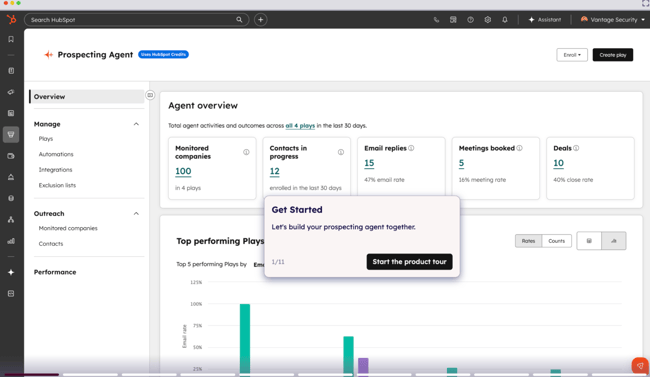
Maintaining Clean CRM Data and Accurate Attribution: The fundamental promise of integrated outbound tools is to ensure the integrity of CRM data. When every touchpoint and interaction is automatically logged with rich context, sales managers gain unprecedented visibility into the sales pipeline. This enables precise attribution, allowing teams to understand which campaigns, messages, and channels are truly driving pipeline growth. Beyond attribution, robust data governance features, including responsible handling of Personally Identifiable Information (PII), mirroring CRM permissions, and maintaining detailed audit trails, are crucial for compliance, especially in regulated industries.
-
Scaling Outbound Without Scaling Headcount: The advent of AI-powered outbound sales automation has revolutionized the ability of sales teams to scale. These tools can now handle complex tasks such as account research, message drafting, and lead scoring with a level of sophistication that allows smaller teams to compete effectively with much larger sales organizations. SaleSo’s 2026 SDR statistics reveal that 30% of all outbound messages are now AI-generated, representing a remarkable 98% increase since 2022. This exponential growth in AI adoption demonstrates its capacity to empower lean teams to achieve significantly higher output.
-
Reducing Common Outbound Mistakes: Structured outbound tools enforce best practices that systematically eliminate prevalent sales errors. These include preventing the sending of too many emails without follow-up calls, ensuring personalization, avoiding outreach to prospects already engaged with competitors, and, critically, preventing the embarrassing scenario of contacting existing customers. When an outbound tool is deeply connected to the CRM, representatives have immediate access to the full engagement history before every touchpoint, ensuring consistent messaging and preventing duplicate or inappropriate outreach. This integrated view transforms outbound from a nebulous activity into a measurable, optimizable system.
Spotlight on Leading Outbound Sales Solutions (2026)
The market for outbound sales tools is dynamic, with several platforms offering robust features. The following tools are recognized for their capabilities, particularly their CRM integration depth, automation features, and AI functionalities. A sound outbound sales CRM architecture positions the CRM as the central system of record for all customer, company, deal, and activity data, with all other tools writing data back to it.
-
Breeze Prospecting Agent + Sales Hub (HubSpot)
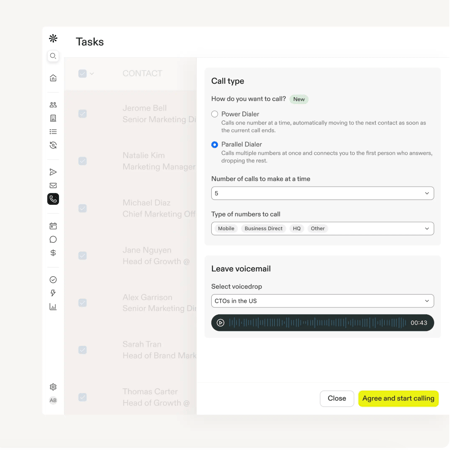
- Overview: The Breeze prospecting agent stands out for its deep native integration with the HubSpot Smart CRM. Operating directly within HubSpot, Breeze leverages CRM data and public signals to research prospects, draft personalized outreach, and automatically log every action to the contact, company, and deal records without any sync delays or complex field mapping. Sales Hub provides the execution layer with multi-channel sequences (email, phone, LinkedIn), real-time email engagement tracking, and a built-in dialer for seamless call management and recording within the HubSpot environment.
- Key Features: AI prospecting agent for native research and outreach; multi-channel sequences with automatic logging; real-time email tracking; built-in dialer with recording; free tools tier with scalable paid plans.
- Market Position: Unique in its native CRM integration, eliminating common sync issues. Ideal for organizations already using or considering HubSpot as their core CRM.
- Best for: Teams seeking an AI-powered outbound solution that is intrinsically part of their CRM, ensuring unparalleled data fidelity and ease of use.
-
Apollo.io
- Overview: Apollo.io offers a comprehensive solution combining a vast database of over 275 million B2B contacts with email sequencing, a built-in dialer, and bi-directional CRM synchronization (Salesforce, HubSpot, Pipedrive). It further enhances its offering with AI-powered lead scoring, intent signals, and AI-drafted email content, positioning itself as an all-in-one platform for prospecting and engagement.
- Key Features: Extensive B2B contact database; email sequencing and automation; built-in dialer; AI-powered lead scoring and intent signals; bi-directional CRM integration.
- Market Position: A strong contender for teams prioritizing an integrated database and engagement platform. Its generous free tier makes it accessible for smaller teams.
- Best for: SMB teams and startups looking for an all-in-one prospecting database and engagement platform with a good balance of features and cost-effectiveness.
-
Outreach
- Overview: Outreach is recognized as an enterprise-grade sales engagement platform, providing sophisticated multi-step sequences across email, phone, and social channels. Its deep CRM integration with Salesforce, HubSpot, and Microsoft Dynamics ensures robust data flow. Outreach’s AI capabilities include deal health scoring, Kaia conversation intelligence for real-time call coaching, and predictive analytics to identify at-risk deals, making it a powerful tool for complex sales cycles.
- Key Features: Advanced multi-channel sequencing; AI-powered conversation intelligence (Kaia); deal health scoring and predictive analytics; robust CRM integration; comprehensive analytics and reporting.
- Market Position: A leader in the sales engagement category, particularly strong for large, complex sales organizations requiring advanced analytics and compliance features.
- Best for: Enterprise B2B sales teams with 20+ representatives running structured outbound motions that demand detailed analytics, stringent compliance controls, and executive-level pipeline reporting.
-
Salesloft
- Overview: Salesloft delivers a unified platform for outbound cadence management, deal intelligence, and forecasting. Its CRM integrations with Salesforce, HubSpot, and Microsoft Dynamics facilitate bi-directional syncing of contacts, activities, and opportunities. Salesloft’s AI features include cadence optimization, automated call analysis, and AI-based forecasting, bridging the gap between SDR outreach and Account Executive pipeline management.
- Key Features: Outbound cadence and sequence management; deal intelligence and forecasting; automated call analysis; AI-based optimization; strong CRM integrations.
- Market Position: Offers a unique value proposition by combining outbound sequencing with robust pipeline management, appealing to organizations seeking to consolidate these functions.
- Best for: Teams that require a unified platform for both outbound sequencing and comprehensive pipeline management, aiming to streamline the transition from prospecting to deal closure.
-
Cognism
- Overview: Cognism specializes as a sales intelligence platform renowned for its highly verified mobile phone numbers and B2B contact data. Its 2026 State of Outbound report demonstrated that phone-first teams utilizing their verified data achieve cold call answer rates of 13.3%, comparable to warm outreach levels. Cognism integrates with major CRMs and sales engagement platforms (Salesforce, HubSpot, Outreach, Salesloft) to enrich existing records with accurate contact data and intent signals, making it invaluable for phone-centric outbound strategies.
- Key Features: Verified mobile phone numbers and B2B contact data; intent data; GDPR compliance framework; seamless CRM and sales engagement platform integrations.
- Market Position: A niche leader for data accuracy, particularly phone numbers, and strong emphasis on GDPR compliance, critical for European markets.
- Best for: Teams heavily reliant on phone-first outbound strategies, requiring highly accurate and verified contact data, especially those operating in or targeting European markets.
Strategic Considerations for Outbound Sales Tools
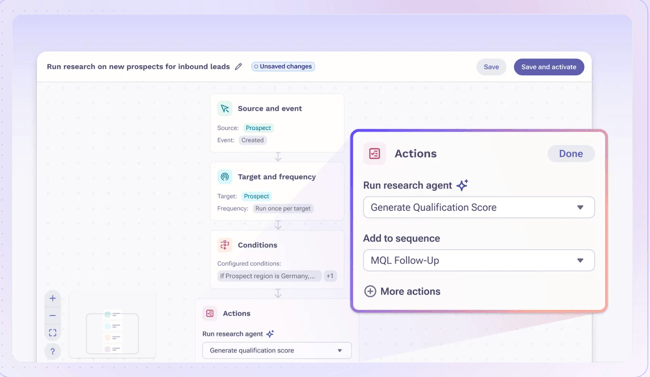
Selecting and implementing outbound sales software requires careful strategic planning to maximize efficiency and ROI.
Evaluating CRM Compatibility and Integration Depth: The paramount consideration remains how deeply and reliably a tool integrates with an existing CRM. Teams should scrutinize CRM object sync coverage (contacts, companies, deals, activities), the completeness of activity logging (e.g., does it just log "activity" or specific call outcomes and email replies?), API rate limits, and the robustness of error handling. A superficial integration that drops critical context or fails intermittently can be more detrimental than no integration at all, corrupting data and undermining strategic insights. Native tools, like HubSpot’s ecosystem, eliminate the integration layer entirely, ensuring seamless data flow. For third-party tools, thorough due diligence on their integration architecture is essential.
Measuring Outbound Efficiency: Beyond basic response rates, evaluation should encompass broader metrics such as time-to-first-meeting, conversion rates through the pipeline, average sales cycle length for outbound-generated leads, and the completeness of CRM data logging. These metrics provide a holistic view of whether the tool is genuinely enhancing efficiency or merely adding complexity. Piloting new tools with a small team before a full rollout allows for real-world validation of these metrics.
All-in-One vs. Best-of-Breed Tools: Small teams (typically under 10 reps) generally benefit significantly from all-in-one platforms. The administrative overhead of managing multiple integrations between separate prospecting, sequencing, dialing, and CRM tools can quickly overwhelm limited RevOps resources. Platforms that consolidate multiple functions, like HubSpot or Apollo.io, minimize this overhead. Best-of-breed stacks, comprising specialized tools for each function, are more suitable for larger organizations with dedicated Revenue Operations teams capable of managing complex integrations and specific workflows that no single platform can adequately address.
Compliance and Data Governance: In an era of increasing data privacy regulations (e.g., GDPR, CAN-SPAM, CASL), adherence to compliance standards is non-negotiable. Reputable outbound sales tools include built-in features for opt-out management, suppression lists, and unsubscribe handling. Teams selling into regulated markets, particularly Europe, must verify that their chosen tool stores data in compliant regions, supports right-to-erasure requests, and maintains a clear legal basis for processing data. Cognism, for instance, has made its robust GDPR compliance framework a key differentiator.
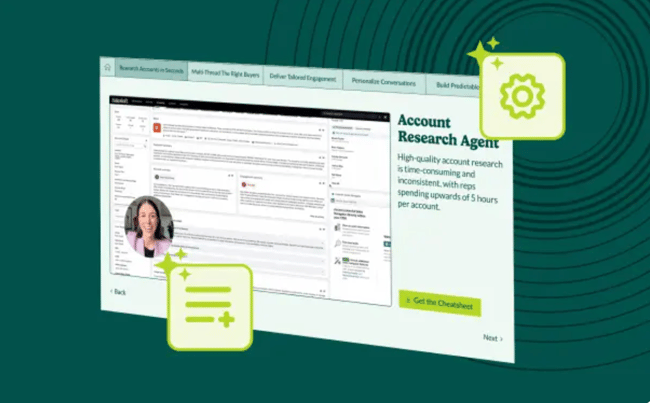
Mitigating Integration Failures: The most common causes of integration failures stem from misconfigured field mapping, inconsistent data formats, and hitting API rate limits. To circumvent these issues, organizations should meticulously document their CRM’s field architecture before connecting any new tool, establish clear deduplication rules in advance, and diligently monitor sync logs, especially during the initial months of implementation. Even minor sync gaps can severely compromise outbound attribution and reporting accuracy, making proactive monitoring crucial.
Integration Depth: The Ultimate Differentiator
In 2026, the most effective outbound sales tools are those that transcend mere automation. They are integral components of a cohesive revenue operations ecosystem, connecting every email, call, and social touchpoint directly to CRM-tracked deal data. This deep integration provides sales managers with the insights needed to identify successful strategies, empowers representatives with the context required for highly personalized outreach, and equips leadership with the confidence to forecast revenue accurately.
While every tool reviewed offers some level of CRM integration, the depth and reliability vary considerably. Native platforms, such as HubSpot Sales Hub with Breeze, inherently eliminate the integration layer, ensuring a single source of truth. Third-party solutions like Apollo, Outreach, Salesloft, and Cognism, while powerful, necessitate meticulous configuration to achieve reliable and comprehensive data synchronization.
The experience of countless organizations transitioning from fragmented outbound stacks to CRM-native or deeply integrated workflows consistently highlights the transformative impact on pipeline visibility. The shift eliminates the loss of follow-up details, empowers leaders to coach based on actionable data rather than intuition, and fosters a unified operational environment. For any organization where outbound tools are not consistently writing clean, contextual data back to the CRM, prioritizing this integration is not merely an improvement but a fundamental necessity for future sales success.