China’s Supreme People’s Court Releases Draft Rules Implementing 2027 Trademark Law Amendments for Public Comment

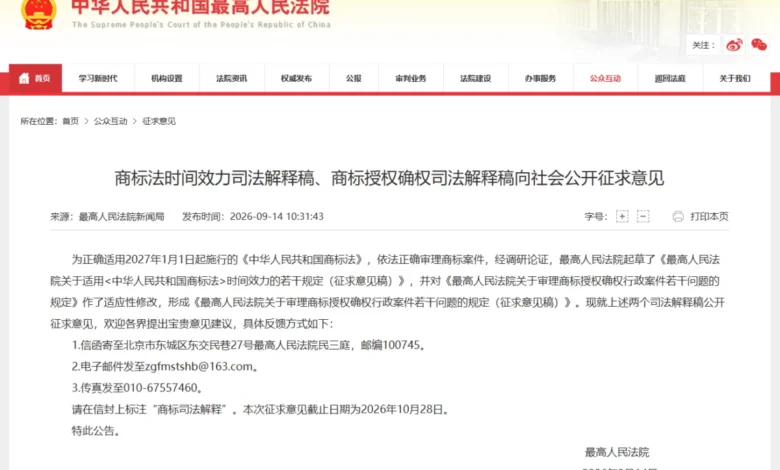
On September 14, 2026, the Supreme People’s Court (SPC) of the People’s Republic of China officially released a comprehensive package of draft judicial interpretations designed to streamline and regulate the implementation of the newly amended Trademark Law, which is slated to take effect on January 1, 2027. This legislative and judicial alignment marks a critical milestone in China’s ongoing efforts to strengthen intellectual property (IP) protection, combat bad-faith trademark registrations, and provide clarity to both domestic enterprises and international brand owners operating within the Chinese market.
The newly published draft package comprises three distinct documents submitted collectively for public scrutiny and feedback. These include rules governing the temporal application of the revised Trademark Law, a formal decision outlining specific amendments to existing judicial provisions on administrative cases involving trademark authorization and confirmation, and the complete, consolidated text of these updated provisions. By opening these drafts for public commentary ahead of the 2027 legislative enforcement date, China’s highest judicial authority aims to preemptively address legal ambiguities and secure multi-sectoral input from legal practitioners, corporate entities, and academic experts.
Background Context and Legislative Evolution
China’s Trademark Law has undergone multiple revisions over the past three decades to keep pace with the country’s rapid economic expansion, the maturation of its domestic market, and its international obligations under various trade agreements. As the volume of trademark filings in China surged past historical benchmarks—surpassing millions of applications annually—issues surrounding malicious hoarding, squatting, and consumer confusion became acute pain points for brand protection.
The upcoming 2027 amendments to the Trademark Law introduce stringent measures aimed at curbing bad-faith applications that lack a genuine intent to use, enhancing the protection of well-known trademarks, and refining administrative adjudication procedures. However, the introduction of a major legislative overhaul inevitably raises complex transitional questions: How should courts handle ongoing litigation initiated under older legal frameworks? Which statutory standards apply to administrative decisions rendered before versus after the effective date? The SPC’s newly released draft judicial interpretations serve as the definitive operational manual to resolve these transitional conflicts, establishing clear boundaries for judges, administrative agencies, and litigants alike.
Core Provisions of the Temporal Application Rules
The draft provisions addressing the temporal effect of the revised Trademark Law establish clear guidelines for determining which legislative version governs specific categories of civil disputes and administrative litigation.
According to Article 1, trademark civil disputes arising from legal facts occurring after the January 1, 2027 implementation date will be strictly governed by the newly revised Trademark Law. Conversely, disputes originating from facts prior to that date generally fall under the purview of the historical laws and judicial interpretations in force at the time. A crucial exception exists for continuous legal facts: if a violation or legal fact predating January 1, 2027, persists after the new law takes effect, the newly revised provisions will apply, barring any specific statutory carve-outs.
For administrative lawsuits challenging decisions made by the State Council’s trademark administration department—such as rejection reviews, non-registration reviews, and cancellation proceedings—the rules establish precise temporal anchors. For instance, administrative challenges against invalidation review decisions will be judged based on the Trademark Law version in effect at the exact time the original registration approval decision was granted. Similarly, rules governing administrative penalties dictate that the law in effect at the time of the illegal act applies, subject to the standard legal principle that a subsequent law imposing a lighter penalty or decriminalizing an act retroactively takes precedence.

Substantive Updates to Trademark Authorization and Confirmation Cases
Beyond transitional rules, the SPC package introduces thirteen specific amendments to the judicial interpretations governing administrative cases involving trademark grant and confirmation. These updates align judicial review standards with the terminology and substantive directives of the 2027 Trademark Law.
Notable revisions include updated statutory definitions regarding protected national symbols, theoretical achievements of the Communist Party of China, and state emblems. The draft also broadens and clarifies protections surrounding well-known trademarks. Specifically, the amendments instruct courts to evaluate whether the unauthorized use of a disputed trademark weakens the distinctiveness, damages the market reputation, or improperly exploits the commercial goodwill of a well-known trademark—moving beyond mere likelihood of confusion to encompass dilution and freeriding.
Furthermore, the drafts tighten scrutiny on prior legitimate rights and interests, expanding protections beyond traditional "prior rights" to cover broader commercial equities, such as well-known corporate trade names, unregistered prior works, character images, and recognized personal names or pseudonyms used in commerce. The threshold for identifying bad-faith registration has likewise been refined, shifting from ambiguous standards of "improper means" to clearer presumptions based on commercial proximity, prior negotiations, and kinship or employment relationships between applicants and prior users.
Public Consultation Process and Timeline
The release of the draft rules initiates a crucial window for stakeholder engagement. The Supreme People’s Court has structured a transparent feedback mechanism, welcoming written submissions from domestic and international interested parties until the consultation period closes on October 28, 2026.
Submissions can be transmitted via multiple official channels:
- By Mail: Addressed to the Third Civil Division of the Supreme People’s Court, No. 27 Dongjiaominxiang, Dongcheng District, Beijing, postal code 100745 (clearly marked with the envelope designation "Trademark Judicial Interpretation").
- By Email: Directed to the dedicated public consultation inbox at [email protected].
- By Fax: Transmitted via the SPC’s legal affairs fax line at 010-67557460.
Legal analysts anticipate a high volume of feedback from intellectual property law firms, industry associations, and multinational corporations, given the profound commercial implications these rules hold for brand portfolios in China.
Fact-Based Analysis of Broader Market Implications
The formal adoption of these judicial interpretations alongside the 2027 Trademark Law amendments is expected to exert a profound influence on China’s intellectual property ecosystem. By providing granular predictability for transitional cases, the SPC reduces judicial fragmentation and encourages consistency across local and intermediate people’s courts.
For brand owners, the explicit inclusion of dilution standards for well-known trademarks and the robust evidentiary framework for prior commercial interests offer powerful legal instruments to combat sophisticated trademark squatting. Simultaneously, the strict temporal rules ensure that pending litigations are managed with legal certainty, minimizing disruption to ongoing administrative and judicial proceedings as the legal regime transitions into 2027. As the public comment period proceeds, legal professionals will closely monitor whether the SPC incorporates industry feedback to further refine provisions concerning generic names, evidence standards, and the scope of administrative review.
Related posts: