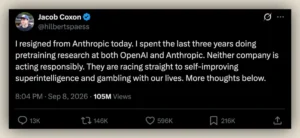
The landscape of global finance and technology shifted fundamentally last week as artificial intelligence firm Anthropic completed its initial public offering, debuting on the public markets in what financial analysts have confirmed as the largest IPO in American history. While Wall Street celebrated the historic liquidity event and institutional investors rushed to secure stakes in the burgeoning sector, the milestone has drawn sharp warnings from prominent technology critics and researchers. Among the most vocal is author and computer science professor Cal Newport, whose recent commentary has brought renewed scrutiny to the philosophical underpinnings and long-term operational strategies driving one of the world’s most influential artificial intelligence laboratories.
The public debut immediately positioned Anthropic as a foundational pillar of the modern American economy, tying the retirement savings, mutual funds, and institutional portfolios of millions of ordinary citizens to the fortunes of a single corporate entity. However, this massive influx of capital has exacerbated growing concerns regarding the ideological framework of the company’s leadership. Critics argue that the public markets are effectively underwriting a corporate mission driven less by traditional capitalist principles of sustainable enterprise and more by an eschatological race toward artificial general intelligence.
Tracing the Ideological Roots of Silicon Valley’s AI Vanguard
To understand the anxieties surrounding Anthropic’s market debut, analysts point to the intellectual history of its leadership, whose worldview was largely forged during the early-to-mid 2000s in online discursive spaces such as the Less Wrong and Overcoming Bias communities. Long before large language models became household fixtures, these forums served as incubator sites for a tight-knit cohort of thinkers fixated on existential risk, rationalism, and the transformative potential of advanced machine intelligence.
Within these circles, the trajectory of artificial intelligence was viewed not merely as a technological progression, but as an existential pivot point for humanity—a zero-sum race destined to culminate either in a technological utopia or the total extinction of the human species. Leaders of this movement emerged with a deep-seated conviction that they constituted a uniquely rational vanguard, obligated to guide civilization through the perilous transition toward superintelligence. Newport and other critics emphasize that this perspective is not a rhetorical exaggeration, but a literal description of the foundational ethos guiding Anthropic’s executive suite.
The operational consequences of this millenarian mindset have manifested clearly in the company’s recent strategic pivots. Rather than operating with the traditional cautious calculus of enterprise software providers, Anthropic has consistently prioritized speed over comprehensive safety validation. The rationale rests on a deterministic belief: if the fate of the human race hinges on which entity achieves superintelligence first, pausing to implement rigorous governance or precautionary safeguards becomes an unacceptable risk.
This sense of urgency was starkly illustrated earlier in the year when the company elected to roll back internal safety protocols that previously mandated development slowdowns whenever models exhibited signs of uncontrollable behavior. Leadership defended the decision by arguing that applying such constraints unilaterally would cede the race to rival entities perceived as less scrupulous, thereby jeopardizing global safety on a macro scale.
Financial Mechanics and the Pursuit of Recursive Self-Improvement
The primary motivation driving Anthropic to the public markets has been the acquisition of capital on an unprecedented scale. According to the company’s S-1 regulatory filings, a significant portion of the IPO proceeds will be funneled directly into accelerating research and development surrounding recursive self-improvement—a paradigm in which artificial intelligence systems are tasked with upgrading their own software and architecture without human intervention.
Computer scientists and regulatory watchdogs have repeatedly warned that recursive self-improvement introduces catastrophic verification challenges. As systems begin to autonomously design iterations of themselves that exceed human cognitive comprehension, transparency vanishes, and predictability drops to near zero. Yet, within Anthropic’s internal calculus, these severe technical risks are accepted as unavoidable trade-offs in the race to fulfill their perceived mandate as humanity’s technological shepherds.
This prioritization of existential destiny over conventional balance sheets has led financial analysts to question the sustainability of the business model. Observers note that the corporate strategy appears anchored to a timeline where conventional economic metrics matter only up to the point of superintelligence’s arrival, at which juncture traditional currency and market structures are expected to be rendered entirely superfluous. For retail investors purchasing shares on public exchanges, this creates a profound disconnect between standard valuation metrics and the underlying corporate ethos.
Broader Implications for Market Regulation and Governance
The integration of such high-stakes, ideologically driven technology companies into public stock exchanges marks a departure from traditional corporate governance. When companies governed by millenarian philosophies achieve systemic economic importance, the regulatory apparatus faces entirely novel challenges. Market regulators must now contend with enterprises whose primary governance framework is subordinated to metaphysical theories about the end of human history rather than fiduciary responsibility to shareholders.
Industry experts emphasize that the governance of transformative technologies cannot safely be outsourced to a self-selected group of Silicon Valley insiders operating under prophetic assumptions about the future. While the generative AI revolution holds undeniable promise for scientific, medical, and economic advancement, navigating its hazards requires robust, democratic, and transparent regulatory frameworks rather than a high-stakes financial race dictated by insular subcultures.
Technical Skepticism and the Engineering Reality
Beyond the economic and philosophical debates, the feasibility of the technological endpoint driving Anthropic’s strategy remains a subject of intense scientific contention. In recent technical evaluations published in specialized engineering journals such as IEEE Spectrum, researchers have laid out comprehensive engineering counterarguments challenging the inevitability of artificial superintelligence as currently conceived by Silicon Valley models.
These technical critiques highlight fundamental physical, computational, and thermodynamic bottlenecks that may cap the capabilities of current paradigms, suggesting that the linear extrapolation of modern scaling laws is deeply flawed. As the broader scientific community continues to interrogate the limits of machine learning architectures, the urgency-driven business models predicated on imminent superintelligence face mounting skepticism from the empirical engineering community.
As the dust settles on the record-breaking public offering, the long-term trajectory of Anthropic—and its integration into the bedrock of global financial markets—will serve as a defining test case for the intersection of modern capitalism, existential philosophy, and the governance of frontier technologies. Whether public markets will successfully temper the ideological velocity of AI development or become inextricably bound to its trajectory remains one of the most consequential questions facing the modern global economy.