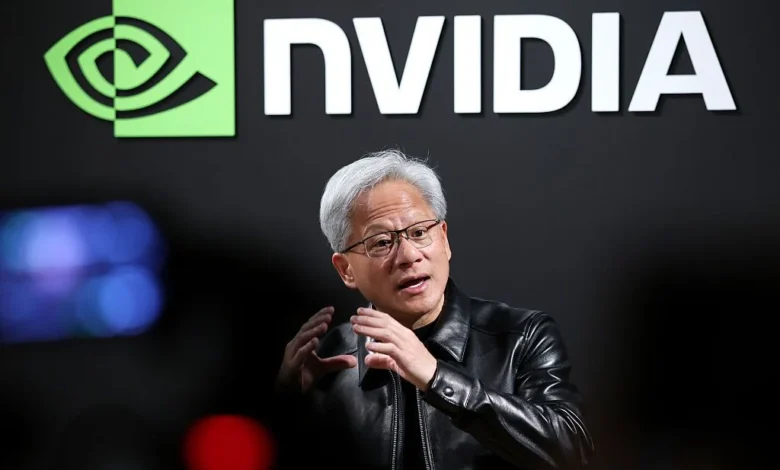
Wall Street staged a historic rally on Monday, fueled by the abrupt and high-profile return of Jensen Huang to the helm of Nvidia. The semiconductor giant, which had been reeling for weeks following a series of personal scandals that led to Huang’s initial departure, saw its shares surge 31.5% in a single session. This move represents the largest one-day percentage gain for the company since May 9, 2003, and resulted in a staggering $954 billion recovery in market capitalization—a record-breaking figure for any U.S. publicly traded entity.
The reversal of fortunes comes after a period of extreme volatility that had pushed the broader technology sector into a technical correction. Last week, the Nasdaq Composite and other major indexes flirted with bear market territory as investors reacted to the leadership vacuum at the heart of the artificial intelligence boom. With Huang back in the CEO chair, the market appears to be betting on a restoration of stability for the AI ecosystem.
A Chronology of the Crisis and Resolution
The turmoil began earlier this month when reports surfaced regarding Jensen Huang’s personal conduct, specifically involving multiple extramarital affairs. The revelation that one of these relationships involved a direct report, while another allegedly involved an individual suspected of being a foreign intelligence operative for China, triggered an immediate board review. Huang subsequently stepped down, citing a need to address personal matters and shield the company from further reputational damage.
The subsequent weeks were characterized by plummeting valuations across the AI sector, as Nvidia—often viewed as the primary engine of modern technological growth—lacked a clear path forward. The correction was swift: the S&P 500 and the Dow Jones Industrial Average suffered consecutive losses that erased trillions of dollars in paper wealth.
However, the deadlock broke over the weekend. In a formal statement released early Monday, the Nvidia board of directors confirmed that after “a series of discussions and meetings,” they had reached a unanimous decision to reinstate Huang as President, CEO, and board director. The board emphasized that, after consultation with senior members of the United States government, they were satisfied that Huang’s tenure posed no ongoing national security risks.
Political Involvement and Executive Intervention
The return of Huang was not merely a corporate governance event; it became a focal point of national political discourse. President Donald Trump publicly claimed credit for facilitating the return, telling CNBC, "I spoke to them, let me put it that way. And I convinced them. I made the deal."
While the administration has not released specific transcripts of these discussions, the involvement of the White House underscores the strategic importance of Nvidia to the U.S. economy. As the primary supplier of the high-end graphics processing units (GPUs) required for training large language models and other AI infrastructures, Nvidia is viewed by many policymakers as a critical component of national industrial policy and technological sovereignty.
Market Reaction and Sector-Wide Rebound
The ripple effects of the news were felt across the entire technology landscape. On Monday, the Dow Jones Industrial Average climbed 3.0% to 49,595, while the S&P 500 rose 4.7% to 7,237. Both indices officially exited correction territory. The Nasdaq Composite, which bore the brunt of the recent sell-off, gained 6.5% to reach 24,089, signaling a significant shift in investor sentiment.
The rally extended beyond Nvidia. Other major players in the semiconductor and AI hardware space saw substantial gains:
- Advanced Micro Devices (AMD): Rose 6.9%.
- Broadcom (AVGO): Increased by 3.0%.
- Marvell Technology (MRVL): Surged 18.4%.
David Miller, Chief Investment Officer and senior portfolio manager at Catalyst Funds, noted that the swift recovery reflects the unique position Huang holds in the market. "Jensen Huang’s return is an enormous positive for Nvidia and the broader AI trade," Miller said. "It removes a major source of uncertainty and restores the visionary leadership that helped build the entire AI infrastructure ecosystem. The market’s reaction reflects just how critical Huang is to investor confidence."
Cautionary Voices Amidst the Euphoria
Despite the record-breaking gains, some market analysts have urged investors to remain cautious, warning that the volatility is rooted in sentiment rather than immediate fundamental changes to company earnings or production capacity.
Mark Hackett, chief market strategist at Nationwide, warned that the extreme price swings demonstrate the emotional nature of the current market cycle. "Nvidia lost $2.7 trillion in market value over six weeks, only to see shares surge roughly 30% on news of Jensen Huang’s reinstatement," Hackett noted. "Nvidia wasn’t worth that much less on Friday, and it isn’t suddenly worth 30% more today. These are trillions of dollars moving on emotion, not fundamentals."
Hackett added that the shift from mass panic to exuberant buying is a stark reminder of the dangers of reactive investing. "The market’s shift from ‘panic’ to ‘never mind’ is a reminder that emotional markets are incredibly difficult to predict, and reacting to every swing can be more dangerous than the volatility itself."
Strategic Consolidation: The CrowdStrike-Zscaler Deal
While the Nvidia saga dominated headlines, the tech sector also saw significant consolidation on Monday. CrowdStrike announced a definitive agreement to acquire its cybersecurity rival, Zscaler, in an all-stock transaction valued at approximately $43.9 billion.
The deal is designed to allow CrowdStrike to dominate the "network security" segment, which analysts identify as the largest sub-sector within the cybersecurity industry. Needham analyst Mike Cikos praised the move, noting, "We like the deal as it brings CrowdStrike into the largest cybersecurity category, expanding CrowdStrike’s total addressable market by over $185 billion in calendar year 2029."
CrowdStrike CEO George Kurtz framed the acquisition as a step toward creating a unified operating system for AI security. "By purchasing Zscaler, we are building cybersecurity’s operating system: a single control plane to deploy AI, control AI, and enable any agentic application to run safely," Kurtz said.
Despite the strategic rationale provided by the company, investors reacted with skepticism, driving CrowdStrike shares down 8.9% on Monday. The divergence between the market’s enthusiasm for the Nvidia news and its lukewarm response to the CrowdStrike-Zscaler merger highlights the current investor focus on established leadership and the stabilization of the AI supply chain over long-term strategic M&A.
Implications for the Future of AI
The events of the past 24 hours have fundamentally altered the landscape for the remainder of the fiscal year. By reinstating Huang, the Nvidia board has essentially signaled that they prioritize his specific operational expertise and industry influence over the risks associated with the recent scandals.
However, the long-term implications for corporate governance in the tech sector remain uncertain. The involvement of the White House in a private company’s personnel decisions—and the market’s reliance on a single individual’s leadership—points to an era where AI-adjacent firms are no longer treated as standard corporate entities, but as essential pillars of national infrastructure.
As the markets look toward the end of the year, the primary challenge for companies like Nvidia will be to convert this restored market confidence into sustained operational execution. The volatility observed on Monday serves as both a testament to the power of the "AI trade" and a warning regarding the fragility of market valuations in an era defined by rapid news cycles and high-stakes executive leadership. Whether the market can sustain these levels will depend on whether the fundamental demand for AI infrastructure remains as robust as the recent price action suggests.