Navigating the Era of Permanent Transition: Why Organizational Agility is the New Business Standard

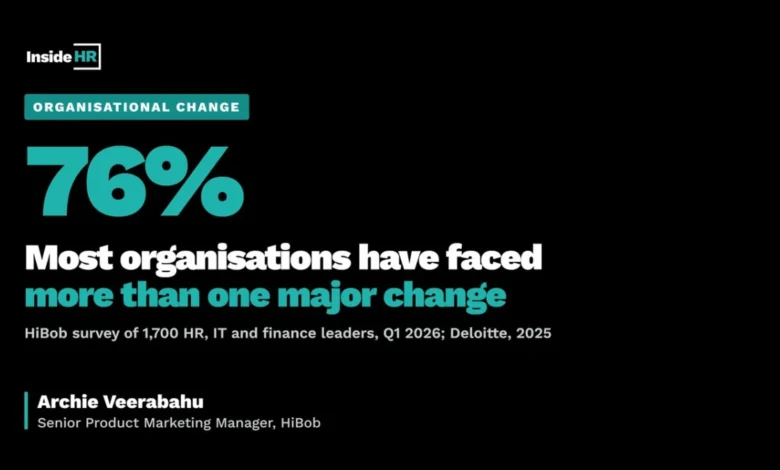
The modern corporate landscape has undergone a profound metamorphosis where stability is no longer the default state, but rather an anomaly. Recent empirical evidence suggests that organizational change, once considered a disruptive, periodic event, has evolved into a persistent, operational baseline. According to a comprehensive survey conducted by HiBob, which polled 1,700 HR, IT, and finance leaders globally, 76% of respondents confirmed that their organizations had navigated multiple major structural transformations in recent periods. This shift necessitates a fundamental rethink of how human resources, finance, and information technology departments collaborate to maintain institutional resilience in an environment characterized by unrelenting volatility.
The Frequency of Flux: Defining the New Normal
Data insights shared by Archie Veerabahu, Senior Product Marketing Manager at HiBob, highlight the sheer velocity at which today’s employees encounter change. Drawing on extensive analysis, Veerabahu notes that the average employee is now subject to approximately 10 planned organizational changes per year. When contextualized, this equates to a major transition every six weeks. This cadence is a departure from historical business cycles, where restructures or strategy pivots were often separated by years of operational consolidation.
This "permanent beta" state of business, where firms are in a perpetual process of updating, expanding, or acquiring, presents significant challenges for management. When change becomes the status quo, the risk of "change fatigue"—a state of exhaustion and cynicism resulting from excessive organizational shifts—increases exponentially. For leadership, the challenge is no longer about how to implement a specific change, but how to build an organizational infrastructure that remains stable while the surface-level architecture is constantly being reconfigured.
Chronology of the Modern Operating Model
To understand how organizations have reached this point, one must observe the shift in business strategy over the last decade. Historically, the "Waterfall" approach to organizational change—where goals were set annually and structural changes were infrequent—dominated the corporate world. However, the post-2020 landscape acted as a catalyst for a more fluid, Agile-based methodology.
- 2015–2019: The Digital Transformation Era. Organizations began experimenting with digital tools, leading to incremental, iterative changes in how work was performed.
- 2020–2022: The Crisis Response Period. The global pandemic forced rapid, reactive changes in remote work, health and safety policies, and supply chain logistics. This period established a precedent for rapid adaptation.
- 2023–Present: The Era of Strategic Persistence. The current phase is defined by the integration of AI, the formalization of hybrid work models, and a focus on operational efficiency. Organizations are now attempting to standardize this high-frequency change rather than viewing it as a reactive emergency measure.
This timeline illustrates that the current, accelerated pace of change is not a temporary anomaly but a consequence of the digital-first environment, where market signals shift rapidly and require an immediate organizational response.
Supporting Data: The Anatomy of Change Management
The HiBob survey serves as a critical indicator for industry leaders. With 93% of surveyed leaders confirming at least one major change in the recent term, the consensus is clear: if an organization is not changing, it is likely stagnating. However, the 76% figure regarding "multiple major changes" indicates that the complexity of these transitions is also increasing.
Supporting research from global consulting firms, such as Deloitte and McKinsey, corroborates these findings, suggesting that the "half-life" of professional skills is shrinking and that business models are becoming obsolete faster than ever before. When human capital, technology stacks, and financial projections are in constant motion, the traditional silos between HR, IT, and Finance become a liability. HR owns the culture and the people, IT owns the data and the systems, and Finance owns the budget and the resource allocation. If these three departments are not perfectly synchronized, the "every six weeks" cycle of change results in operational friction, disengaged employees, and fiscal inefficiency.
The Interdisciplinary Challenge: HR, Finance, and IT Alignment
The intersection of HR, Finance, and IT is currently the most critical pressure point in modern business. In the webinar, Designing for change: A modern operating model for HR, experts argue that the success of a modern enterprise depends on how effectively these three pillars can communicate.
For instance, when an organization plans an acquisition or a major restructure, the HR team requires accurate people data to assess talent gaps. Simultaneously, the IT department must ensure that systems are scalable and integrated, while Finance must forecast the long-term ROI of the human capital investments. If these departments work in isolation, the result is usually a disjointed implementation that fails to achieve its stated objectives.
The modern operating model requires a move toward a "data-first" culture. This involves ensuring that people data is not just stored, but actionable. As organizations integrate Artificial Intelligence into their decision-making processes, the quality of data becomes paramount. AI-driven HR analytics can help leaders predict the impact of a restructure before it happens, allowing for a proactive rather than reactive stance.
Official Perspectives and Strategic Implications
Archie Veerabahu’s commentary underscores a vital truth: the leaders who succeed in this environment are those who stop viewing change as a "project" with a start and end date. Instead, they view it as a continuous operational function.
"If we are expecting our employees to navigate a new organizational reality every six weeks, we must provide them with the tools and the culture to do so without burning out," suggest industry observers. The implications for the workforce are significant. Organizations that fail to manage the psychological impact of this high-frequency change risk losing top talent to competitors who offer more stability or better change-management support.
Furthermore, the integration of AI into these processes is not merely a technological upgrade; it is a structural necessity. By automating routine administrative tasks associated with organizational shifts, leaders can free up their teams to focus on the human side of change—communication, support, and cultural alignment.
Broader Impact: The Future of the Workplace
Looking ahead, the mandate for organizations is clear: build a structure that is "change-ready." This involves several key components:
- Modular Organizational Design: Creating teams that can be reconfigured quickly without dismantling the core culture of the business.
- Data Democratization: Ensuring that HR, IT, and Finance have access to the same "single source of truth" regarding organizational performance and employee sentiment.
- Resilient Leadership Development: Training managers to lead teams through ambiguity. In a world of change, the most valuable leadership trait is the ability to maintain clarity and focus amidst shifting priorities.
The findings from the HiBob survey and the accompanying insights from the InsideHR webinar series suggest that the "constant change" model is here to stay. As organizations continue to iterate, the ability to manage the human experience—the emotional and logistical toll of constant transition—will be the defining competitive advantage of the next decade.
Conclusion
The data provided by global surveys serves as a wake-up call to boards and executive teams. With a major organizational change occurring every six weeks on average, the margin for error is razor-thin. Organizations that cling to outdated, static operating models will inevitably find themselves struggling to keep pace with more agile competitors.
Success now depends on the seamless integration of HR, IT, and Finance, underpinned by a culture that values data, transparency, and employee well-being. By embracing the reality of constant flux and designing systems that prioritize agility, leaders can transform the challenge of perpetual change into a engine for sustained growth and innovation. The question for modern leaders is no longer "How do we survive the next change?" but "How do we build a company that is fundamentally designed for change?" As the research highlights, the answer lies in the intentional, interdisciplinary design of the modern operating model.