Navigating the Rise of AI Sales Development Representatives: Strategy, Pitfalls, and Implementation Frameworks


Artificial Intelligence Sales Development Representatives (AI SDRs) have rapidly transitioned from speculative concept to boardroom agenda item, promising a technological remedy to long-standing capacity constraints within B2B sales organizations. Traditionally, human SDR pipelines experience bottlenecks as sales professionals spend valuable hours manually researching prospective accounts, coordinating meeting schedules, and updating customer relationship management (CRM) systems. Generative AI agents offer a solution by maintaining continuous operational momentum. However, widespread integration hinges entirely on access to pristine data feeds and rigorously defined qualification frameworks.
Despite aggressive marketing campaigns from software vendors, industry adoption remains in its infancy. Data compiled by the Bridge Group in its 2025 benchmark study of 351 business-to-business companies indicates that only 1% of organizations currently deploy AI SDRs as a distinct staffing model. Consequently, contemporary commercial strategy revolves less around whether artificial intelligence possesses the technical capability to execute basic sales tasks, and more around precisely which segments of a proven sales motion an automated agent can oversee without jeopardizing lead quality, customer relationships, or domain sender reputation.
Defining the Scope and Mechanics of Autonomous Sales Agents
An AI SDR functions as specialized software engineered to execute a bounded, well-defined subset of the broader sales development lifecycle. Typical responsibilities include scraping account intelligence, dispatching pre-approved outreach sequences, and logging interaction metrics directly into the enterprise CRM before gracefully executing a warm handoff to a human account executive or sales representative.
Differentiating these advanced agents from legacy productivity enhancements—such as automated call summarizers or email drafting utilities—requires examining operational autonomy. While traditional tools simply generate inputs for human workers to review and execute, modern AI agents utilize conditional logic to independently determine subsequent steps in a complex sales workflow. This level of agency preserves thousands of human labor hours annually.
Nevertheless, human oversight remains indispensable. Experienced sales representatives routinely identify subtle nuances in prospect replies that automated qualification parameters inevitably misinterpret. Furthermore, human operators demonstrate superior cognitive flexibility when live discovery sessions reveal unexpected enterprise needs that invalidate the initial outreach thesis. Consequently, resilient AI implementations require explicit rule-sets designed to halt automated sequences, preserve granular historical context, and immediately escalate complex interactions to human supervisors whenever anomalous inputs occur.

Inbound Safety Versus Outbound Vulnerabilities
The operational risk profile of an AI SDR shifts dramatically depending on the directional nature of the sales motion. Inbound inquiries represent a fundamentally safer testing ground than cold outbound prospecting. Inbound buyers have explicitly signaled intent by requesting communication, authorizing agents to eliminate queue times, provide overnight and weekend coverage, gather mandatory qualification data, and instantly secure meeting times while buyer interest remains at its peak.
Empirical evidence underscores the competitive advantage of rapid inbound response times. A prominent study conducted by Workato, which submitted demo requests to 114 B2B companies, revealed that a mere single organization delivered a personalized email response within a five-minute window, with the overall average response time stretching across nearly 12 hours. Similarly, executive insights published by SaaStr highlighted an instance where an automated inbound agent successfully secured a high-value enterprise contract on a Saturday evening when no human personnel were available to monitor incoming inquiries.
Conversely, outbound prospecting exposes an enterprise to severe operational hazards. Because cold prospects never solicited outreach, every automated transmission draws directly upon the corporate domain’s overall reputation, brand equity, and finite market goodwill. High-volume outbound campaigns driven by stale data or loose targeting frequently trigger spam complaints, prompt email service providers to penalize sender infrastructure, and prematurely exhaust target accounts that the enterprise may desperately need to engage later in the sales cycle.
Furthermore, cold outreach rapidly transitions from rigid scripts into dynamic, high-stakes conversations requiring active listening and emotional intelligence. A prospect’s polite brush-off frequently masks a firm rejection, while an account meeting surface-level firmographic criteria may instantly reveal a complete lack of budget or purchasing authority during initial discovery. Outbound deployment consequently demands exceptionally stringent data governance, strict deliverability thresholds, mandatory human approval gates, and comprehensive escalation protocols.
Anatomy of Failed AI SDR Pilots
Industry post-mortems indicate that the vast majority of AI SDR pilots collapse due to organizational and foundational deficiencies rather than inherent software failures. An autonomous sales agent accelerates operational throughput at a pace that quickly exposes underlying flaws within an organization’s target account lists, qualification standards, and CRM hygiene.

First, successful deployments require a historically validated track record of qualified opportunities. An AI agent lacks the cognitive capacity to formulate an Ideal Customer Profile (ICP) from scratch or resolve internal disagreements between sales development teams and account executives regarding the definition of a qualified lead. If an organization cannot clearly articulate what constitutes a viable sales opportunity, automated tools will simply flood the pipeline with low-quality prospects, crowding out high-conversion accounts. Chronicles of early adopter experiments, such as those detailed by SaaStr during their multi-agent rollouts, emphasize that revenue operations (RevOps) must thoroughly clean internal data architectures, validate buyer personas, and optimize human-driven messaging sequences long before scaling automation.
Second, agent effectiveness is tethered entirely to data integrity. Kyle Asay, Senior Vice President of Sales at LaunchDarkly, candidly shared his organization’s experience after rushing into an AI SDR deployment. Within months, the company was forced to uninstall the software after discovering that personalized outreach materials were routinely being dispatched to existing customers rather than net-new prospects due to pervasive duplicate entries within the enterprise CRM. Personalization parameters mapped erratically to incorrect corporate entities, causing response rates to plummet toward zero. Asay’s cautionary observation has since become an industry maxim: artificial intelligence scales operational efficiency when organizations are thoroughly prepared, but it enables companies to execute catastrophic mistakes at unprecedented scale when they are not.
Third, revenue operations and sales enablement teams must dedicate substantial operational capacity to monitor, tune, and govern autonomous agents. Rather than deploying software across an entire department simultaneously, industry practitioners recommend beginning with a single, highly isolated workflow. Experts interviewed by venture firm SignalFire suggest dedicating four to eight hours per week of dedicated RevOps and enablement time to maintain basic workflows, while more complex multi-agent deployments chronicled by SaaStr demanded between 15 and 20 hours weekly dedicated exclusively to performance auditing and prompt tuning.
Strategic Routing: AI-First, Hybrid, or Human-First
Determining the precise operational boundaries for artificial intelligence requires evaluating buyer intent, relationship value, workflow predictability, data hygiene, and the financial ramifications of an erroneous interaction. For the vast majority of commercial enterprises, a hybrid operational model serves as the most prudent default configuration.
AI-led approaches excel in highly structured scenarios characterized by well-documented processes and pristine data sets. Conversely, high-value enterprise accounts possessing incomplete historical context, sensitive relationship dynamics, or complex multi-stakeholder purchasing committees necessitate direct human control.
Sophisticated organizations establish explicit operational handoffs between software and staff. Vercel Chief Operating Officer Jeanne DeWitt Grosser noted that deploying automated agents to manage inbound lead triage enabled human team members to concentrate intensely on high-value outbound prospecting. Similarly, SaaStr utilizes autonomous agents to qualify and schedule introductory meetings for transactional inquiries, while major enterprise sponsorships immediately trigger human intervention.

Taxonomy of Task Ownership: Own, Assist, or Escalate
To operationalize a hybrid sales model effectively, revenue leaders must rigorously categorize specific tasks into three distinct operational buckets: complete ownership, human-assisted execution, and mandatory escalation.
Tasks suitable for complete agent ownership comprise rule-based activities with binary outcomes. Lead triage, automated CRM record updates, standardized calendar scheduling, and verified first-touch outreach fall securely within this domain. Sales teams can easily measure whether the software executed the prescribed directive without requiring subjective interpretations of buyer psychology.
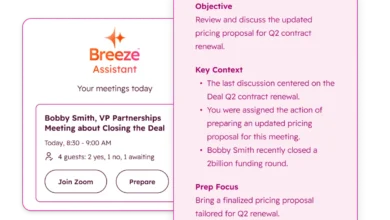
Tasks designed for human-assisted execution involve scenarios where computational speed accelerates preparation, but human judgment dictates the final course of action. AI agents excel at synthesizing account research, generating initial message drafts, compiling comprehensive call preparation briefs, and surfacing relevant objection-handling playbooks. In these instances, the artificial intelligence assembles evidentiary materials, while human sales representatives evaluate strategic implications and execute the final communication. Platforms such as HubSpot’s AI-guided selling and prospecting agents operationalize this exact dynamic by pairing automated administrative workflows with centralized Smart CRM context.
Finally, ambiguous situations, complex technical objections, and sensitive buyer interactions mandate immediate human escalation. Minor linguistic nuances in prospect replies frequently elude automated semantic processing. As technology commentator Scott Brinker aptly observed following early software demonstrations, an AI SDR often performs flawlessly in controlled testing environments until it encounters the unpredictable reality of an actual human buyer.
Evaluating and Procuring AI Sales Software
Selecting enterprise-grade sales automation software requires rigorous evaluation against specific operational benchmarks. Purchasing decisions should never be made based solely on polished vendor demonstrations. Before executing commercial contracts, procurement teams must verify integration capabilities with existing CRM architecture, assess compliance with regional data privacy regulations such as GDPR and CCPA, analyze transparent pricing structures inclusive of implementation and data enrichment costs, audit deliverability management safeguards, and examine verified peer references.

Furthermore, procurement professionals must exercise extreme diligence regarding vendor customer metrics. High-profile industry reporting from outlets like TechCrunch has previously exposed instances where emerging enterprise software startups artificially inflated active customer counts by counting short-term pilot participants or accounts with aggressive opt-out clauses as fully realized, long-term commercial deployments. Legal counsel should always review outbound email automation protocols to ensure compliance with emerging data protection statutes before launching campaigns into the public market.
Measuring Pilot Success and Future Outlook
Evaluating an AI SDR pilot requires treating the software with the same rigorous probationary standards applied to a newly hired human employee. Organizations must establish clear Key Performance Indicators (KPIs) prior to deployment, including pipeline velocity, cost-per-opportunity generated, meeting show rates, and downstream conversion percentages. Comparing pilot data directly against established historical baselines provides an objective evaluation of whether the technology delivers genuine return on investment.
Ultimately, the future of sales development does not lie in the wholesale replacement of human talent, but rather in strategic augmentation. By delegating high-volume, repetitive administrative burdens to intelligent software agents, organizations empower human sales professionals to focus their cognitive energy where it matters most: conducting empathetic discovery, building enduring relationships, and closing complex enterprise deals.