The digital commerce landscape is undergoing a profound structural shift as the boundaries between traditional web interfaces and machine-readable environments begin to blur. On October 15, during the Ship 26 conference in San Francisco, Shopify CEO Tobi Lütke and Vercel CEO Guillermo Rauch unveiled a strategic partnership aimed at defining the next generation of "agentic ecommerce." By integrating Shopify’s rebuilt Hydrogen software development kit (SDK) with Vercel’s new AI-enabled storefront template, the two companies are providing developers with the tools to build digital storefronts that function seamlessly for both human consumers and autonomous AI agents.
This initiative marks a departure from the conventional design philosophy of the last two decades, which prioritized the visual user experience (UX) above all else. Instead, the new framework focuses on structured data accessibility, allowing AI agents to navigate, query, and interact with merchant inventories with the same proficiency as a human shopper, without requiring the interpretation of complex HTML or visual assets.
A Chronology of Collaboration
The partnership between Shopify and Vercel is not a sudden development but the culmination of an iterative technical roadmap. The relationship gained significant momentum on June 30, when the two companies announced a comprehensive rebuild of the Hydrogen SDK. This project was designed to decouple Shopify’s robust backend commerce infrastructure from specific frontend constraints, allowing developers to deploy storefronts across a diverse array of JavaScript frameworks and serverless runtimes.
The October 15 announcement at Ship 26 represents the second phase of this roadmap. By introducing the Vercel Shop template, the companies have provided a "reference architecture" that demonstrates how to implement the tools developed during the June update. This template acts as a blueprint, enabling developers to bypass the boilerplate work typically associated with custom storefront builds and focus on the unique, high-level features of their brand’s shopping experience.
Technical Foundations: Hydrogen and Vercel Shop
Building a modern, high-performance ecommerce storefront is an arduous task that requires orchestrating complex systems, including real-time inventory synchronization, pricing engines, dynamic cart management, and secure checkout flows. Traditionally, these integrations have been prone to latency and data consistency issues.
The rebuilt Hydrogen SDK addresses these challenges by organizing common ecommerce functions into a modular, reusable library. Developers can utilize these components to ensure that product catalog data, pricing, and availability remain consistent across every interaction point. Vercel Shop builds upon this foundation by adding a layer of semantic accessibility.
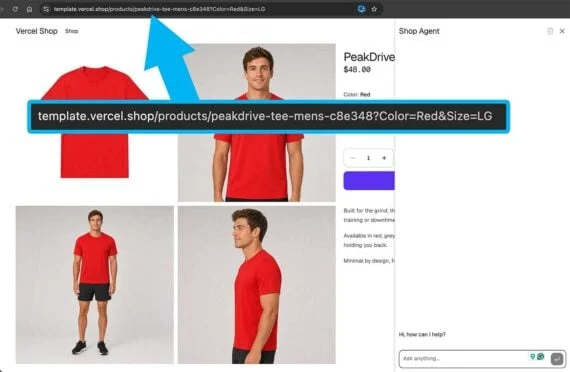
When a developer uses the Vercel Shop template, they are not merely creating a website; they are deploying an interface that inherently understands machine communication. The template utilizes URL parameters and structured data formats that allow AI agents to parse specific product attributes—such as color, size, material, and stock status—directly from the browser address bar. For instance, a search for a specific item can be translated into a precise URL string, enabling an AI to "deep link" into a product configuration without the need for human intervention.
The Rise of Agentic Ecommerce
The concept of "agentic ecommerce" refers to the ability of AI-driven software agents to perform tasks on behalf of a user, such as finding a specific product, comparing prices, managing cart additions, and navigating store policies.
In the current ecosystem, if an AI agent were to shop on a standard website, it would need to parse the visual structure of the page, which is fragile and subject to frequent changes. The Vercel Shop template eliminates this friction. Because the store is built with agent-readable data, an external AI agent can interact with the store’s backend services directly. If a consumer asks an AI assistant to "find a black jacket in size large under $100," the agent can query the store’s API, verify the inventory in real-time, and confirm the exact product parameters without needing to render a single pixel of the frontend.
This efficiency is expected to reduce the "computational tax" currently required for AI to navigate the web, potentially leading to faster, more accurate purchasing journeys.

The Internal Store Assistant
Beyond external agents, the Vercel Shop template includes a built-in, optional AI shopping assistant designed to enhance the experience for human visitors. This feature serves a role similar to existing enterprise AI tools, such as Walmart’s Sparky or Amazon’s Alexa for Shopping.
The assistant is integrated directly into the site’s cart management system. If a shopper is browsing a collection and becomes uncertain about sizing or style, they can query the assistant. Because the assistant shares the same session state as the visual storefront, the shopper can add items to their cart through a chat interface, and the website will immediately reflect those changes.
Crucially, the system maintains strict security protocols. While the assistant can handle product discovery and cart management, it is strictly prohibited from finalizing transactions. Shopify remains the source of truth for all financial transactions, ensuring that payment processing and sensitive checkout data remain within the company’s PCI-compliant environment. Developers are given the flexibility to configure the assistant’s tone, product guidance, and the specific data it is permitted to access via Vercel’s AI Gateway.
Industry Implications and Strategic Outlook
The collaboration between Shopify and Vercel signals a significant pivot in the ecommerce industry. As generative AI becomes more prevalent in daily consumer life, merchants are beginning to realize that their storefronts must serve two distinct audiences: humans who value visual aesthetics and brand storytelling, and machines that value structured data and logical flow.
During the conference, Tobi Lütke emphasized the necessity of this openness. "Checkouts are ridiculously hard to get right," Lütke noted. "It’s one of those pieces of software that actually does need 20 years of tinkering with. And Shopify has always been very open, and so we invite people to remix pieces from our checkout just as much as you want."
This "remixable" architecture is a strategic advantage for Shopify. By allowing developers to utilize the most difficult parts of the commerce stack—checkout, payments, and inventory—while providing the flexibility to innovate on the interface, Shopify effectively future-proofs its platform against shifting consumption habits.
For Vercel, the partnership underscores its position as the premier infrastructure provider for the modern web. By standardizing the "Vercel Shop" template, the company is positioning itself as the gateway through which this new wave of agentic commerce will be deployed.
Broader Economic Impact
The move toward agentic ecommerce has the potential to reshape customer acquisition costs and conversion rates. If AI agents become the primary way consumers discover products, merchants who prioritize machine-readable storefronts will likely see improved visibility in AI search results.
Furthermore, the data suggests that the complexity of modern ecommerce builds is driving a need for this kind of consolidation. According to industry analysis, the average mid-to-large enterprise uses over 20 different software tools to manage their ecommerce operations. The Hydrogen-Vercel integration acts as a bridge, reducing the integration burden and allowing businesses to deploy high-performance, AI-ready storefronts in a fraction of the time previously required.
As the retail industry approaches the next decade of digital transformation, the collaboration between Shopify and Vercel serves as a case study in how platform providers are responding to the rise of artificial intelligence. By building for both the human eye and the machine mind, they are setting the standard for a new era of commerce that is as accessible to software as it is to shoppers. As more merchants adopt these tools, the industry will likely see a surge in specialized, highly performant, and deeply integrated shopping experiences that define the next chapter of the digital economy.