The Perils of Total Automation Why LinkedIn’s Talent Development Lead Warns Against Removing Routine Tasks in the AI Era

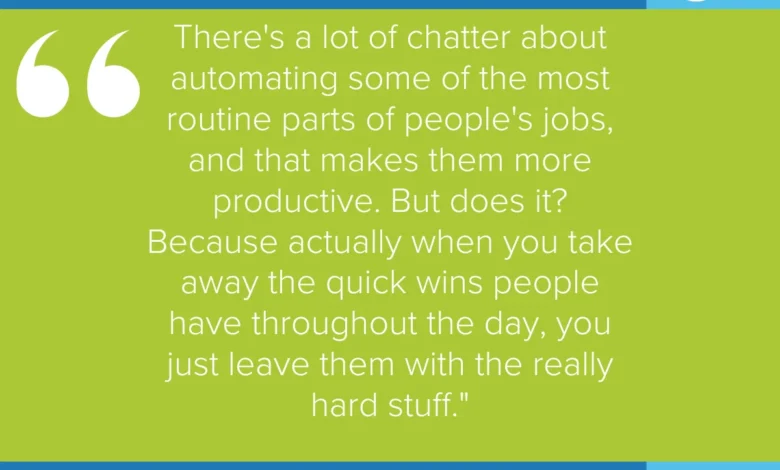
The rapid integration of artificial intelligence into the corporate landscape has sparked a race among Human Resources (HR) leaders to automate every possible routine and repetitive task within their organizations. The prevailing logic suggests that by offloading "busy work" to algorithms, employees are liberated to focus exclusively on high-value, complex, and creative projects that drive innovation. However, Kevin Bishop, the Director of Talent Development at LinkedIn, has issued a stark warning regarding this trend, suggesting that the drive for total efficiency may be inadvertently architecting a widespread crisis of employee burnout and morale collapse.
As organizations across the globe transition into an AI-augmented reality, the focus has largely remained on technical implementation and cost-saving metrics. Yet, Bishop’s insights highlight a critical oversight: the psychological necessity of the "mundane." By stripping away the low-stakes, repetitive tasks that characterize much of the modern workday, companies may be removing the essential mental "palate cleansers" that allow workers to sustain high performance over the long term.
The Efficiency Paradox: A Case Study in Customer Service
To illustrate the hidden dangers of over-automation, Bishop points to a recent real-world scenario involving a large-scale organization that implemented AI to handle its customer service operations. On paper, the initiative was a resounding success. The company successfully transitioned two-thirds of its routine customer service inquiries—such as password resets, shipping updates, and basic account queries—to an automated AI interface.
From a purely quantitative perspective, the efficiency gains were undeniable. The cost per interaction plummeted, and the speed of resolution for basic issues increased. However, the qualitative impact on the human workforce was catastrophic. Before the implementation of AI, human representatives experienced a balanced workday. Their shifts were a mix of high-intensity conflict resolution and low-intensity, satisfying "quick wins."
Bishop notes that these simple tasks, such as helping a customer reset a password, provided employees with a brief mental respite and a frequent "dopamine hit" of successful completion. These moments allowed the brain to recover from the cognitive load of more complex problems. Once the AI took over the simple tasks, the human workers were left with an unrelenting eight-hour shift composed entirely of the most difficult, emotionally taxing, and volatile interactions. They were no longer solving simple puzzles; they were exclusively managing customers who were angry, distraught, or facing systemic failures. The result was an immediate and sharp decline in employee morale, followed by a spike in turnover rates.
The Psychological Cost of Constant Cognitive Load
The phenomenon Bishop describes aligns with established psychological theories regarding cognitive load and emotional labor. When an employee’s entire workday is condensed into high-stakes problem-solving, the brain remains in a state of high arousal for extended periods. This lack of "down-regulation"—the ability to switch to a lower-effort task—leads to rapid mental exhaustion.
Supporting data from the American Psychological Association (APA) and various workplace wellness studies suggest that variety in task difficulty is a key component of job satisfaction. A 2023 report on workplace stress indicated that employees who feel they are constantly working at the "edge of their capacity" are 63% more likely to experience burnout. By removing the routine, AI is effectively forcing employees to operate at peak capacity every minute of the day.
Furthermore, the "quick wins" that Bishop highlights are essential for maintaining a sense of self-efficacy. In the field of organizational psychology, self-efficacy refers to an individual’s belief in their capacity to execute behaviors necessary to produce specific performance attainments. When a worker only deals with intractable, high-conflict problems where "winning" is rare or takes hours to achieve, their sense of professional competence can begin to erode.
Supporting Data: The State of AI and Burnout in 2024-2025
The warning from LinkedIn’s talent lead comes at a time when AI adoption is reaching a fever pitch. According to the 2024 Work Trend Index published by Microsoft and LinkedIn, 75% of knowledge workers globally are now using AI at work. While 90% of users say AI helps them save time, a significant portion also reports that the "saved time" is immediately filled with more work, rather than a reduction in intensity.
Additional research from Gartner suggests that by 2026, 80% of HR leaders will have integrated generative AI into their talent management workflows. However, Gartner also warns that "algorithmic fatigue" is becoming a documented risk. Employees who interact with AI-driven systems that dictate their workflow or remove their autonomy report higher levels of alienation from their roles.
The chronology of this shift is telling. In the early 2010s, automation was largely confined to manufacturing and backend data processing (Robotic Process Automation). The "Generative AI Revolution" that began in late 2022 moved the needle toward the automation of cognitive and creative tasks. We are now in a phase where the "middle management" of one’s own workday—the choosing of easy versus hard tasks—is being outsourced to software, often with unintended psychological consequences.
Talent Velocity and the SPARK TALENT 2026 Framework
Kevin Bishop is set to expand on these findings at the upcoming SPARK TALENT 2026 conference in Disney Springs, Florida. At the center of his presentation will be the concept of "talent velocity." Within the LinkedIn framework, talent velocity is not merely about the speed of hiring or promotion; it refers to the rate at which an organization can develop, deploy, and retain its human capital in a way that is sustainable.
Bishop argues that for talent velocity to remain high, the "human-AI partnership" must be designed with human biology in mind. If the velocity is too high—meaning the work is too intense and unrelenting—the system will eventually break, leading to "talent friction" or mass exits.
The SPARK TALENT conference, a premier event for HR executives and talent developers, is expected to host leaders from across the Fortune 500. The focus of the 2026 event is "The Human-Centric Future," a direct response to the tech-heavy narratives of the previous three years. Industry insiders expect Bishop to introduce practical tools that allow HR leaders to audit the "emotional weight" of a job description after AI tools have been applied.
Broader Implications for HR Strategy and Organizational Culture
The implications of Bishop’s warnings extend beyond customer service centers. In legal departments, AI can now review thousands of routine contracts, leaving junior associates to handle only the most contentious and legally fraught disputes. In healthcare, AI can triage routine symptoms, leaving nurses and doctors to deal exclusively with terminal or high-risk cases.
If the "entry-level" or "routine" work is completely removed, organizations face several long-term risks:
- The Erosion of the Talent Pipeline: Routine tasks are often the training ground for junior employees. By automating the "easy" work, companies may be inadvertently removing the ladder that allows novices to gain the confidence and foundational knowledge required to handle complex tasks.
- Loss of Workplace Community: Routine tasks often facilitate social interaction. In many offices, the "busy work" is what people do while chatting or collaborating. When every task requires 100% cognitive focus, social cohesion often suffers.
- Retention Challenges: If a job becomes a relentless gauntlet of high-stress problems, employees are likely to demand significantly higher compensation or simply leave for roles that offer a more balanced cognitive load.
Official Responses and Expert Perspectives
While many tech providers continue to push for "full automation" suites, some industry voices are beginning to echo Bishop’s concerns. Analysts at Deloitte’s Human Capital practice have recently advocated for "Workforce Architecture" that prioritizes "human sustainability." This approach suggests that AI should be used to augment human capability rather than replace human activity entirely, ensuring that the "human in the loop" has a sustainable and rewarding role.
In response to these emerging concerns, some forward-thinking companies are implementing "Cognitive Load Audits." These audits assess the mental demands placed on employees throughout a shift and look for "red zones" where AI has removed all low-intensity tasks. Some firms are even experimenting with "artificial routine"—purposely leaving certain simple tasks for humans to ensure they maintain a sense of accomplishment and mental variety.
Strategic Recommendations for HR Leaders
As Bishop and other talent leaders prepare for the 2026 summit, the consensus is shifting toward a more nuanced application of technology. To protect morale and prevent burnout, HR leaders are encouraged to follow three primary guidelines when rolling out AI tools:
- Audit the "Residual Workday": Before finalizing an AI implementation, leaders must look closely at what the leftover workday looks like for the human employee. If the remaining tasks are 100% high-stress, the implementation plan must be revised to include "recovery tasks."
- Reintroduce Micro-Wins: Ensure that employees still have opportunities for quick, satisfying completions. This might mean allowing humans to handle a percentage of routine inquiries or creating new, low-stress responsibilities that provide mental breaks.
- Prioritize Emotional Resilience Training: If AI is going to increase the density of difficult tasks, organizations must provide employees with the tools to manage that increased emotional and cognitive load, including more frequent breaks and robust mental health support.
The rush toward AI-driven efficiency is an inevitable evolution of the modern economy. However, as Kevin Bishop’s insights suggest, the organizations that thrive in the coming decade will not be those that automate the most, but those that automate the most intelligently. By respecting the human need for routine and the psychological value of the "easy win," leaders can ensure that their push for productivity does not come at the cost of their most valuable asset: their people.