The Strategic Integration of Email and SMS Marketing: A Blueprint for Modern Omnichannel Retail

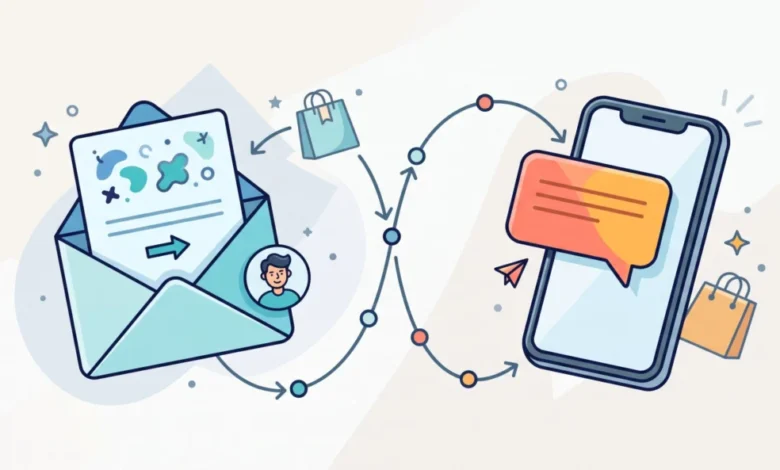
In the contemporary retail landscape, acquiring a customer’s mobile phone number at checkout represents a significant shift in digital proximity. While email communication functions much like a public postal corridor—accessible, capacious, and occasionally overlooked—a direct-to-device phone number serves as a direct line into an individual’s personal space. Despite this fundamental distinction, many modern brand founders and digital marketing directors continue to treat both channels as interchangeable pipes. They routinely deploy identical promotional messaging across platforms or neglect one entirely in favor of the other. Industry data indicates that relying on a single channel invariably leaves both revenue and consumer goodwill untapped. By strategically synthesizing email and SMS marketing, businesses can harness the distinct strengths of each medium, creating a cohesive omnichannel strategy that respects consumer boundaries while maximizing conversion potential.
The Divergent Profiles of Email and SMS Marketing
To understand the mechanics of omnichannel integration, one must examine the operational parameters of both communication mediums. Email remains the foundational medium for long-form brand storytelling, visual product presentation, and detailed customer segmentation. Its primary advantage lies in its cost-effectiveness and capacity for depth. Brands can dispatch elaborate newsletters, educational guides, and multi-tiered nurture campaigns for nominal overhead.
However, email inherently suffers from latency. A promotional campaign often lands in an inbox already crowded with dozens of unread messages, remaining dormant until the recipient chooses to allocate attention—a window that may range from hours to never.
Conversely, SMS possesses an immediate, high-impact velocity. Industry benchmarks consistently demonstrate that text messages achieve remarkable open rates—frequently exceeding 98%—within minutes or even seconds of delivery, cutting cleanly through digital noise. Yet, this immediacy is balanced by severe structural constraints. A standard SMS restricts copy to roughly a single line and a half, leaving zero margin for detailed explanations, while each transmission incurs distinct carrier costs. Over-reliance on text messaging quickly deteriorates consumer sentiment, transforming a welcome brand interaction into an unwelcome intrusion. Consequently, neither channel offers a standalone solution. Sustainable growth requires recognizing that the intrinsic weaknesses of email are precisely the operational strengths of SMS, and vice versa.
Categorizing Communications: The Expiration Matrix
Establishing an effective channel split requires evaluating a single critical metric: whether the message possesses a hard expiration date.
Communications that remain relevant over time naturally belong in the email inbox. This category encompasses newly launched product collections, founder narratives, educational "how-to" guides designed to improve product utility, and slow-burn nurture sequences engineered to warm up cold subscriber lists over a fortnightly period. Such content suffers no detriment from arriving an hour late and explicitly requires an uncluttered environment to be read and digested thoroughly.
Conversely, time-sensitive alerts demand the deployment of SMS. Examples include flash sales concluding at midnight, immediate stock notifications for high-demand items, and abandoned cart reminders generated while purchase intent remains at its peak. These messages lose their entire utility if delayed until the following morning. By matching the lifespan of the message to the delivery channel, brands prevent internal channel competition, allowing email to serve as the definitive repository for brand narrative while SMS acts as a precise, high-priority notification system.
Sequential Automation Versus Parallel Dissemination
A pervasive misstep in modern marketing automation is the simultaneous deployment of parallel triggers, where both email and text messages fire at the exact same moment for a single consumer action. This practice effectively squanders two distinct communication touchpoints on a redundant task. Modern omnichannel strategy advocates for sequential automation, spacing interventions deliberately across time.
For instance, within a standard welcome flow, an introductory email should always precede SMS outreach. A newly acquired subscriber merits a proper introduction outlining brand identity, product offerings, and any introductory incentive. Only after a delay of 24 to 48 hours—assuming the subscriber has not yet completed a purchase—should a concise, single-text nudge be deployed.
This sequential logic applies directly to abandoned cart recovery protocols. Initial automated emails shoulder the heavy lifting by displaying abandoned items alongside direct navigational links back to the checkout page. If the transaction remains incomplete several hours later, a brief text message bridges the conversion gap while purchase motivation remains viable. Conversely, back-in-stock notifications represent an optimal scenario for SMS-led campaigns, as the consumer explicitly requested immediate notification upon inventory replenishment. Shipping updates similarly benefit from a hybrid split: an immediate SMS confirmation provides instant psychological reassurance, while the full, detailed tracking manifest resides within an email for later reference.
During high-volume retail periods such as Black Friday and Cyber Monday (BFCM), pacing becomes paramount. Email shoulders the heavy logistical burden of the campaign build-up, promotional catalogues, and brand narratives, whereas SMS is reserved strictly for critical temporal milestones, such as sale launches and final countdown hours.
Platform Consolidation and Implementation Frameworks
Executing a sophisticated sequential strategy requires integrated technological infrastructure. Managing email and SMS across fragmented, siloed platforms often results in disjointed customer experiences and inaccurate data synchronization. Unified marketing platforms—such as Omnisend—address this challenge by consolidating email, SMS, and web-push notifications into a single, centralized automation view. This architectural alignment enables workflows to seamlessly transition from email to SMS within a singular customer journey, utilizing unified behavioral segments derived from combined purchase and browsing history.
For organizations seeking to implement these methodologies without overwhelming internal resources, industry specialists recommend beginning with two foundational automated flows: the welcome series and the abandoned cart recovery.
The welcome sequence capitalizes on peak consumer interest immediately following registration or initial purchase, establishing the tonal baseline for all subsequent interactions. Meanwhile, abandoned cart automation recovers measurable revenue from transactions stalled at the final hurdle. Brands are advised to deploy these core sequences using a primary email framework backed by a single SMS touchpoint, maintaining this configuration for several weeks before expanding into secondary flows like back-in-stock alerts.
The Economics of Restraint and Consumer Consent
In the realm of digital marketing, frequency tolerance varies dramatically between channels. Email inherently forgives high frequency; an additional promotional campaign in a crowded inbox is easily bypassed without generating consumer animosity. Mobile devices operate under entirely different psychological rules. An untimely text message arriving late in the evening, or excessive messaging throughout a single week, frequently provokes an immediate opt-out response. Once a consumer unsubscribes from an SMS list, the brand permanently forfeits its highest-converting, immediate-visibility channel.
Consequently, regulatory compliance and ethical restraint must govern SMS strategy. Explicit opt-in collection, transparent opt-out mechanisms, and strict adherence to recipient time zones are non-negotiable operational standards. Maintaining a smaller, highly engaged SMS list that retains consumer trust yields substantially higher long-term return on investment than an inflated database characterized by high churn and consumer fatigue.
Ultimately, successful omnichannel marketing operates as a disciplined exercise in channel allocation. By deploying the appropriate message to the correct medium and establishing clean, sequential handoffs, brands can optimize engagement without overstepping consumer boundaries, transforming mobile proximity into enduring brand loyalty.