How to Check if Your Web Page is in an AI Search Retrieval Index Without Webmaster Tools

The modern search engine optimization (SEO) landscape has expanded far beyond traditional web crawlers and index databases governed by major search engines like Google and Bing. For decades, digital marketers and site administrators relied on simplistic yet robust methods to verify whether a web page resided within a search index. Chief among these was the universally adopted "site:" search operator. By prefixing a uniform resource locator (URL) or a domain name with this command, practitioners without direct access to backend administrative panels—such as Google Search Console (GSC) or Bing Webmaster Tools (BWT)—could instantaneously determine if a specific webpage had been successfully indexed.
Another foundational heuristic long utilized by the SEO community involved verbatim text matching. When professionals suspected that a piece of content might be unindexed, duplicated, or improperly syndicated across the web, they would extract a distinct, highly meaningful block of text from the source page, enclose the snippet in quotation marks, and execute a literal query. If the target page appeared in the resulting search engine results pages (SERPs), it confirmed that the underlying string of text had been successfully crawled, processed, and stored within the search engine’s database.
However, the rapid acceleration and widespread commercial adoption of generative artificial intelligence (AI) search platforms, retrieval-augmented generation (RAG) models, and conversational search assistants have profoundly disrupted these legacy auditing workflows. As users increasingly migrate away from traditional ten-blue-link interfaces toward natural language chat interfaces—such as OpenAI’s ChatGPT, Anthropic’s Claude, and Microsoft Copilot—the mechanics of content discovery and retrieval have undergone a paradigm shift. Crucially, many of these AI-driven systems operate with varying degrees of transparency regarding their underlying retrieval indexes, leaving traditional SEO practitioners searching for new methodologies to audit their digital assets.
The Evolution of Search Verification in the Era of Conversational AI
The transition from keyword-driven search to conversational, AI-driven information retrieval has created a significant visibility gap for digital marketers. In traditional search ecosystems, a lack of access to Google Search Console or Bing Webmaster Tools could easily be mitigated by creative use of search operators and exact-match quotation queries. In the modern AI-search paradigm, however, the absence of standardized, direct verification tools feels acutely restrictive. AI chatbots do not always expose a traditional index directory or provide granular crawl statistics, rendering standard diagnostic procedures obsolete for pages operating outside traditional algorithmic visibility metrics.
Despite these structural hurdles, technical SEO professionals have begun formulating innovative workarounds to bridge the gap. By leveraging the search capabilities now natively embedded within many leading AI assistants, administrators can effectively reverse-engineer the retrieval process. Rather than relying on opaque backend reporting, practitioners can prompt an AI chatbot equipped with real-time web-search capabilities to verify whether a specific piece of content exists within its current operational reference database.
Methodology for AI Retrieval Auditing
Executing an AI-based retrieval audit requires a systematic approach to prompt engineering and snippet selection. To determine whether an AI model’s underlying search mechanism has ingested and indexed a particular webpage, an administrator must first extract a sufficiently unique, statistically distinct snippet of text from the target document. Generic headers, navigational elements, or boilerplate footers should be strictly avoided in favor of substantive, context-rich body paragraphs.
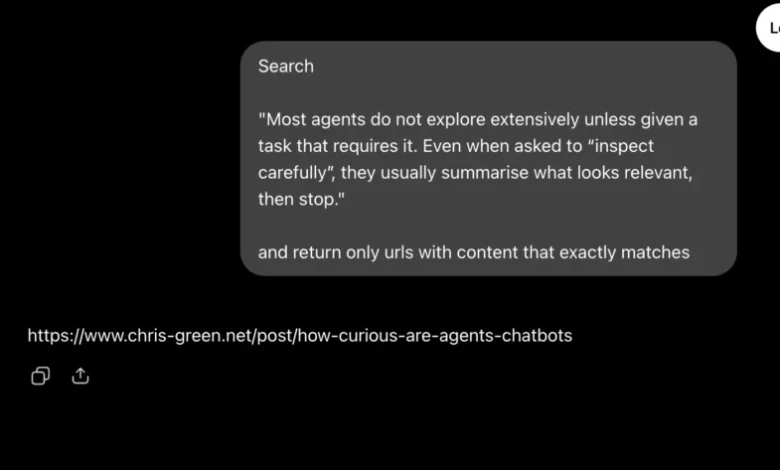
Once an appropriate snippet has been isolated, the practitioner inputs a targeted prompt into an AI chatbot configured with web-retrieval capabilities. A standard, effective framing follows this structured pattern:
Search for "paste your snippet here" and return any results which contain that exact text only.
By instructing the model to isolate and return references containing the exact textual string, the auditor can observe whether the AI’s retrieval engine successfully surfaces the corresponding URL. Empirical testing across multiple conversational AI environments indicates that this technique yields highly indicative, actionable results regarding a page’s presence in an AI search index.

Analysis and Troubleshooting: Interpreting AI Search Responses
When an AI chatbot successfully retrieves and cites a URL in response to an exact-match snippet query, digital marketers can draw several critical inferences regarding the state of their digital properties. Most fundamentally, a positive retrieval result provides empirical proof that the target webpage has been successfully discovered, crawled, and integrated into the AI platform’s searchable corpus.
Conversely, if the AI model fails to return the expected URL, or if it hallucinates alternative sources, site administrators are immediately presented with a clear framework for technical troubleshooting. Potential factors contributing to a failed retrieval audit include:
- Crawl and Discovery Delays: The webpage may be newly published and simply awaiting initial discovery by the AI platform’s web-fetching agents.
- Indexing Restrictions: Technical directives—such as overly restrictive robots.txt files, meta robots tags (e.g., noindex), or improper HTTP header configurations—may be actively blocking AI scrapers and retrieval bots from accessing the content.
- Content Uniqueness and Density: The selected textual snippet may lack sufficient linguistic uniqueness, causing the retrieval algorithm to favor higher-authority competing sources containing similar phrasing.
- Rendering and JavaScript Barriers: If the content is heavily reliant on client-side rendering without proper server-side rendering (SSR) or dynamic rendering fallbacks, automated AI retrieval tools may fail to parse the underlying text.
It is important to note that AI chatbots frequently pull data from disparate, decentralized sources and may utilize multiple third-party search APIs or proprietary retrieval indexes. Consequently, industry experts recommend executing verification tests multiple times—ideally across different sessions or utilizing varied textual snippets—to account for variance in source retrieval and index synchronization delays.
Workflow Automation and Browser Extensions
While manual copy-pasting of text snippets into conversational AI interfaces offers a viable diagnostic workaround, the process can become tedious and inefficient when scaled across large enterprise websites with thousands of URLs. To streamline this operational workflow, members of the technical SEO community have begun developing specialized developer tools and browser extensions designed to automate exact-match retrieval testing.
One such open-source utility, known as "Exactly Matchy," has emerged as a conceptual framework for accelerating the audit process. Designed as an experimental browser extension, the tool allows administrators to highlight text on a live webpage and automatically format a precise retrieval query for compatible AI chat environments.
Because third-party browser extensions introduce potential security and privacy considerations, cybersecurity experts advise caution when integrating unverified software into daily workflows. Practitioners wishing to utilize such tools are strongly encouraged to review the underlying source code—typically hosted on public repositories such as GitHub—and operate in developer mode to ensure data integrity and security compliance before deployment.
Broader Implications for Search Visibility and Traffic Acquisition
A frequent point of confusion among digital marketers revolves around the distinction between content retrieval and search visibility, commonly referred to as "ranking." It is entirely possible for a webpage to successfully pass an AI retrieval audit—confirming that the underlying text is indexed and accessible to conversational search models—while simultaneously failing to drive meaningful referral traffic or prominent placement within AI-generated summaries.
This discrepancy highlights a fundamental evolution in modern search optimization. While ensuring that a page is discoverable and retrievable by AI systems represents a vital foundational hurdle, passing this initial technical check does not guarantee user engagement. In the age of Answer Engine Optimization (AEO) and conversational search, content performance is increasingly dictated by topical authority, information gain, brand prominence, and the relative utility of the content compared to competing sources within the same vertical.
Ultimately, while conversational AI models do not provide the exhaustive diagnostic reporting historically found in dedicated search console suites, innovative workarounds empower technical professionals to audit, analyze, and troubleshoot their indexing status effectively. By combining traditional technical SEO principles with modern AI-prompting methodologies, digital marketers can maintain granular oversight of their content’s visibility across both legacy search engines and emerging conversational retrieval platforms.
Related posts: