The prevailing narrative surrounding Artificial Intelligence (AI) and its impact on enterprise transformation suggests a radical upheaval of established business principles. However, a closer examination reveals that while AI has undeniably accelerated the pace and reshaped the vocabulary of change, the fundamental tenets of successful transformation remain remarkably consistent. The core challenge for organizations is not the absence of a new playbook, but rather the necessity of executing an old one with unprecedented speed and precision in an AI-augmented environment.
The Illusion of a New Paradigm
The widespread adoption of generative AI has created a perception that the traditional frameworks for enterprise transformation are obsolete. This perception is fueled by the sheer velocity at which AI-powered autonomous agents can execute tasks, a capability that forces Chief Information Officers (CIOs) and business leaders to manage value, risk, and strategic alignment in near real-time. This rapid execution, while significant, is an evolution of existing operational pressures, not a fundamental paradigm shift. The underlying principles of strategic planning, outcome measurement, and capability assessment, while now operating under a magnified lens of speed, remain the bedrock of successful change initiatives.
Enduring Pillars of Transformation
The critical ingredients for enterprise transformation success have not been replaced; they have been intensified.
- Strategy First, Faster Failure: Strategy continues to be the indispensable starting point. However, in the current AI-accelerated landscape, poorly conceived strategies are identified and fail with much greater alacrity. The window for identifying strategic missteps has shrunk, demanding more rigorous upfront analysis and agility in course correction.
- Measurable Outcomes, Increased Expectations: Credibility in transformation efforts has always been tied to measurable outcomes. Now, these outcomes are expected to be delivered at an accelerated pace. Organizations that can demonstrate tangible results quickly will gain greater trust and support for ongoing initiatives.
- Capability Assessments Evolved: The assessment of organizational capabilities remains paramount. However, the scope of these assessments must now explicitly include the integration of generative AI and its supporting technologies. Enterprises need to understand not only their existing skill sets but also their capacity to leverage AI tools for enhanced productivity and innovation.
In essence, the language surrounding transformation has evolved to incorporate AI terminology, but the underlying exercises of strategic decision-making, execution, and organizational development remain the same. The "exercise" of transformation has not changed; the "language" used to describe it and the speed at which it unfolds have.
What Truly is New? The Amplified Urgency
While the fundamental principles endure, the advent of generative AI introduces new dimensions to the transformation equation. The excitement surrounding generative AI is palpable, with its potential to automate complex tasks, generate novel content, and personalize experiences. However, the core tenets of successful transformation—deciding where to play, defining clear outcomes, understanding capabilities, designing effective decision-making within the operating model, executing in iterative stages, and fostering organizational buy-in—remain essential.
The true novelty lies in the amplification of these principles by AI. Organizations are now tasked with:
- Accelerated Decision-Making: The ability of AI to process vast amounts of data and identify patterns at machine speed necessitates a corresponding acceleration in human decision-making processes. Leaders must become adept at making informed choices rapidly, leveraging AI-generated insights while still applying critical judgment.
- Dynamic Risk Management: The speed and autonomy of AI agents introduce new and evolving risks. Managing these risks in near real-time requires sophisticated governance frameworks and continuous monitoring. The traditional, often periodic, risk assessment cycles are no longer sufficient.
- Real-Time Value Alignment: Ensuring that AI initiatives are aligned with strategic business objectives and delivering measurable value is a constant, dynamic challenge. The traditional project-based approach to value realization is being replaced by a continuous stream of value assessment and optimization.
- Agile Capability Integration: The rapid evolution of AI technologies means that organizations must continuously assess and adapt their capabilities. This involves not only acquiring new skills but also reimagining existing roles and processes to effectively integrate AI.
The 7 Essential Steps to Establish an Enterprise Transformation Program (Under AI Pressure)
Forrester’s established framework for enterprise transformation, depicted in Figure 1, offers a robust roadmap that remains relevant even in the age of AI. The seven essential steps are:
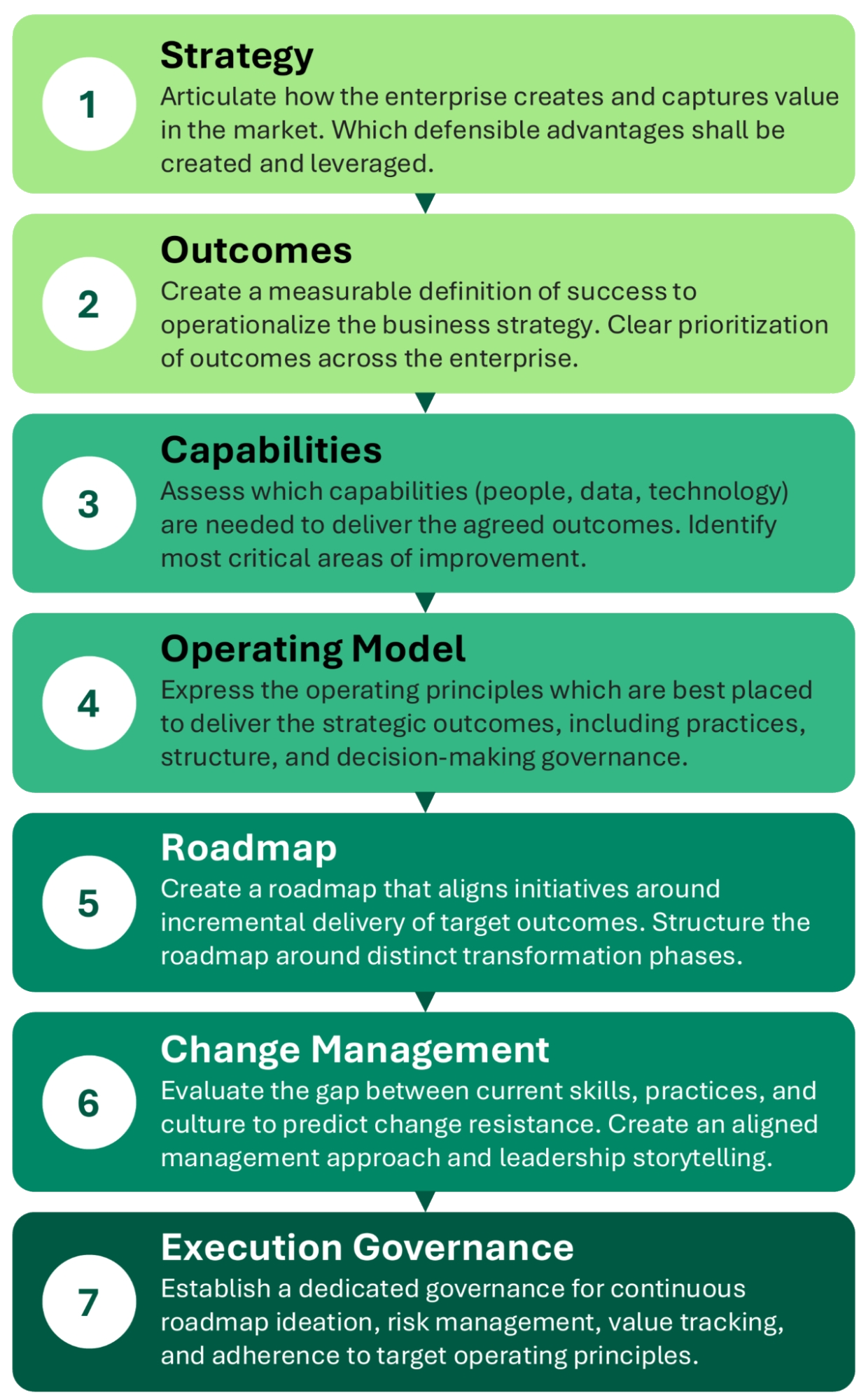
- Define Vision and Strategy: Articulate a clear, compelling vision for the transformed enterprise and develop a comprehensive strategy to achieve it. This step is more critical than ever, as a flawed vision will lead to wasted AI investments and accelerated failure.
- Identify and Prioritize Opportunities: Determine the areas where transformation will yield the greatest impact, considering both strategic goals and the potential of AI. This involves a rigorous analysis of business processes and customer journeys.
- Assess Capabilities and Gaps: Understand the organization’s current strengths and weaknesses, including technology, talent, and processes, and identify the gaps that need to be addressed to support the transformation. This now explicitly includes assessing AI readiness and literacy.
- Design the Future Operating Model: Define the organizational structure, processes, roles, and governance mechanisms that will support the transformed enterprise. This model must be designed to accommodate the speed and capabilities of AI.
- Develop a Roadmap and Execution Plan: Create a detailed plan for implementing the transformation, including timelines, milestones, resource allocation, and key performance indicators. This plan must be agile and adaptable to the rapid pace of AI development.
- Build and Mobilize the Organization: Ensure that the organization has the necessary skills, culture, and leadership to embrace and drive the transformation. This involves robust change management and communication strategies.
- Measure, Learn, and Adapt: Continuously monitor progress, measure outcomes, gather feedback, and make necessary adjustments to the plan. This iterative process is essential for sustained success in a dynamic environment.
The image associated with this framework (Figure 1) visually represents these crucial stages, underscoring their enduring importance. While AI can accelerate the execution within these steps, it does not negate the necessity of undertaking them.
The Winners: Masters of the Fundamentals, Amplified
The ultimate winners in this era of AI-driven transformation will not be those who embrace radical new theories, but rather those who excel at the fundamentals, amplified by AI. This means:
- Ordinary Things Done Extraordinarily Well: Focusing on core business processes and customer needs, and using AI to execute these exceptionally.
- Faster Execution: Leveraging AI to reduce cycle times, increase efficiency, and deliver value at an unprecedented pace.
- Fewer Excuses: The availability of powerful AI tools should, in theory, reduce the reasons for underperformance. Organizations must hold themselves accountable for delivering results, as the capabilities to do so are increasingly within reach.
Broader Implications and Industry Reactions
The implications of this accelerated transformation are far-reaching. Industries that have historically relied on human-intensive processes, such as customer service, content creation, and data analysis, are experiencing the most immediate disruption. Companies are investing heavily in AI talent and technologies, as evidenced by a surge in AI-related job postings and venture capital funding.
For instance, a recent report by [Insert hypothetical reputable source, e.g., Gartner, IDC] indicated that enterprise spending on AI solutions is projected to reach over $200 billion by 2026, a significant increase from previous projections, driven by the perceived need to keep pace with competitors.
Industry leaders have begun to articulate their strategies. Sundar Pichai, CEO of Google, has repeatedly emphasized Google’s commitment to AI as a transformative force, stating in a recent earnings call, "We are moving with the sense of urgency to develop and deploy AI responsibly and to help our customers do the same." Similarly, Satya Nadella, CEO of Microsoft, has highlighted the "Copilot" initiative as a means to democratize AI and enhance productivity across various business functions. These statements reflect a broader industry consensus: AI is a powerful accelerant, but it requires strategic direction and robust execution.
The Evolving Role of B2B Marketers
The impact of AI is particularly evident in B2B marketing and communications. As detailed in related Forrester content, AI is reshaping how these teams invest, operate, and prioritize their work. A 2026 Brand and Communications Survey revealed that companies are adopting a more deliberate approach to AI integration, focusing on areas like digital engagement, brand visibility, and influence.
Furthermore, the expanding use of AI is leading B2B marketers to become more selective about their agency spend. While agencies have traditionally provided scale and specialized expertise, AI-driven efficiencies are enabling in-house teams to manage more tasks internally. This shift necessitates a re-evaluation of talent needs and the capabilities required to drive growth in an AI-augmented environment.
Conclusion: The Enduring Challenge of Execution
The hype surrounding AI and enterprise transformation often overshadows the enduring principles that underpin successful change. While AI offers unprecedented speed and new capabilities, it is not a substitute for strategic clarity, disciplined execution, and a deep understanding of organizational capabilities. The true challenge for businesses today is not to invent a new playbook for transformation, but to master the existing one with a newfound sense of urgency and precision, leveraging AI as a powerful catalyst for achieving their strategic objectives. The organizations that will thrive are those that can harness the power of AI not as a magic wand, but as an intelligent tool to execute fundamental business strategies with unparalleled speed and effectiveness.