Navigating the AI Frontier: Essential SEO Tools Empowering Small Businesses in a Competitive Digital Landscape

Artificial intelligence (AI) has rapidly transformed the digital marketing landscape, making sophisticated AI-powered Search Engine Optimization (SEO) tools an indispensable asset for small businesses striving to maintain competitiveness and relevance. In an era characterized by accelerated technological evolution, these tools are no longer a luxury but a fundamental requirement for businesses aiming to keep pace with dynamic marketing trends. However, the sheer volume of AI solutions, each promising comprehensive problem-solving capabilities, presents a significant challenge for small enterprises, often operating with lean teams and constrained resources, in discerning which investments truly deliver tangible value.
The undeniable shift towards AI integration in marketing is supported by robust data. According to HubSpot’s latest AI Trends for Marketers report, a substantial two-thirds of marketers globally have already incorporated AI into their professional routines. This figure escalates further among American marketers, with 74% reporting AI usage. These statistics underscore a clear market trajectory: businesses, regardless of size, must strategically invest in AI SEO tools, whether through direct financial outlay or dedicated time for implementation and learning. The failure to adapt risks significant competitive disadvantage in an increasingly AI-driven search environment.
This comprehensive guide aims to demystify the AI SEO landscape for small businesses, spotlighting the essential tools that lean teams are effectively leveraging to maximize output with limited input. It encompasses a spectrum of solutions, from free foundational utilities like Google Search Console (GSC) and Google Analytics (GA4) to more integrated, paid platforms such as HubSpot, providing a strategic roadmap for adoption.
The Strategic Imperative: Identifying High-Value AI SEO Tools
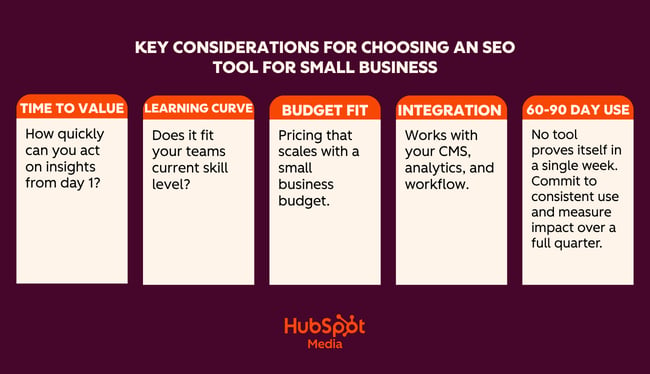
AI SEO tools are designed to streamline critical SEO functions, including keyword research, content creation, on-page optimization, technical issue resolution, and visibility tracking. The primary challenge for small businesses lies in selecting tools that offer sustained value, aligning with their specific operational needs and budgetary constraints. Key considerations for procurement include time-to-value, learning curve, cost-effectiveness, and ease of integration.
Time-to-Value: Accelerating Impact for Lean Teams
Time-to-value (TTV) measures the speed at which a tool delivers meaningful results post-implementation. For small businesses operating with limited personnel and often without a dedicated SEO specialist, a tool’s TTV is paramount. Solutions that demand extensive configuration periods or require external consultancy for setup can quickly become a burden, outweighing their potential benefits unless the return on investment is exceptionally high and clearly defined.
Consider the practical implications: a tool like Google Search Console offers almost immediate, invaluable data upon basic setup, making it a universal recommendation for any website. Its passive data collection and rapid insight generation demonstrate high TTV. In contrast, comprehensive platforms like HubSpot, while offering extensive features, may require a greater initial time and financial investment to unlock their full potential. The decision hinges on whether the advanced capabilities are critical to business growth, justifying the upfront commitment. Tools that significantly reduce human labor, boost marketing conversions, address cross-business challenges, and directly contribute to revenue growth are typically worth a higher TTV investment. Conversely, a tool that sits unused after a complex setup process represents a wasted resource.
Learning Curve: Prioritizing User-Friendliness

The efficacy of any tool is directly tied to a team’s consistent ability to utilize it. Enterprise-grade SEO platforms, often replete with advanced features, can overwhelm small business users who may lack specialized SEO expertise. When evaluating the learning curve, key questions include: How quickly can a non-expert understand and operate the tool? What level of ongoing training is required? Are the outputs easily interpretable?
The most effective AI SEO tools for small teams provide intuitive interfaces, guided workflows, clear, plain-language recommendations, and actionable next steps, rather than presenting raw, complex data requiring expert interpretation. This ensures that valuable insights are accessible and can be translated into immediate action, empowering generalist marketers.
Cost and Budget Fit: Balancing Investment with Scalability
Optimal AI SEO solutions for small businesses reside at the intersection of practical utility, team adoption, and affordability. These tools must not only solve specific problems at a reasonable price point but also offer scalability as the business grows. Evaluating future cost implications — one year or even five years down the line — is crucial. Investing in a tool that becomes prohibitively expensive at higher tiers can lead to the disruptive and time-consuming headache of switching platforms later.
A strategic approach involves identifying the top three time-consuming SEO tasks that current tools fail to address. Each potential paid platform should then be rigorously evaluated against its ability to resolve these specific bottlenecks. A tool that effectively addresses one critical pain point often delivers more value than a multi-feature tool that only superficially touches on several issues.
Integration Ease: Fostering Seamless Workflows
The ability of an AI SEO tool to seamlessly integrate with existing business systems significantly boosts adoption rates. As highlighted by MuleSoft, 86% of IT leaders believe that AI agents can introduce complexity rather than value without proper integration. When SEO data flows effortlessly into an existing Content Management System (CMS), Customer Relationship Management (CRM), or analytics platform, it becomes an enhancement to established workflows rather than an isolated, additional task. Such integrations improve data coherence, enhance overall efficiency, and provide stronger motivation for teams to engage with the new tool. Prioritizing platforms that offer robust integration capabilities is a critical step in building a cohesive and efficient digital marketing stack.
The 60-90 Day Test: Measuring Real-World Value
Initial demonstrations and trial-period enthusiasm often fail to capture a tool’s true long-term value. A more reliable indicator is consistent team usage and demonstrable, attributable outcomes at the 60- to 90-day mark. Small businesses should negotiate extended testing periods or opt for monthly payment plans initially, allowing sufficient time to assess practical utility and ROI before committing to annual subscriptions.
The Evolving Role of AI in Small Business SEO: Capabilities and Limitations
While AI dramatically enhances small business SEO, it is crucial to understand its strengths and, more importantly, where human oversight remains indispensable. Small business SEO cannot rely on tools alone; a strategic blend of AI efficiency and human intelligence is key.
Drafting and Scaling Content Quickly (with Caution)
AI excels at generating content rapidly, producing blog posts, FAQs, service page copy, and meta descriptions in minutes. For small businesses struggling with content consistency, this represents a significant time-saver. By providing AI with target keywords, audience profiles, and desired tone, marketers can quickly obtain solid working drafts. AI performs exceptionally well for factual or definitional content (e.g., "What is anchor text?").
However, for thought leadership pieces, content requiring novel insights, or expert opinions (e.g., "Is SEO dead in the age of AI search?"), human input is vital. AI lacks personal experience, nuanced understanding of a specific business or industry, and the ability to generate truly original thought. Human editors must review AI-drafted content for accuracy, brand voice, factual correctness, and personalization. Google increasingly rewards content exhibiting genuine expertise, experience, authoritativeness, and trustworthiness (E-E-A-T), attributes that AI cannot credibly replicate without significant human intervention.
Finding Keyword and Topic Ideas: AI as an Ideation Engine
AI tools are powerful ideation engines. They can suggest keyword clusters, generate customer-centric questions, and identify related topics that might otherwise be overlooked, effectively replacing hours of manual research for resource-constrained teams.
Despite its ideation prowess, AI often suggests keywords without concrete search volume data. Marketers must still validate these ideas using tools like Google Keyword Planner or through human intuition to ensure demand. While AI can generate broad keyword ideas, its effectiveness for sophisticated content clustering or in-depth Search Engine Results Page (SERP) analysis often falls short of human expert analysis.
Optimizing Existing Pages: Efficiency in Iteration
AI tools can rapidly audit and optimize existing webpages by rewriting title tags, improving meta descriptions, refining heading structures, and enhancing readability. This capability is invaluable for small businesses with numerous underperforming pages, enabling significant improvements without a large budget.
For critical pages, a layer of human review is essential to ensure optimal performance. While AI can handle routine optimization tasks effectively, human judgment is necessary for high-impact pages where subtle nuances can significantly affect search performance and user experience.
Essential AI SEO Tools for Small Businesses: A Detailed Review
The following tools have been selected for their proven utility for lean teams and their genuinely useful AI capabilities. For businesses building an SEO foundation from scratch, HubSpot’s SEO Starter Pack is an invaluable free resource.
I. Tools for SEO and Technical Audits
HubSpot SEO Recommendations
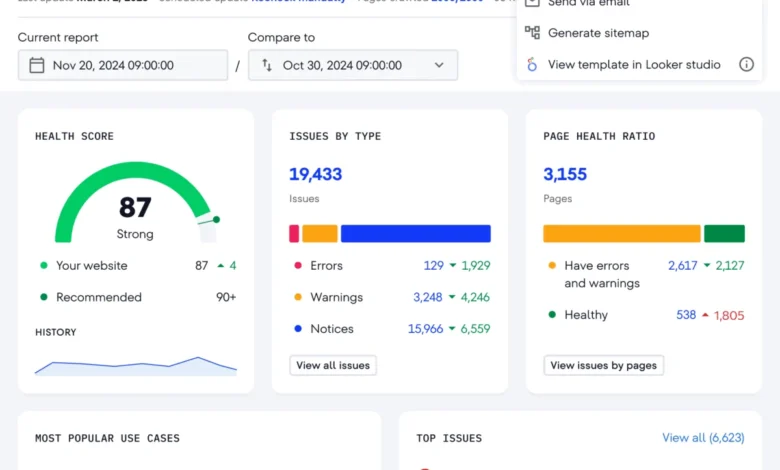
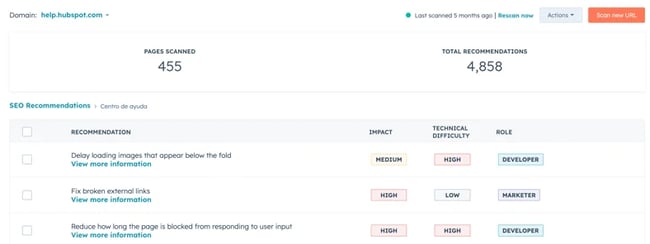
HubSpot’s SEO recommendation tools are deeply integrated within its Marketing Hub, offering a unified approach to SEO. Unlike standalone platforms that present raw issue lists, HubSpot connects SEO recommendations directly to its content editor, CRM, and reporting dashboard. This integration ensures that every fix, content piece, and ranking improvement is directly linked to measurable business outcomes.
The core value lies in the actionable presentation of findings. HubSpot prioritizes on-page updates for non-experts, making it ideal for small businesses without dedicated technical SEO resources. Instead of complex data, HubSpot clearly explains why an issue is flagged, its impact on search performance, and the specific action required for resolution, enabling any team member to understand and address problems effectively.
- Key Features: Automatic website scanning, issue prioritization (critical, high, medium, low), detailed explanations and actionable solutions, integration with content editor and CRM. Technical scans cover broken links, meta description issues, alt text, HTTPS, page speed, and heading structure. On-page features include keyword placement, readability checks, and internal linking opportunities.
- Integration: Uniquely ties SEO to email marketing, landing pages, social media, ads, and the free CRM, providing a full-funnel view from organic search to closed deals. This makes it particularly effective for B2B businesses, linking SEO activity directly to pipeline and revenue.
- Pricing: Basic recommendations are available on free and Starter plans. Full suites, including topic clusters, advanced reporting, content strategy tools, and AEO features, require Pro or Enterprise subscriptions. It’s often more cost-effective when considering the combined functionalities it replaces (CMS, CRM, email, SEO, reporting).
- Best for: Small business marketers and lean teams seeking an all-in-one platform for SEO, content, CRM, and comprehensive reporting.
SE Ranking
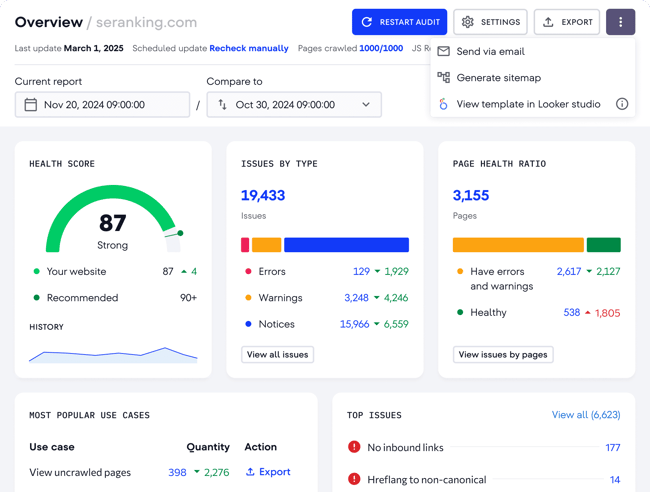
SE Ranking is a robust AI-powered platform offering keyword tracking, site audits, competitive research, and AI-driven insights. It provides a comprehensive suite of tools covering technical SEO, keyword research, backlink analysis, competitor monitoring, and content gap identification, making it a well-rounded solution for content creators and agencies managing multiple projects.
- Key Features: Detailed website audit, competitive research, keyword rank tracking, backlink checker, content marketing platform with AI writing assistant.
- Pricing: Plans start at an accessible Wallet tier, with Standalone and Enterprise options for larger needs. A 14-day free trial is available.
- Analysis: SE Ranking strikes an excellent balance between feature depth and affordability, making it a strong contender for small businesses. Its clean interface and actionable recommendations are particularly valuable for teams without in-house SEO specialists. While Semrush and Ahrefs are industry powerhouses, SE Ranking provides comparable value at a more accessible price point.
- Best for: Small businesses and lean SEO teams requiring a full-featured SEO platform without the premium price tag of enterprise alternatives.
II. Tools for Automated Content Optimization
HubSpot Content Hub
HubSpot’s Content Hub unifies content strategy, creation, optimization, and performance measurement, offering essential consolidation for lean teams. A standout feature is its topic cluster tool, which facilitates building content around authoritative pillar pages supported by interconnected cluster content. This strategy signals topical authority to search engines, a reliable method for compounding organic traffic.
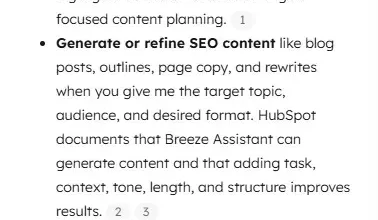
- Breeze: HubSpot’s AI Layer for Content: Breeze acts as an AI co-pilot within Content Hub, assisting human writers in content creation and optimization. It helps draft and refine on-brand content, generate structured drafts, and allows writers to incorporate their expertise and edits. Breeze Content Agent suggests topics, generates search-optimized drafts, and ensures brand voice consistency. This human-AI co-creation model prioritizes accuracy, brand voice, and trust over fully automated content generation.
- Beyond Drafting: Breeze also automates critical optimization tasks like generating meta titles and descriptions, suggesting internal links, reformatting for readability, and repurposing content across various formats and channels (e.g., Content Remix).
- Performance Tracking: Integrated with HubSpot’s CRM, Content Hub tracks content performance not just by traffic and rankings but by its contribution to leads, pipeline, and revenue. This attribution capability is invaluable for justifying content investments to stakeholders, moving the conversation from mere traffic numbers to tangible business outcomes.
- Pricing: Available as a standalone product with a free plan, and paid plans starting at $20 per user per month. Breeze Content Agent features are typically available on Content Hub Pro and Enterprise editions.
- Best for: Small businesses seeking to integrate content strategy, creation, and performance tracking directly with their CRM for measurable ROI.
Yoast SEO
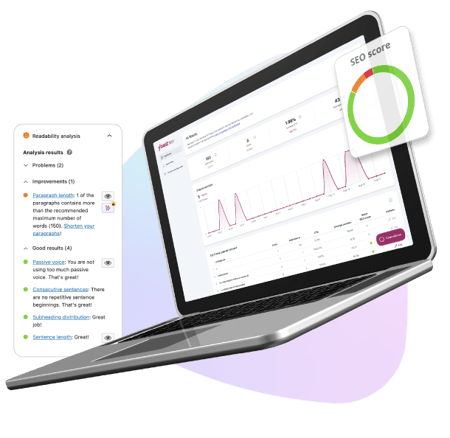
Yoast has long been the default SEO plugin for millions of WordPress websites, providing real-time on-page SEO guidance directly within the WordPress editor. It offers a low-friction way to integrate AI-assisted recommendations into the writing and editing process.
- Key Features: Real-time content analysis for SEO and readability, meta title and description optimization, XML sitemap generation, internal linking suggestions, schema markup integration. The AI+ package further enhances content creation and optimization.
- Pricing: Free package covers basic on-page SEO. Premium and AI+ packages start at $9.90 per month for more advanced features.
- Analysis: Yoast is an excellent optimization assistant, helping teams polish existing content. However, it is not a comprehensive SEO platform for keyword research, competitor analysis, or backlink monitoring. It pairs well with a tool like SE Ranking for broader SEO needs. Businesses already using HubSpot’s Content Hub may find Yoast redundant.
- Best for: Small businesses running WordPress websites that need real-time, on-page SEO guidance seamlessly integrated into their content workflow.
AnswerThePublic
AnswerThePublic is a powerful content ideation tool that leverages Google autocomplete data to visualize questions, prepositions, comparisons, and related searches surrounding a given keyword or topic. It significantly reduces the guesswork in content planning for lean teams.
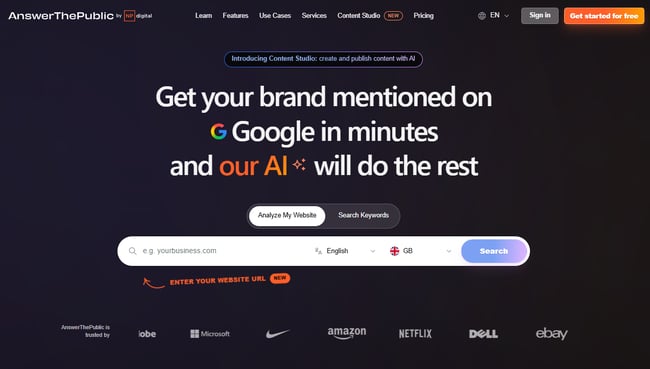
- Key Features: Visual data presentation (search clouds), topic and question generation (who, what, when, where, why, how), comparison and related search insights, exportable data.
- Pricing: Offers three free searches per day, with paid packages starting at $13.33 per month for expanded search and export functionalities.
- Analysis: AnswerThePublic is a highly effective, budget-friendly tool for populating a content calendar with genuinely searched-for topics. Its visual format aids in identifying content ideas suitable for topic cluster strategies. While excellent as a standalone ideation tool, its functionality may overlap with features available in comprehensive platforms like HubSpot.
- Best for: Small business marketers and content teams focused on quickly identifying audience questions and search phrases for content planning.
III. Tools for Tracking Rankings and AI Visibility
HubSpot AEO (Answer Engine Optimization)
In the evolving landscape of search, tracking traditional keyword rankings is no longer sufficient. HubSpot AEO is designed to monitor and improve how brands appear in AI-generated answers, making it a crucial component of modern SEO strategy.
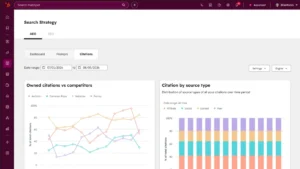
- Key Features: Monitors brand mentions across major AI engines (ChatGPT, Perplexity, Gemini), tracks brand descriptions and comparisons to competitors, identifies visibility gaps. Its unique CRM integration allows it to suggest prompts based on industry, competitors, and customer segments, providing unparalleled context.
- Pricing: Free 28-day trial (25 prompts across all three engines). Paid plans start at $50/month (or $45/month annually), tracking 25 daily prompts across three engines, up to 2,500 answers per month.
- Analysis: HubSpot AEO is a leading LLM SEO analysis software. Its ability to connect AI visibility insights directly to CRM data allows businesses to understand the true impact of AI presence on their pipeline and revenue, moving beyond vanity metrics.
- Best for: Small businesses and marketing teams aiming to monitor and enhance their brand’s presence in AI-generated answers, linking these insights directly to CRM data.
HubSpot AEO Grader
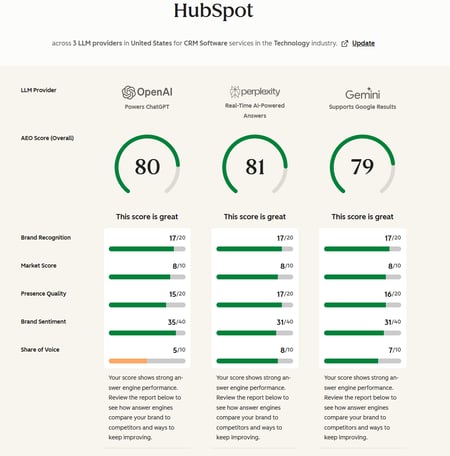
The HubSpot AEO Grader offers a fast, free, and accessible snapshot of how AI engines currently perceive a brand. It’s a diagnostic tool requiring no setup or subscription, making it an ideal starting point for businesses new to AI visibility.
- Key Features: Analyzes AI visibility across ChatGPT, Perplexity, and Gemini simultaneously, cross-validates responses, and produces a composite score out of 100. The score is broken down across five dimensions: AI Presence, AI Mentions, AI Reputation, AI Accuracy, and AI Trust.
- Pricing: Free forever.
- Analysis: The AEO Grader provides a clear, plain-English breakdown of a brand’s AI standing, making complex concepts accessible. It’s an excellent initial benchmark tool, invaluable for early auditing and discovery. It helps answer "how does AI represent my brand right now?" before a business decides on ongoing monitoring with HubSpot AEO.
- Best for: Any business seeking a quick, free assessment of their brand’s current AI engine perception without prior AEO experience or commitment.
Google Analytics (GA4)
Google Analytics (GA4) is the indispensable foundation of any small business analytics setup. As a free, Google-built tool, it tracks traffic sources, visitor behavior, and conversion outcomes. It is not replaced by paid tools but often integrated with them.
- Key AI Features: AI-powered insights for anomaly detection, predictive metrics (churn probability, purchase probability), and automated reporting. Its event-based data model offers a flexible and future-proof approach to tracking user interactions.
- Pricing: Free forever.
- Analysis: GA4 is a non-negotiable tool for every website. Its ability to segment audiences by AI referral source and track conversion behavior offers an affordable way to measure the impact of AI traffic.
- Best for: Every business with a website, serving as the core analytics platform for understanding user behavior and marketing performance.
Google Search Console (GSC)
Google Search Console (GSC) tracks a website’s performance in Google search results before visitors even arrive. It is a critical, free tool that provides direct data from Google, offering unparalleled reliability for understanding actual search performance.
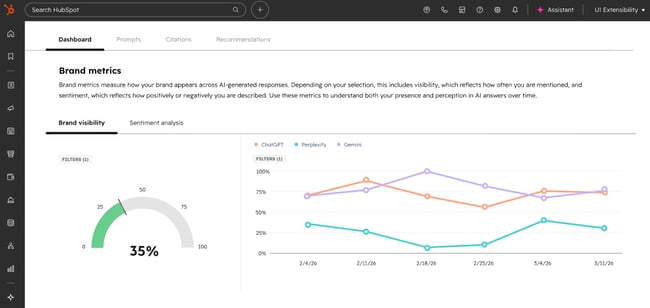
- Key Features: Provides data on search queries generating impressions and clicks, indexed pages, technical issues flagged by Google, and Core Web Vitals performance. Its AI-driven insights simplify complex SEO data into plain English, making it accessible for small teams.
- Pricing: Free forever.
- Analysis: GSC is a must-have tool, foundational for any SEO strategy. Its direct data from Google provides an accurate picture of organic search performance and technical health. Its user-friendly interface, enhanced by AI, allows even non-SEO experts to understand and act on critical website insights.
- Best for: Every business with a website; it should be set up on day one for comprehensive SEO monitoring.
The Broader Implications: Small Businesses in an AI-Driven World
The proliferation of AI SEO tools is not merely a technological trend; it represents a paradigm shift that can significantly impact the survival and growth of small businesses. By leveraging AI, small enterprises can level the playing field, gaining efficiencies and analytical capabilities traditionally reserved for larger corporations. AI allows lean teams to automate repetitive tasks, identify complex patterns in data, and make more informed decisions, thereby optimizing resource allocation and enhancing competitive posture.
However, the adoption of AI also necessitates a continuous learning curve and strategic adaptation. While AI handles the heavy lifting of data processing and content generation, human creativity, strategic thinking, and ethical judgment remain paramount. Small businesses must foster a culture of continuous learning to effectively integrate these tools, ensuring that AI serves as an enhancer of human potential rather than a replacement. The ultimate goal is to empower teams to focus on high-value, strategic initiatives that drive innovation and foster genuine customer connections, leveraging AI to amplify their impact.
Conclusion: The Right AI SEO Tool Solves Strategic Problems
For small businesses aiming to streamline their operations without compromising on capability, integrated platforms like HubSpot offer a compelling all-in-one solution. Its Marketing Hub consolidates technical SEO recommendations, on-page optimization, topic cluster planning, and performance tracking. Content Hub, powered by Breeze, handles content creation and optimization with a human-AI co-creation model. The addition of AEO for AI visibility monitoring and the free CRM for revenue attribution means a single platform can replace multiple disparate tools, significantly simplifying a business’s technology stack.
Ultimately, the most effective AI SEO tool for a small business is the one that directly addresses its specific challenges, offers a clear return on investment in terms of time and resources saved, and seamlessly integrates into existing workflows. Strategic selection and thoughtful implementation of these AI-powered tools are critical for small businesses to thrive in the increasingly complex and competitive digital landscape.
Related posts: