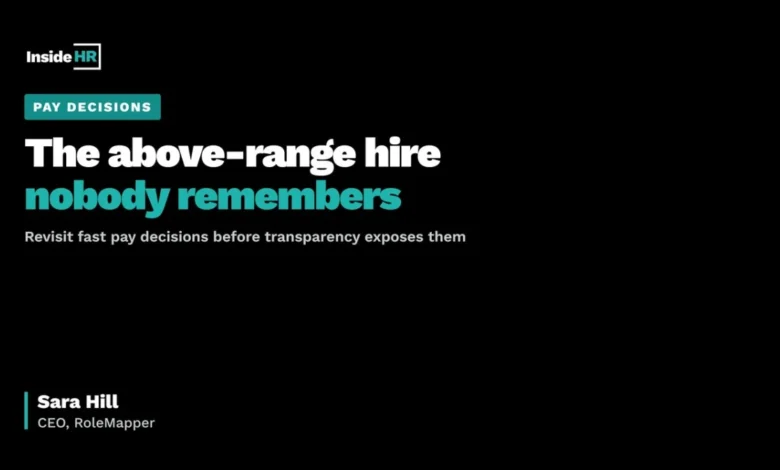
The modern hiring landscape is defined by an increasing tension between the urgent need for talent and the growing legislative mandate for organizational pay equity. When a business faces a critical vacancy, the pressure to secure a high-performing candidate often leads to compensation decisions that deviate from established salary bands. While these "above-range" hires are frequently justified as necessary tactical maneuvers to bridge a skills gap, they represent a significant long-term liability in an era defined by radical pay transparency. As Sara Hill, CEO of RoleMapper, recently highlighted in an InsideHR webinar, these once-hidden anomalies are now becoming focal points for internal friction, legal risk, and reputational damage.
The Anatomy of the "Fast Pay" Decision
In the traditional recruitment model, hiring managers operate under a "time-to-fill" imperative. When a specialized role remains open, productivity losses and team burnout pressures often dictate that an offer must be extended quickly. If the only qualified candidate demands a salary exceeding the internal benchmark, the organization faces a binary choice: leave the role vacant or break the pay structure.
Historically, this was viewed as a localized decision—a confidential agreement between an individual and the hiring manager. However, the emergence of pay transparency legislation across the European Union, the United States, and the United Kingdom has fundamentally altered the risk profile of such decisions. What was once a private negotiation is now subject to scrutiny by existing employees, job applicants, and regulatory bodies who demand standardized compensation frameworks. When an outlier hire remains on the payroll for years without the justification for their premium salary being revisited, the organization enters a state of structural imbalance that is increasingly difficult to defend.
A Chronology of the Transparency Shift
The current crisis of pay defensibility did not materialize overnight. It is the result of a decade-long evolution in workplace expectations and legal requirements:
- 2010–2015: The Era of Obscurity: Pay was largely considered a private matter. Pay scales were internal documents, and discussions regarding salary between employees were often discouraged or explicitly forbidden in employment contracts.
- 2017–2020: The Rise of Regulatory Reporting: The introduction of gender pay gap reporting in the UK (2017) forced companies to look at their aggregate data. This revealed the macro-level impact of individual, unmanaged pay decisions.
- 2021–2023: The Legislative Wave: Jurisdictions globally began moving from reporting to enforcement. New York City’s Salary Transparency Law and the EU Pay Transparency Directive (2023) shifted the burden of proof to the employer. Companies are now required to provide salary ranges in job postings and, in some cases, share criteria for pay progression.
- 2024 and Beyond: The Defensibility Mandate: The current environment requires that pay structures be not only consistent but also "defensible." If an organization cannot explain why one employee earns 20% more than a peer in an identical role, the resulting pay equity lawsuits and internal morale issues are becoming a primary operational risk.
Supporting Data and the Cost of Pay Inequity
The financial and cultural consequences of "range-busting" hires are quantifiable. According to research from the WorldatWork association, companies that fail to maintain pay parity often face significantly higher turnover rates. When employees discover that a new hire with similar qualifications is earning a premium, the "psychological contract" of the workplace is fractured.
Data from the Society for Human Resource Management (SHRM) suggests that 60% of employees are more likely to seek new employment if they believe their organization lacks pay transparency. Furthermore, the cost of rectifying these imbalances is substantial. Organizations that wait for an audit or a legal challenge to correct pay anomalies often incur costs associated with retroactive pay adjustments, legal fees, and the loss of institutional knowledge when top performers leave in protest of perceived unfairness.
The "above-range" hire often creates a ripple effect. If a manager brings in a new recruit at 115% of the midpoint, the existing team—who may have been performing at that level for years—inevitably learn of the discrepancy. In a transparent environment, this leads to immediate wage inflation as existing staff demand parity, effectively forcing the employer to recalibrate the entire department’s budget to accommodate a single hasty decision.

The Strategic Imperative: Building a Defensible Architecture
The core of the issue, as identified by Sara Hill, is not the decision to pay a premium to secure talent, but the failure to manage that premium over time. Organizations that successfully navigate this new era do so by implementing a robust "job architecture."
A defensible pay structure relies on three pillars:
- Objective Job Architecture: Every role must be mapped to a level, with clear responsibilities and competencies that justify its place in the salary structure. If a candidate is hired above range, it should be because they possess a distinct, documented competency that warrants a higher placement within the architecture, not because of a "fast" negotiation.
- AI-Driven Benchmarking: Modern HR teams are increasingly utilizing artificial intelligence to analyze market rates in real-time. This ensures that pay ranges remain competitive and that outliers are identified and addressed during annual compensation reviews.
- Governance and Review Cycles: The most critical failure point is the "set it and forget it" mentality. If a premium hire is brought in to address an immediate business need, the compensation package should be reviewed at the six-month or one-year mark. If the business need has shifted or the team has caught up, the pay premium should be normalized or transitioned into a performance-based bonus structure rather than base salary.
Broader Impact: The Role of HR in the Transparency Age
The role of the HR professional is undergoing a profound transition from an administrative function to a strategic guardian of organizational equity. In the past, HR was often the facilitator of the "fast hire." Today, HR must act as the friction point that ensures legal and ethical compliance.
This shift requires a change in how hiring managers are trained. They must be empowered to understand that the speed of a hire is secondary to the long-term sustainability of the organization’s pay structure. Organizations that prioritize short-term gains at the expense of structural integrity are increasingly finding themselves at odds with both the law and their own workforce.
Furthermore, the legal implications are expanding. In jurisdictions like the EU, the burden of proof now rests with the employer. If an employee challenges their pay, the company must provide detailed, objective data proving that their compensation is based on neutral criteria. A "hiring manager’s discretion" is no longer a valid legal defense.
Future-Proofing the Organization
As transparency mandates continue to gain momentum, companies must audit their existing payrolls for "legacy outliers." It is not sufficient to implement new, transparent policies for future hires while leaving historical discrepancies unaddressed. A proactive approach—involving a comprehensive compensation audit—allows organizations to identify these anomalies and develop a roadmap for adjustment before they become the subject of public scrutiny or litigation.
The transition to transparent pay is not merely a compliance exercise; it is an opportunity to build trust. When employees understand the logic behind their compensation, engagement and retention typically improve. Conversely, when pay remains a "black box" that hides the remnants of past bad decisions, the risk of cultural and legal erosion increases.
Ultimately, the lesson for HR and leadership teams is clear: the convenience of a fast, above-range hire is an illusion. In the modern, transparent workplace, every dollar paid must be justifiable. By focusing on rigorous job architecture and regular, data-informed reviews, organizations can attract the talent they need without compromising the integrity of their compensation structures. The age of the "hidden" hire is over; the age of defensible pay has begun.