Salesforce has unveiled a transformative expansion of Slackbot’s capabilities, enabling the conversational AI agent to seamlessly integrate with and orchestrate operations across the entire Salesforce ecosystem, including CRM data, Tableau analytics, Data 360 insights, and a growing array of AI agents. This significant enhancement, powered by new Managed Connected Platform (MCP) servers, positions Slack as the central conversational interface for enterprise operations, maximizing the return on investment across Salesforce’s comprehensive suite of tools. For 25 years, Salesforce customers have meticulously built a robust foundation of customer data, intricate business logic, custom automations, and deeply tailored CRM configurations that are integral to their operations. However, the efficacy of this rich data has often been hampered by the need to navigate multiple browser tabs and disparate tools during critical team discussions.

This challenge prompted Salesforce’s strategic move, announced earlier this year, with the introduction of Headless 360. This initiative aims to liberate customer data and business logic from static browser interfaces, allowing it to flow directly into Slack, which Salesforce now champions as the premier conversational operating system for the entire enterprise. The underlying philosophy recognizes that genuine work and critical business decisions don’t solely reside within databases or browser tabs; they unfold within dynamic team conversations where collaboration, debate, alignment, and execution drive progress. In the burgeoning "agentic era," where artificial intelligence agents are becoming increasingly integral to workflows, Slack emerges as the optimal environment for humans and AI agents to collaborate effectively.
Unlocking the Full Power of the Salesforce Ecosystem within Slack

The latest advancements mean that Slackbot, the personalized AI agent embedded directly within Slack, can now reason across the entire Headless 360 platform and all the tools a team utilizes. This newfound intelligence is facilitated by dedicated new MCP servers from Salesforce, acting as the connective tissue. Users can now simply ask Slackbot about a customer, and it will pull a comprehensive profile directly from the CRM. Inquiries about market trends can instantly surface live Tableau visualizations. The ability to initiate complex workflows is also dramatically streamlined, with Slackbot coordinating seamlessly across applications like Jira, Box, Claude, or any other connected app. This eliminates the need for tab-switching, custom coding, or elaborate setup procedures.
Crucially, this entire orchestration occurs within shared Slack channels, transforming isolated, single-player sessions into a collaborative space where humans and AI agents work transparently. Salesforce’s own IT team has already leveraged this unified approach to dramatically streamline its operations, reportedly saving its 1,500+ engineers thousands of custom coding hours annually. This internal success story underscores the tangible productivity gains and operational efficiencies that the new integration promises for customers.

Rob Seaman, EVP and GM of Slack at Salesforce, emphasized the profound shift, stating, "Everything you’ve built with Salesforce — your data, your workflows, your agents — is now available in Slack the same way you’d talk to a teammate. This brings the work right to where the impetus for the work is: the conversation. We are using Salesforce this way hundreds of thousands of times a week across our employees and can’t wait for our customers to do the same." This sentiment highlights the strategic vision of embedding complex enterprise functionalities within the natural flow of communication.
Streamlining CRM Operations in the Conversational Interface

The integration is designed to accelerate the realization of CRM value by simplifying data-based decision-making and ensuring data accuracy. With Salesforce functionalities integrated into Slack, a sales representative can finalize a deal without ever having to open the opportunity record in a separate browser tab. Similarly, a service agent can efficiently route a case to the appropriate personnel directly from their ongoing conversation.
Thanks to the dedicated Salesforce MCP servers for Salesforce apps, users gain the ability to delve into customer records, update sales pipelines, and trigger business workflows and agents—all within a single conversation with Slackbot. This eliminates context loss and the need for separate logins, consolidating the entire Salesforce experience into one intuitive interface. Furthermore, Slackbot intelligently adapts to each organization’s unique Salesforce configuration, automatically mapping custom objects, field configurations, and permission structures to ensure trusted and secure access. Existing validation rules and user-level permissions are respected, and any custom automations built by teams become accessible simply by asking Slackbot.

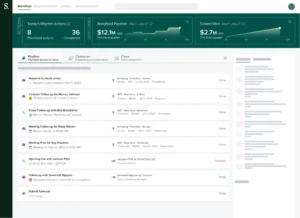
For sales teams, this means they can manage their entire revenue motion without ever leaving Slack. Agentforce Sales, a specialized offering, operates in the background, automatically advancing deals and proactively surfacing the most relevant next actions at scale. A sales manager, for instance, can ask Slackbot to retrieve the team’s open opportunities, identify potential risk signals, and receive answers grounded in live CRM data and business logic. This insight can then be instantly converted into a shareable canvas within Slack for immediate team action. A sales representative can instruct Slackbot to update their CRM based on daily activities and approve those changes with a single click. Regardless of the required steps or tools, everything is accessible and actionable in one unified location.
Kris Billmaier, EVP and GM of Sales Cloud at Salesforce, reiterated the significance for sales organizations: "Sales Cloud in Slack is the future of how revenue teams work. AI is changing what it means to sell and putting Salesforce intelligence and data inside Slack, where sellers already live, means teams stop chasing context and start driving growth. That shift is happening now, and we’re right at the center of it."

For Salesforce administrators, the setup process is remarkably straightforward. They can discover, install, and govern Salesforce MCP servers from a single user interface, requiring no custom integration code. Automatic authentication is handled through the existing Slack-Salesforce connection, streamlining deployment. This evolution means that conversations themselves become the locus of record management, enabling teams to access and act on data with unprecedented ease. Insights are no longer siloed but shared openly, ensuring Salesforce operates in harmony with how teams naturally work.
Bringing Analytics and Data into Collaborative Workflows

The integration of Tableau and Data 360 into Slackbot via MCP servers represents a significant step towards democratizing data access within organizations. Users no longer need to exit their conversations to extract answers from data, nor do they risk misinterpretations due to fragmented context. Instead, anyone in the organization can now surface live, accurate data directly within the decision-making flow.
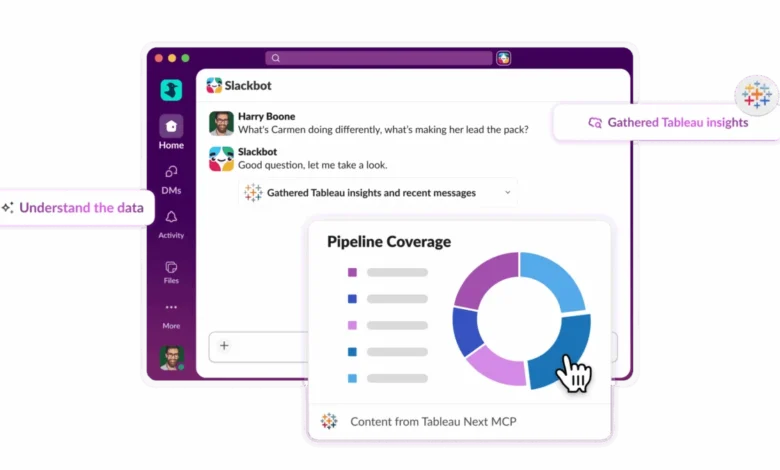
Tableau’s agentic analytics platform underpins every Slackbot response, ensuring that insights are grounded in the organization’s governed, trusted knowledge base. This guarantees consistency and accuracy. Answers are enriched with interactive visualizations—such as heatmaps, trend lines, and detailed breakdowns—making even complex data readily digestible for all team members. Consequently, every subsequent decision, from updating a record to briefing a team, is firmly rooted in real-time data, precisely where the work is happening. For example, during a forecast review, if a question arises about whether the team is "on track," a live, accurate answer is provided in seconds, empowering the team to act with full awareness of their current standing.

Furthermore, Data 360 is now directly accessible in Slack through the Data 360 MCP. This integration brings unified, real-time business context into every Slackbot conversation, harmonized across CRM and other integrated sources. This ensures that every response begins with a complete and accurate picture, eliminating guesswork. The Data 360 Skills equip Slackbot with institutional knowledge, enabling it to take appropriate actions. Pre-built skills capture the nuances of how a business operates, including specific steps to follow, decisions to make, and critical verification processes, ensuring confident and scalable actions. For instance, a user can request a customer’s unified profile from Slackbot, share it within a campaign channel, and collaborate with the team on decisions. Slackbot can then proceed to update segmentation logic or verify identity data, all within the ongoing conversation. By understanding the channel context—the deal, the team’s intent, the ongoing strategy, or a bug triage—Slackbot intelligently taps into Tableau and Data 360 to surface truly relevant information, moving beyond generic data pulls.
Integrating Every App and Agent into the Conversation

Slack’s fundamental design principle has always been to foster collaboration and advance work. This forms the bedrock of a true "multiplayer experience," creating an open environment where human teams and AI agents can work together transparently, benefiting the entire organization. Leading industry partners such as Anthropic, Box, and DocuSign have already deployed AI agents specifically designed to operate within this shared environment. Now, Slackbot seamlessly connects with this expanding ecosystem, orchestrating across various third-party tools and summoning the right agent precisely when needed, akin to bringing an expert into a conversation.
A rapidly growing ecosystem of partners—including Atlassian, Zapier, Lattice, and over 25 others—have developed MCP-native apps that deliver interactive, action-ready experiences directly into Slack channels and integrate with Slackbot conversations. These apps benefit from the same contextual awareness, Salesforce data access, and insights as Slackbot itself, becoming integral to the work and the conversation. Moreover, MuleSoft Agent, now connected to Slackbot, extends the integration layer into the conversational interface. Users can inquire about system health, discover available APIs and assets, or receive instant alerts when issues arise, all without leaving the channel where the team is actively working.

This means the same Slackbot conversation used to update a Salesforce pipeline can also pull a Jira ticket to address a customer service query, surface a Box document for a prospect, or trigger a DocuSign approval for deal paperwork. All these actions can occur without switching tools, requiring separate logins, or losing crucial context. Given its understanding of the channel context—whether a team is discussing strategy or triaging a bug—Slackbot can identify the appropriate tool for the task, handle authentication, and execute on behalf of the user, all with the customer’s needs in mind. Its actions and findings can be shared back to the channel, allowing colleagues to build upon answers or identify any missed details. This capability distinguishes AI that merely assists an individual from AI that propels an entire organization forward.
Unlocking Enterprise Value: A Strategic AI Investment

The ultimate value of any enterprise investment—be it in frontier AI models, data platforms, or specialized agents—is directly proportional to the effectiveness of the interface that connects it to the people driving the business. Similarly, the extensive investment in Salesforce CRM can only yield greater returns and work harder when its data transcends static records and integrates directly into the operational heart of the organization.
Salesforce positions Slack as that essential missing layer—the conversational interface where teams genuinely work. It is presented not merely as a collaboration tool but as a high-leverage AI investment that dictates whether the other 98% of an organization’s technology budget delivers its full potential. By unifying Salesforce data with the critical conversations that propel a business, teams can cease chasing context and instead act upon it proactively. Insights are shared openly rather than being siloed. Decisions are made with a comprehensive understanding, not just a fragmented view. Consequently, the core work that truly advances a business—aligning, deciding, and executing—occurs more swiftly, collaboratively, and transparently.

Michael Herman, Global Salesforce Practice Leader at IBM, highlighted the impact: "At IBM, we operate within a highly complex global enterprise where critical decisions are made continuously across teams, functions, and geographies. By integrating Slackbot and Tableau, we have established a unified digital experience that consolidates the insights, communications, and operational context decision-makers need into a single, intuitive interface. Processes that previously required navigating fragmented communication channels and disparate sources of information can now be completed in seconds, enabling faster, more informed decision-making across the organization from any device."
Availability and Future Outlook

The new capabilities are generally available (GA). The Slackbot MCP Client integrates seamlessly with Salesforce-hosted MCP Servers and is accessible on any Slack plan that includes Slackbot, provided the Slack workspaces are connected to Salesforce. New Salesforce customers will automatically have free Slack workspaces created for them. Existing Salesforce customers can connect Slack today.
This launch, particularly Agentforce Sales, which brings the end-to-end revenue motion to life for teams in Slack, is just the beginning. It demonstrates real-time deal updates, cross-channel context, and partner workflows all running within deal channels, eliminating tool-switching. Revenue teams can now experience firsthand how a complete enterprise motion can operate entirely within a single conversational workspace. Over the coming weeks, Salesforce anticipates rolling out more use cases extending across the agentic enterprise, encompassing service teams resolving cases faster together, and every line of business running their workflows precisely where their teams already collaborate. This strategic evolution underscores Salesforce’s commitment to embedding intelligence and automation directly into the flow of work, making enterprise software more intuitive, collaborative, and ultimately, more impactful.
Related posts: