Media Landscape in Flux: White House Press Tensions, Executive Shakeups, and Global Bureau Realignment

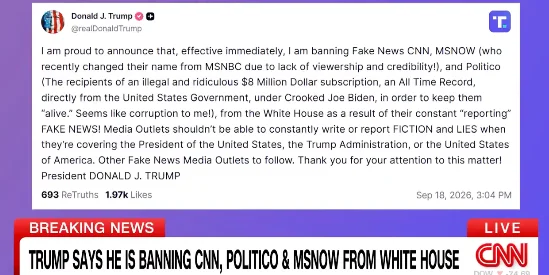
The current volatility within the American media ecosystem reached a fever pitch this Friday as President Donald Trump declared an immediate ban on CNN, MS NOW, and Politico from reporting within the White House grounds. This unprecedented confrontation between the executive branch and major news organizations comes amid a broader period of industry-wide transformation, characterized by significant leadership transitions at major networks, the shuttering of international bureaus, and the strategic pivot toward direct-to-consumer digital subscription models.
The White House Press Crisis
The ongoing standoff escalated Friday afternoon during an Oval Office Q&A session. When pressed by members of the press corps regarding the legal and logistical basis for his decision to bar the three outlets, President Trump declined to provide a specific incident, citing instead a cumulative history of coverage over the previous two years. The president’s assertion that he holds the authority to revoke press credentials based on editorial content has triggered immediate pushback from the affected networks and media advocacy groups.
CNN issued a firm statement characterizing the potential ban as an "illegal assault" on rights protected by the First Amendment of the U.S. Constitution. The network emphasized its commitment to maintaining its presence at the White House, arguing that the government cannot legally obstruct news organizations from fulfilling their role as the "fourth estate." This sentiment was echoed by Weijia Jiang, a former president of the White House Correspondents’ Association (WHCA), who took to social media to highlight the text of the First Amendment, specifically the clause prohibiting the government from abridging the freedom of the press.
Legal analysts note that while the White House has wide latitude in managing access to the grounds for security and logistical purposes, using access as a punitive tool against specific outlets for their reporting raises significant constitutional questions. Historical precedents, such as the 1977 ruling in Sherrill v. Knight, established that the government must provide a clear, non-arbitrary process for revoking press passes, as they constitute a significant property interest for journalists.
Leadership Transitions at NBC News
As the industry grapples with political pressures, internal corporate structures are also undergoing a massive reorganization. NBC News is currently navigating the departure of Janelle Rodriguez, the executive vice president of programming, who is stepping down after a 12-year tenure. Rodriguez’s departure marks the end of a significant era for the network, particularly regarding the expansion of its digital programming arm, NBC News Now.
In the wake of this transition, NBC News president of editorial Rebecca Blumenstein has unveiled a new leadership architecture designed to consolidate content oversight. Catherine Kim has been elevated to the role of executive vice president of editorial and content, a position that grants her broad authority over both the linear network’s special reports and the growing NBC News Now streaming service. Simultaneously, Matt Carluccio’s portfolio has been expanded to encompass the network’s critical editorial units, including investigative, business, climate, and health reporting. The reorganization also streamlines the management of the network’s flagship program, NBC Nightly News, with executive producer Matt Frucci now reporting directly to Blumenstein.
Global Realignment: The CNBC Hong Kong Closure
The shift in media focus is also manifesting in the geographic footprint of major business news outlets. CNBC confirmed this week that it has ceased operations at its Hong Kong bureau, citing a strategic shift in international programming and resource deployment. This closure has resulted in the cancellation of several business-day programs, including Inside India, The China Connection, and Europe Early Edition.
The decision follows a multi-month internal audit of the network’s global operations, weighing commercial viability against operational costs. CNBC stated that while a "small number" of staff members were affected, the network is not retreating from the region entirely. Instead, the organization is pivoting its resources toward its Singapore and Beijing offices. These hubs, alongside existing operations in London and Abu Dhabi, are expected to serve as the pillars of CNBC’s international editorial and technical infrastructure moving forward. Industry observers suggest that this contraction reflects a broader trend among legacy media companies looking to streamline costs in an increasingly fragmented global advertising market.
Weekend Programming Shifts at ABC News
ABC News is moving to refresh its weekend identity with a new anchor lineup for Good Morning America (GMA). The network has implemented a new dual-anchor strategy to boost engagement on Saturday and Sunday editions. Rachel Scott, who previously served as a senior political correspondent, has been tapped to co-anchor the Saturday broadcast alongside Whit Johnson. Scott will maintain her role as the host of the Disney+ streaming program What You Need to Know.
The Sunday edition will feature Rhiannon Ally paired with Gio Benitez. Furthermore, the network is restructuring its meteorological team, with Leslie Lopez moving from her role at KABC in Los Angeles to serve as the weekend meteorologist for GMA. She succeeds Somara Theodore, who has transitioned to a full-time role on the weekday shift at ABC News Live. These changes are part of a broader push to integrate the network’s 24/7 streaming operations with its linear broadcast schedule, with the new anchor team members also rotating as hosts for ABC News Live Weekend.
Cultural Tensions at CBS News
The storied program 60 Minutes has returned for its new season under the leadership of Bari Weiss and Nick Bilton, amid both internal enthusiasm and significant controversy. While network executives Tom Cibrowski, Weiss, and Bilton have lauded the season premiere as a "powerful start," the program’s internal culture remains under intense scrutiny.
The transition has been marked by the departure of several longtime producers and editors, most notably former managing editor Guy Campanile. In a public statement regarding his exit, Campanile alleged that the current leadership has fostered an environment of editorial interference. He specifically cited concerns that the program’s reputation for independence is being compromised by attempts to align reporting with White House talking points. The network maintains that its editorial standards remain intact, yet the public nature of these grievances suggests a deepening divide between the legacy journalistic staff and the new management team.
Digital Monetization: The MS NOW Membership Model
Reflecting the industry’s shift away from traditional ad-supported revenue, MS NOW has officially launched its "MS NOW Membership" program. This direct-to-consumer initiative, which debuted on September 9, is designed to deepen audience engagement through a seven-day interactive schedule. The platform offers subscribers exclusive access to live Q&A sessions with network reporters and hosts, utilizing both text-based and video-conferencing tools. By moving behind a paywall and offering tiered access, MS NOW is following a trend set by other major digital outlets attempting to insulate their revenue streams from the volatility of the digital advertising market.
Outlook for the California Governor Debate
Despite the ongoing friction between the White House and the press corps, major networks are moving ahead with high-profile political coverage. CNN has finalized plans to host the California Governor Debate on Wednesday, September 30, at 9 p.m. ET. The event, which will be moderated by veteran anchors Jake Tapper and Dana Bash, is slated to feature candidates Xavier Becerra and Steve Hilton. The debate, to be broadcast from the network’s Los Angeles studios, will be distributed across CNN’s domestic, international, and Spanish-language platforms. This event serves as a critical test for the network’s commitment to providing a platform for political discourse even as it navigates the current challenges regarding its status at the White House.
As these various developments unfold, the underlying theme remains clear: the media landscape is undergoing a period of intense structural and political realignment. From the constitutional questions surrounding presidential access to the shifting economic models of international business news, the industry is entering an era where adaptability is no longer just an advantage, but a requirement for survival.