The End of Reading is Here: How the Digital Age Threatens the Foundations of Modern Literacy and Cognitive Fitness

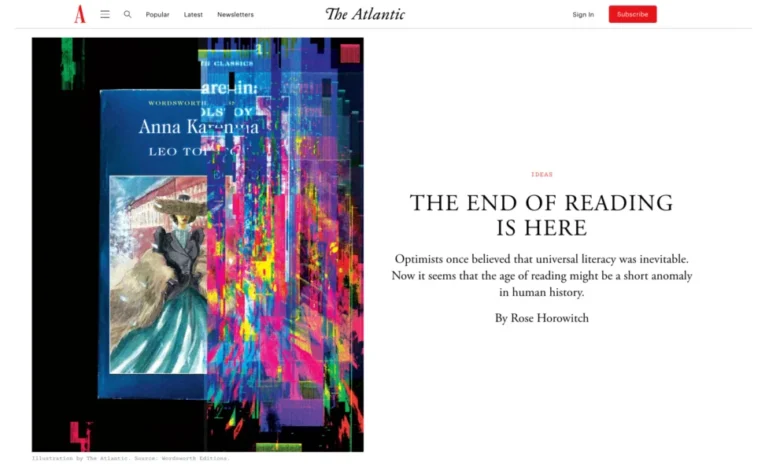
The modern world is currently witnessing a profound transformation in how human beings consume information, driven by an era of ubiquitous digital technology, hyper-connected social media platforms, and endless streams of ephemeral content. This shift has ignited an urgent debate among cultural critics, technology theorists, and educators regarding the rapid decline of deep reading. At the center of this discourse is a recent, comprehensive feature published in The Atlantic by journalist Rose Horowitch, titled The End of Reading is Here. Spanning over 8,500 words, Horowitch’s investigative piece synthesizes a growing body of sociological and psychological data suggesting that society is careening toward a post-literate age.
This alarming cultural pivot has not gone unnoticed by other contemporary thinkers. Commentators such as James Marriott have similarly warned of the dawn of a post-literate society, exploring the devastating consequences of diminishing attention spans and the displacement of books by algorithmic entertainment. As contemporary digital tools continue to fragment human focus, experts are increasingly questioning whether the abandonment of traditional reading represents a benign technological evolution or an existential threat to the cognitive architecture of human civilization.
Chronology of the Literacy Crisis: From Print to Pixels
To understand the current crisis, observers must trace the historical trajectory of human communication technologies. For centuries, the printed word served as the primary vehicle for transmitting complex ideas, preserving historical narratives, and cultivating critical thinking. The transition from oral traditions to a literate society—meticulously documented by cultural historians like Walter Ong in his seminal work Orality and Literacy—fundamentally rewired human consciousness. Writing and reading did not merely introduce a new method for exchanging data; they birthed the very concepts of linear logic, institutional democracy, human rights, and the autonomous self.
In the latter half of the twentieth century, the introduction of television and personal computing began to subtly alter reading habits, shifting populations toward visual and auditory media. However, the arrival of the twenty-first century—marked by the proliferation of smartphones, high-speed mobile internet, and engagement-driven social media algorithms—accelerated this decline exponentially. Over the past decade, educators and researchers have documented a sharp, quantifiable drop in sustained reading comprehension, book sales among younger demographics, and the capacity of individuals to engage with long-form, complex texts. Horowitch’s recent reporting encapsulates this decade-long slide, presenting a stark portrait of a culture increasingly hostile to deep, contemplative reading.
Empirical Data and the Scope of the Decline
The argument that society is experiencing a structural retreat from literacy is supported by a mounting body of empirical research. Educational assessments, publisher reports, and psychological studies over the past ten years reveal consistent downward trends in reading metrics across nearly all age groups.
Statistically, studies show a significant reduction in the amount of time average citizens—particularly adolescents and young adults—dedicate to reading books for pleasure. Standardized testing data from educational institutions worldwide indicate a parallel erosion in advanced reading comprehension skills. Students are increasingly struggling to parse multi-clause sentences, maintain concentration over extended texts, and synthesize abstract arguments.
Furthermore, digital analytics demonstrate that the average user’s attention span on digital platforms has plummeted, with content consumption increasingly dominated by short-form video formats, bulleted summaries, and hyper-linked snippets. These metrics paint a cohesive picture: traditional reading is no longer the default mode of information processing for a substantial portion of the global population. Instead, it is being actively crowded out by frictionless, high-dopamine digital environments designed to exploit psychological vulnerabilities and maximize screen time.
Expert Perspectives and Theoretical Implications
The implications of this retreat extend far beyond personal leisure or academic performance; they strike at the heart of democratic discourse and intellectual capability. Technology theorists and cognitive scientists have raised alarms regarding the societal fallout of a post-literate culture.
In recent public commentary, including an op-ed published in The New York Times, analysts have drawn parallels between physical health and cognitive fitness. Just as modern populations faced epidemics of sedentary lifestyles and poor physical health following the rise of industrialized convenience, contemporary society now faces a crisis of mental atrophy due to digital overconsumption.
Prominent scholars argue that literacy is not merely one tool among many, but rather the foundational technology that enabled the modern intellectual ecosystem. When individuals cease to grapple with complex prose, their capacity for nuanced thought, empathy, and historical contextualization diminishes. As James Marriott explores in his forthcoming book, The New Dark Ages, a society that abandons literacy risks plunging into a new form of intellectual obscurity, wherein citizens become acutely vulnerable to misinformation, emotional manipulation, and ideological polarization.
The parallels between historical dark ages and the modern digital landscape lie in the loss of shared, objective truths derived from rigorous textual analysis. Without the cognitive discipline enforced by reading, public discourse degrades into reactionary soundbites, undermining the institutional norms that sustain free and open societies.
Toward a Culture of Cognitive Maintenance
As the debate intensifies, institutional leaders, educators, and cultural commentators are confronted with a critical question: how should society respond to the systemic erosion of literacy?
Scholars advocating for cognitive preservation argue that addressing this mental decline requires a deliberate cultural and personal paradigm shift, mirroring the public health campaigns that successfully transformed physical fitness habits in the late twentieth century. Just as society learned to categorize processed foods as detrimental to physical well-being—leading to structured dietary guidelines and routines around exercise—modern individuals must begin to treat hyper-distracting digital media as cognitive junk food.
This proposed framework involves establishing strict personal and professional boundaries regarding information consumption. Rather than allowing algorithms to dictate daily media intake, individuals are encouraged to purposefully schedule dedicated blocks of time for reading, writing, and deep self-reflection. Educational systems are similarly urged to resist the temptation to digitize every aspect of learning, actively preserving physical libraries, tactile textbook engagement, and uninterrupted silent reading periods in classrooms.
Broader Impact and Future Outlook
The transition toward a post-literate society represents one of the most significant sociological crossroads of the modern era. As Rose Horowitch observed in the concluding remarks of her Atlantic feature, humanity has been bequeathed an astonishing wealth of intellectual history, artistic expression, and accumulated wisdom through the written word.
Whether contemporary civilization chooses to safeguard this inheritance or allow it to be dismantled by the conveniences of the digital age remains entirely an open question. The choices made by policymakers, educators, technology developers, and individual citizens over the coming years will determine whether the twenty-first century marks the dawn of a progressive digital renaissance or the twilight of human literacy. Systemic intervention, cultural re-evaluation, and a renewed commitment to cognitive discipline will be required to ensure that the transformative power of the written word endures for future generations.
Related posts: